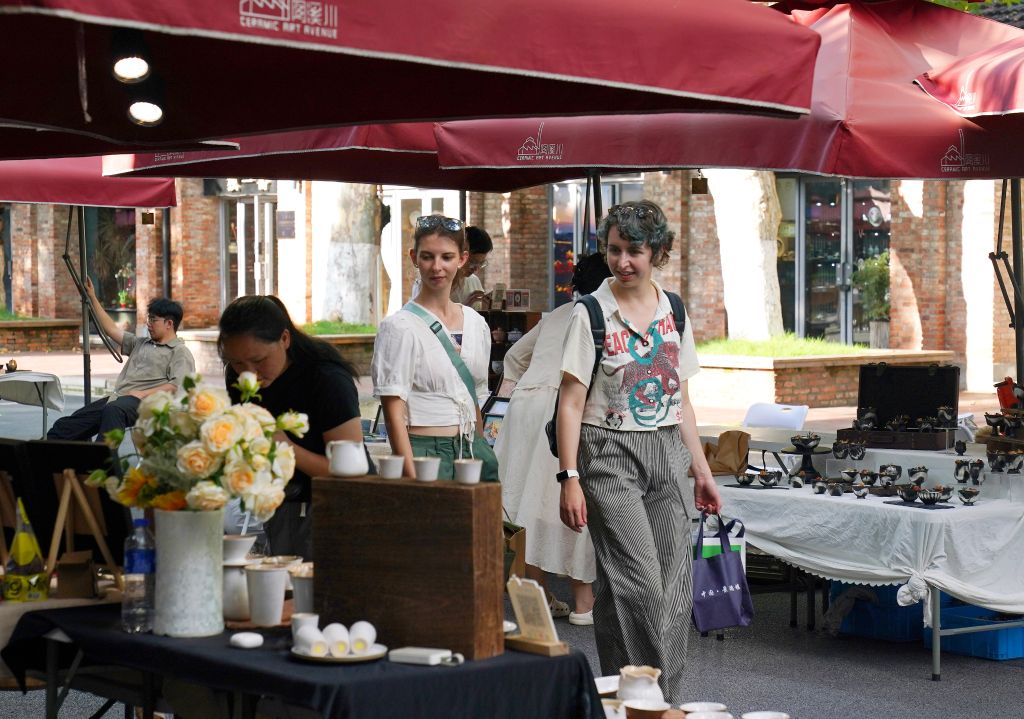
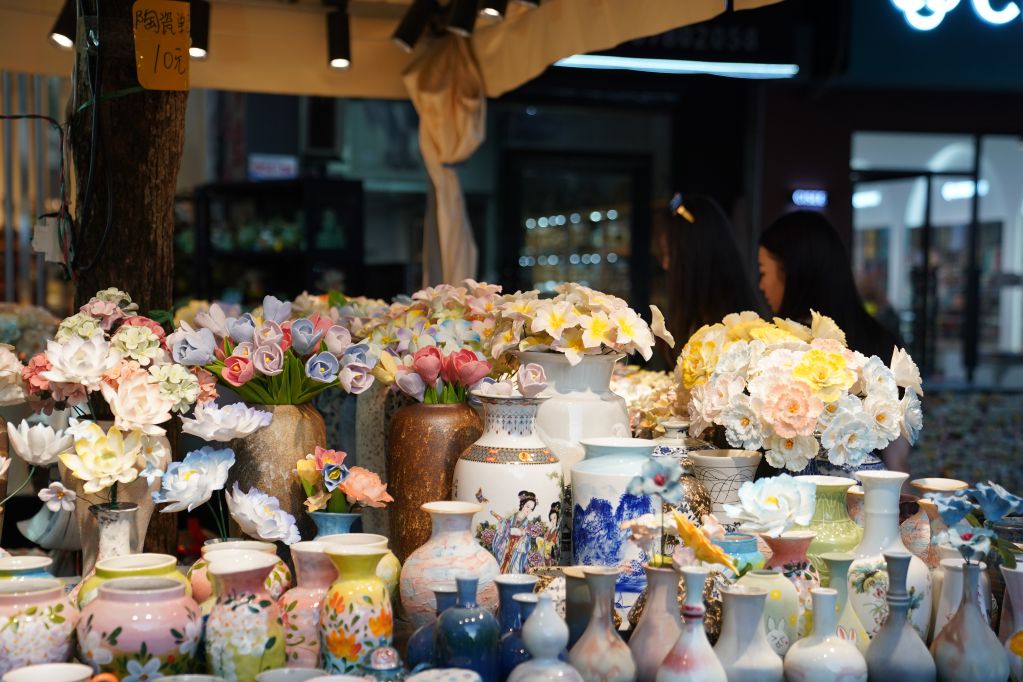
NANCHANG, Aug. 29 (Xinhua) -- Sleek, colorful, and artfully crafted, the ceramics lining the shelves of a shop in Jingdezhen's Taoxichuan art district reveal little about their surprising beginnings: piles of broken porcelain once bound for the landfill.
The brand, XUN, which means "recycling," turns discarded porcelain into vases, planters, tableware and other ceramic products by sorting, crushing and purifying the waste before reformulating and firing it into new ceramic material.
"We started the brand because we wanted to give waste porcelain a second life," said Lan Lan, the shop's owner and a co-partner in the brand. "Once it is made into a new product, you can hardly tell it was recycled. It's safe, durable and even adds a distinctive touch by retaining some porcelain particles in the finished pieces."
XUN also uses sand-mold 3D printing to shape recycled material into larger decorative pieces. Its products are showcased annually at the China International Import Expo and Canton Fair, with strong sales in Europe and the Americas.
"We aim to tackle the problem of ceramic waste by shifting from taking more from nature to making better use of what we already have," she said. The brand showcases an approach that addresses the problem at its root while giving the porcelain industry a new lease on life.
This shift may be modern, but the impulse behind it taps into a much older instinct. In Jingdezhen, China's porcelain capital, giving broken porcelain a second use is a habit centuries in the making.
For generations, broken porcelain shards, spent saggers and worn-out kiln bricks were used to fill waterways, raise ground levels and build walls and foundations, turning waste from the kilns into part of the city's infrastructure.
Even the city's street names still carry the memory. Xianong, or "lower alley," marks the ground that was once reclaimed from the river using discarded porcelain -- a linguistic fossil of how waste once shaped the land beneath people's feet.
Ceramic waste was also packed beneath streets to create porous layers that allowed rainwater to seep into underground channels, helping the flood-prone city manage runoff.
By 1990, Jingdezhen had more than 90,000 meters of sewers, including over 6,000 meters of arched channels built with discarded kiln bricks. One drainage channel laid in 1914 remains in use today.
The city's centuries-old porcelain landscape gained global recognition in July, when Jingdezhen Handicraft Porcelain Industry Sites were inscribed on the UNESCO World Heritage List, becoming China's 61st World Heritage site.
That tradition of reuse now faces a new challenge. Official data shows that Jingdezhen produces up to 90,000 tonnes of discarded porcelain each year, much of which ends up dumped or buried.
"Ceramic waste does not readily decompose and can pose long-term environmental risks if not properly handled," said Zhang Jingjing, vice president of Jingdezhen Ceramic University. "Recycling the waste into new materials through crushing and reformulation is currently the most effective way to reduce its environmental impact."
A growing number of businesses and designers are doing just that.
Yi Design, a startup, turns discarded ceramics into reusable materials for architecture and art design. Its permeable brick, made from more than 90 percent recycled porcelain, is well-suited to "sponge city" projects designed to ease urban flooding and heat. The brick won an iF Design Gold Award in 2022.
Such practices are now finding institutional backing. In 2024, Jingdezhen launched a "zero-waste city" initiative, urging ceramic makers to cut waste at the source through technological upgrades while pushing for broader, higher-value uses of discarded porcelain.
"Waste porcelain has long been a bottleneck to the green development of the ceramic industry," said Tong Xiwei, an official with the ecology and environment bureau of Jingdezhen. "We are working to reduce, recycle and safely manage solid waste while fostering new zero-waste models across Jingdezhen's ceramic industry."
Tong added that the effort extends beyond factory walls, encouraging businesses, communities and residents to embrace greener ways of producing and living.
In July, China released a plan to advance the development of the country's circular economy during the 15th Five-Year Plan period (2026-2030), aiming to basically establish a high-quality development system for the recycling economy by 2035. As part of the efforts, the plan calls for stronger waste collection and recycling networks, as well as technological upgrading and industrial innovation.
For Lan Lan, the momentum feels like something Jingdezhen has been doing all along: finding a place for what its kilns leave behind.
She hopes that every piece of waste porcelain -- like the shards once packed beneath Jingdezhen's streets a century ago -- eventually finds its way home. "Nothing is truly discarded. It's simply waiting for its next form." ■