
BEIJING, Aug. 24 (Xinhua) -- As China and Brazil deepen green cooperation, Chinese companies are bringing cutting-edge technologies to the South American country, helping diversify its energy supply and accelerate its push for sustainable development, according to industry insiders.
"China and Brazil share a high degree of consensus on building an ecological civilization," Zhou Zhiwei, a researcher at the Chinese Academy of Social Sciences, told Xinhua. Zhou cited Brazil's "New Industry" policy as an example, saying it is highly compatible with China's green development approach.
The industrial policy initiative, launched by the Brazilian government for the 2024-2026 period, aims to re-industrialize the country by boosting productivity, sustainability and innovation. Energy transition is one of the policy's key priorities.
The focus is similar to China's own development approach. China's 15th Five-Year Plan (2026-2030) prioritizes accelerating the comprehensive green transition of economic and social development, calling for faster progress in shaping green modes of production and day-to-day life.
The two countries' strategic priorities, including green development, energy transition and re-industrialization, are highly consistent, Zhou said, adding that as they deepen green cooperation, China's experience in areas ranging from infrastructure development to industrial modernization and technological innovation can offer a "valuable benchmark."
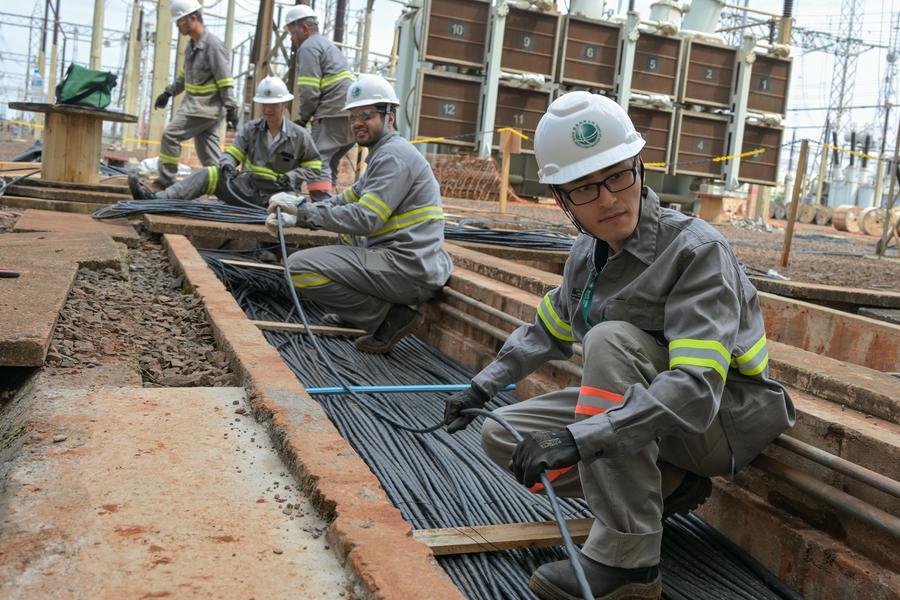
In a landmark move set to reshape Brazil's green energy infrastructure, State Grid Corporation of China has recently broken ground on a 1,468-kilometer ultra-high voltage (UHV) power transmission project, marking the largest investment in an electricity transmission franchise project in the South American country's history.
Leveraging China's mature UHV technology, the megaproject is scheduled to begin operation in 2029. It will serve as a vital energy artery, channeling wind, solar and hydropower from Brazil's resource-rich northeast to major load centers in the central and eastern regions. Once fully operational, the project is expected to deliver more than 20 billion kWh of clean energy annually, equivalent to a reduction of 6.84 million tonnes of carbon dioxide emissions.
Previously, State Grid had launched the Belo Monte UHV direct current Phase I and Phase II projects, which transmit large amounts of hydroelectric power generated in the Amazon basin in northern Brazil directly to the country's metropolitan southeast.
Such projects, powered by China's advanced clean energy technology, have helped Brazil optimize its energy resource allocation and accelerate the green and low-carbon transformation of its energy structure, according to an official statement from State Grid.
In addition to state-led infrastructure projects, private Chinese companies are also playing an increasingly active role in Brazil's green transition, bringing market-oriented solutions in areas such as clean energy, electric mobility and sustainable manufacturing.
A case in point is CHINT Group Co., Ltd., a smart energy solutions provider headquartered in east China's Zhejiang Province. The company has been operating in the Brazilian market for more than 20 years, with a localized ecosystem spanning operations, manufacturing, delivery, as well as research and development.
One of the latest milestones in the company's expansion in Brazil came in 2025, when it inaugurated a smart meter factory in the northwestern city of Manaus, mainly manufacturing electronic and smart energy meters. The entire production process is localized.
Nearly a year later, the factory has focused on creating local jobs and supporting the development of power technologies across Latin America. "By bringing our expertise in electricity and new energy to Brazil, we are deepening energy cooperation between the two countries and supporting the low-carbon transition of Brazil's power industry," said Shan Hao, country manager for Brazil at CHINT Global.
Likewise, EP Equipment, a Chinese manufacturer and service provider specializing in electric and autonomous forklifts, has also been exploring the Brazilian market for years.
To adapt to Brazil's operating conditions, including its tropical climate and muddy terrain, EP Equipment has enhanced the durability of its products and developed models, which feature long endurance and quick-swap batteries, to better meet the needs of the Brazilian market, said Zhao Hailiang, general manager of Zhejiang EP Equipment Imp. & Exp. Co., Ltd.
Commenting on the prospects for China-Brazil cooperation in the clean energy transition, Jose Medeiros da Silva, professor and director of the Brazil Studies Center at Zhejiang International Studies University, said that as two of the world's largest developing economies, the two countries can play a decisive role in exploring ways to integrate economic growth, social inclusion and environmental protection.
To provide further financial support for such cooperation, the Brazilian Development Bank and the Export-Import Bank of China have set up a 1-billion-U.S.-dollar investment fund, with the goal of expanding capacity cooperation in sustainable development. The fund focuses on supporting projects in areas such as climate change, new energy and infrastructure.
Looking ahead, analysts note that China-Brazil green cooperation not only complements the two countries' respective strengths, but also offers a valuable reference for cooperation between major Global South economies.
"China has capital, technology and manufacturing scale, while Brazil has abundant natural resources and a pressing need for sustainable industrialization," Zhou said, adding that such cooperation is not about one side aiding the other, but about promoting mutual benefit.
"More importantly, this cooperation model demonstrates that the transition to a green economy can be a driver of growth, rather than a drag on it," Zhou said. ■