
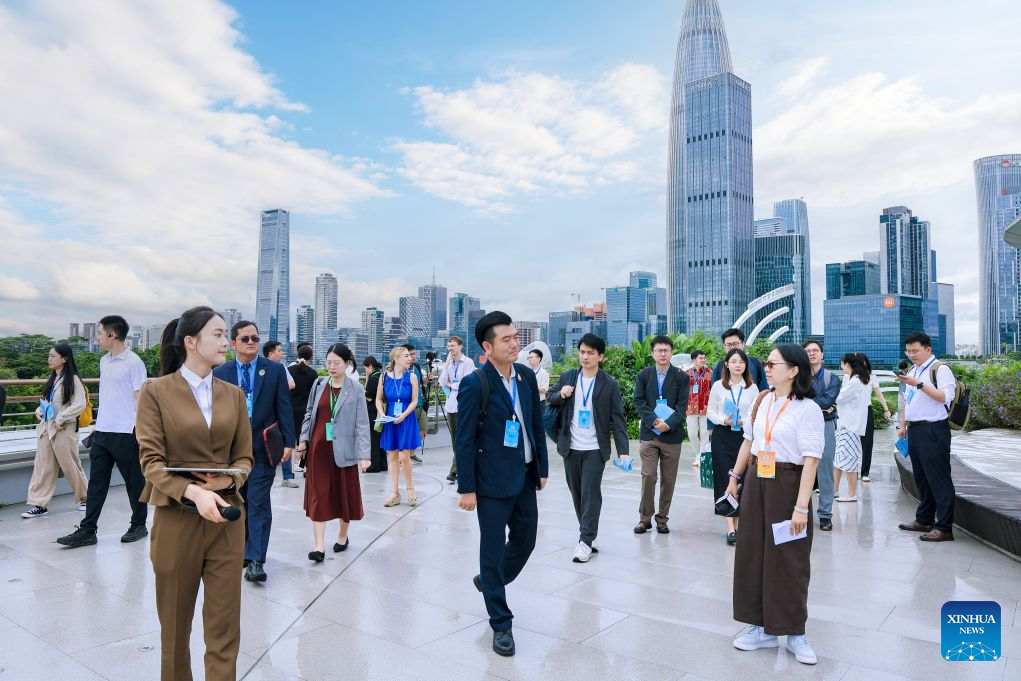
Guests visit the Chunhui Substation in downtown Shenzhen, south China's Guangdong Province, Aug. 21, 2026.(Xinhua)
SHENZHEN, Aug. 23 (Xinhua) -- Young experts and scholars from the Asia-Pacific region gathered in Shenzhen, a world-leading tech hub in south China's Guangdong Province, to explore how the green energy transition could shape the region's future and their role in this endeavor.
Themed "Asia-Pacific Youth Gathering: Building a Shared Future Through Energy," the event on Friday brought together over 60 experts, scholars and journalists from 13 countries and regions for dialogue and discussion panels.
"Building a clean, secure and efficient energy system constitutes a vital cornerstone for the common prosperity of the Asia-Pacific," said Yu Guanyi, head of the think tank office of the APEC Sustainable Energy Center, at the opening ceremony of the event.
Noting the importance of young voices in the green transition, Leo Barry, an Australian master's student at the Yenching Academy of Peking University, said that encouraging more young people to take part in such professional discussions is crucial to inspiring them to make real contributions to delivering a cleaner, greener and more prosperous future.
Young representatives also visited China's first zero-carbon interactive substation, the 110-kV Chunhui Substation in downtown Shenzhen, to learn how green energy can deliver dependable power to fuel the metropolis' bustling industrial and commercial activities.
With Shenzhen set to host the 33rd APEC Economic Leaders' Meeting in November, delegates paid extra attention to green-energy cooperation among countries in the region.
The power network in the Asia-Pacific still faces common challenges such as accessibility and mismatches in resource and demand, which make energy cooperation within the region even more important, said Chhoeun Raksmey of Cambodia's Ministry of Industry, Science, Technology and Innovation.
In response, Yang Bo, a project commercial specialist at China Southern Power Grid Co., Ltd., shared his insights. He has been involved in China's first 500-kV cross-border alternating-current power link in Laos, which came into operation in April.
Earlier this month, hydropower from northern Laos reached the Guangdong-Hong Kong-Macao Greater Bay Area for the first time via the link, and is expected to reach a total transmission volume of approximately 600 million kWh by the end of October.
"This bilateral power cooperation program allows Laos to translate its resource endowments into tangible economic gains for local communities, strengthening its role as a regional clean energy hub," Yang told Xinhua.
Laos' green power arriving in Shenzhen comes as China deepens its green transition cooperation with regional partners. Under frameworks including the Belt and Road Initiative and the Lancang-Mekong Cooperation mechanism, China has actively participated in cross-border construction of clean energy projects in wind, solar, hydropower and energy storage, propelling the region's green development.
Such cooperation also introduces leading photovoltaic technology, power-grid equipment, intelligent dispatching systems and energy-management solutions, helping advance power supply reliability and energy efficiency, said Chisa Jermwarayukorn, secretary-general of the Asia-Pacific Think Tank.
She added that this approach will enable countries in the region to stay more closely connected and become long-term partners.
"As neighbors with different resources, it's time for us to share our advantages, enhance bilateral and multilateral cooperation, and bring more tangible projects to the Asia-Pacific region, so as to achieve a green and sustainable future together," stressed Chhoeun Raksmey. ■


