HANGZHOU, Aug. 8 (Xinhua) -- Clad in a red volunteer vest bearing a badge in the shape of a jade-inlaid lacquer cup, one of her favorite Liangzhu artifacts, American Emma Chen greeted visitors to the Liangzhu Museum in east China, and then shared stories of a civilization that flourished more than 5,000 years ago.
For Chen, the ancient artifacts on display are more than relics from the past. They offer a glimpse into the wisdom of the Liangzhu people, showcasing their sophisticated social structure, farming practices and exquisite jade craftsmanship, dating back to the Neolithic age.
"Although no written records of the Liangzhu people have been found, archaeology, together with later historical texts, allows us to gradually piece together their way of life and better understand the cultural legacy they left behind," she said.
The Liangzhu ruins, located in Hangzhou, capital city of east China's Zhejiang Province, have been recognized as a testimony to the existence of Chinese civilization at least 5,000 years ago. They have also been inscribed on the UNESCO World Heritage List.
Starting from 2023, the Liangzhu Forum has been held annually to gather global archaeologists, historians, museum directors and artists to discuss world civilizations, heritage conservation and cross-cultural dialogue. The forum has also contributed to several international cooperation projects, including the establishment of an archaeological research center focused on Liangzhu.
"To me, the greatest significance of Liangzhu lies in its archaeological value," Chen said. "Its remains, especially the city structure, have been well preserved, so that we can use its three-tier layout to help visitors understand how the ancient city was organized and what it reveals about the social hierarchy of the Liangzhu people."
A museum enthusiast, Chen became a frequent visitor to Liangzhu Museum before joining its volunteer team. During one visit, dressed in traditional Chinese attire for a lantern riddle event, she met staff members recruiting volunteers -- an encounter she describes in Chinese as "yuanfen," or a special connection.
"I was thrilled because it was exactly the kind of work I had always wanted to do," she recalled.
Fluent in Chinese, Chen studied Asian Studies as an undergraduate in the United States before settling in China. Now in her fifth year as a volunteer guide at Liangzhu Museum, Chen has immersed herself in the archaeology of China's Neolithic cultures, expanding her professional knowledge and exploring new ways to share its stories with visitors.
"What attracts me most is the opportunity to share the fascinating stories behind the long Chinese history with more people, while presenting them in a professional and detailed way," she said.
Chen's journey is part of a broader effort at Liangzhu Museum, where more than 200 volunteers, including a growing team of bilingual guides, help visitors from around the world better understand the ancient civilization.
"We offer English-language guiding services two days a week, with more than 20 volunteers now able to provide tours in English," said Shan Qingjuan, a museum staff member.
The rising demand for bilingual services comes amid a growing interest among international visitors in exploring China's diverse and time-honored cultural heritage. A survey by the China Tourism Academy found that more than 60 percent of inbound tourists consider experiencing Chinese culture a major purpose of their trip.
The museum has received over 527,000 visitors so far this year, including more than 5,100 overseas visitors, mainly from Southeast Asian countries and the United States.
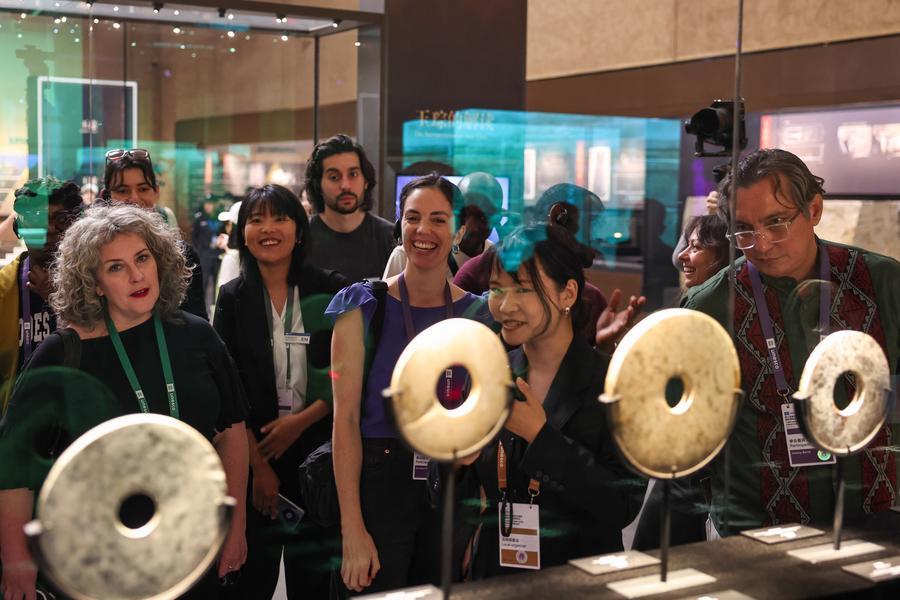
"Many international visitors are fascinated by the visible details of Liangzhu artifacts, especially the symbols carved on jade and pottery, including images of houses, animals and the iconic sacred human-animal motif," said Yao Hua, a veteran bilingual volunteer at Liangzhu.
A former pharmaceutical professional, Yao joined the museum's volunteer team in 2015. During her tours, she often uses digital tools to help overseas visitors understand the intricate patterns on Liangzhu artifacts.
"When introducing the sacred human-animal motif carved on jade artifacts, I would use a tablet to enlarge the image for them to examine the details such as the eyes, nose and fangs," Yao said.
Yao prefers to think of herself as an exhibition interpreter. "Our job is not only to explain what visitors are looking at, but to help them explore the ideas, stories and curatorial thinking behind the exhibition," she said. "We are a bridge between cultural relics and visitors."
To better fulfill the role, Yao has continued to expand her knowledge across archaeology, art and history, finding connections that help bring ancient civilizations closer to visitors.
Over the past five years of training volunteer guides, Yao has witnessed the transformation of Liangzhu's volunteer team, with younger and highly skilled volunteers joining the program as public interest in the civilization continues to grow.
Dong Zhen, a popular museum content creator who is in his 30s, joined the volunteer team after his first visit to Liangzhu in 2022. His first encounter with the site raised a question in his mind: why did people 5,000 years ago choose to build a magnificent ancient kingdom on marshlands and wetlands?
Driven by curiosity, Dong studied extensive materials, learned from experienced guides and passed the museum's rigorous training system. Now he has nearly a million subscribers across social media.
"A guide's role is not only to impart knowledge, but to awaken curiosity," he said. This year, Dong began focusing on an exhibition on ancient Greek civilization at the Liangzhu Museum. "By learning about Ancient Greece today, we are not pursuing the unfamiliar, but trying to understand human civilization, and, in doing so, gain a deeper understanding of ourselves."
Liangzhu's volunteer team has become an important force supporting the museum's work, said Xu Yao, deputy director of the museum's exhibition and education department. Beyond providing guided tours, volunteers also contribute to visitor services, educational programs and photography, while their insights and suggestions are incorporated into the museum's public outreach efforts.
Since 2024, Emma Chen has pursued a master's degree in museum studies at Zhejiang University, joining a community of more than 6,700 international students from over 160 countries and regions.
She also helped translate "Liangliang's World," a five-volume series of English-language picture books on Liangzhu culture, published by Dixie W Publishing Corporation in the United States.
Chen believes cultural differences should not be a reason to simplify China's history and culture for international audiences.
"Some people think we should only introduce the basics because foreigners may not fully understand Chinese culture. But I think we need to share more, not less, and find effective ways to make it accessible to them," she said. ■