BEIJING, Aug. 8 (Xinhua) -- The curtain rises, but the applause comes from audiences far beyond the theater walls.
Bathed in stage lights, dancers move gracefully before a cluster of cameras. On the other side of the lens, viewers respond in real time, with comments and emojis streaming up the screen, virtual gifts arriving, and thousands tuning in from homes across the country.
The performers belong to the Guangzhou Song and Dance Theatre in south China's Guangdong Province. Known for productions inspired by traditions such as the lion dance, the troupe is among a growing number of arts groups turning to livestreaming and social media to connect with audiences beyond the theater.
For He Mu, a dancer with the troupe, the digital stage offers an entirely unexpected element.
After a serious knee injury forced her to bow out from the stage in 2025, He feared that the performing career she had spent more than two decades building might be put on hold. When the theater later launched a livestreaming program, however, she found her way back beneath the lights.
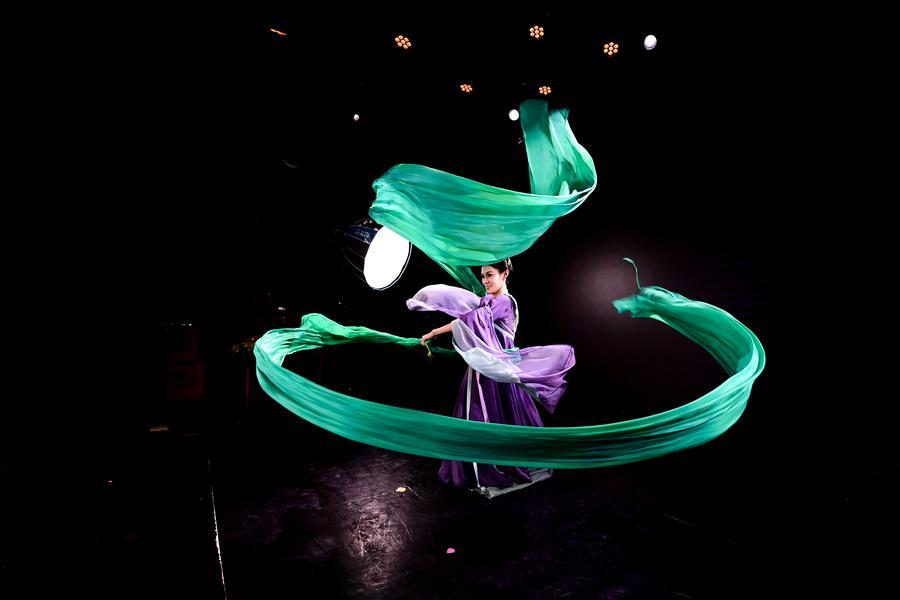
Accustomed to the distant gaze of theater audiences, He stepped into the livestream studio with little experience in front of cameras and almost no instinct for online interaction. She had prepared only a handful of Dunhuang-inspired dances.
The response took her by surprise. "Viewers were incredibly enthusiastic," she recalled.
Encouraged, she began to improvise. Flower petals floated through the air as the spotlight followed her every gesture. Freed from the tightly choreographed structure of the traditional stage, she discovered a more spontaneous and intimate side of her artistry.
The chemistry that she has found with her new audiences is becoming a trend in this field.
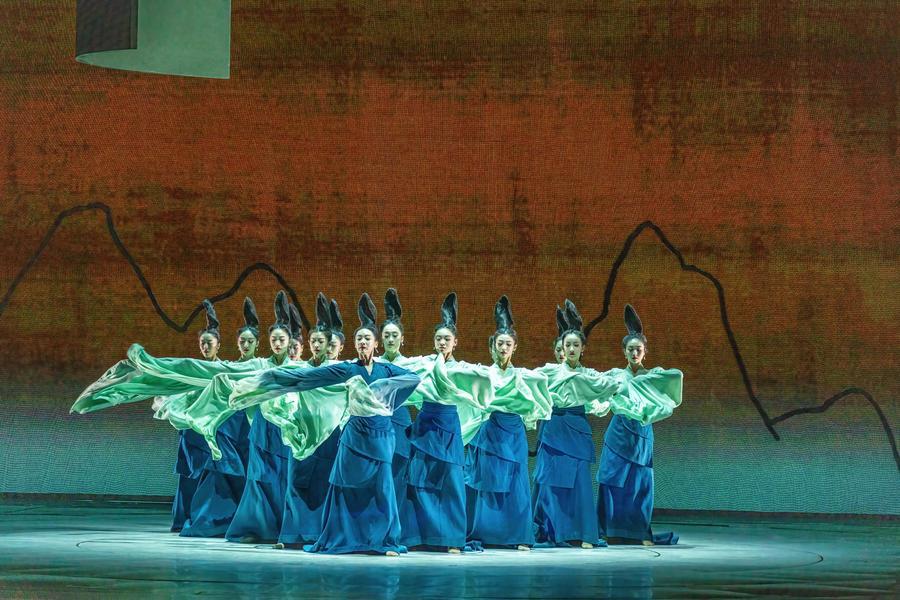
During a livestream of Poetic Dance: The Journey of a Legendary Landscape Painting, a dancer slowly turned her face toward the camera. The movement would barely have registered from the back rows of a theater, but on a phone screen, the lingering glance filled the frame. Within minutes, the audience had swelled to tens of thousands.
While some critics and traditionalists worry that the intimacy of the screen may flatten the grandeur of the stage, the dancers see the medium differently. Meng Qingyang, the production's lead performer, calls livestreaming "a convenient aesthetic experience" that fits naturally into modern life.
"Attending the theater requires calculation -- scheduling the time, navigating the commute after work," she said. "Livestreaming allows people to experience the performance whenever they have a brief moment, lying comfortably at home after a long day."
Yet convenience tells only part of the story.
What reaches viewers is often more than a dance. The Poetic Dance, a widely acclaimed dance drama, unfolds like the 900-year-old handscroll that inspired it. Mineral blues and greens shimmer against the warm patina of aged silk, while dancers move with the measured grace of ink brushstrokes gliding across a landscape.
Beneath its beauty lies an aesthetic shaped over centuries -- one that finds strength in restraint, grandeur in simplicity, and meaning in the empty spaces as much as in the painted ones.
A Beijing resident, unable to secure a ticket for the Poetic Dance, decided to experience the performance on her phone.
"We Chinese people," she said, "come from landscapes like these."
The comment points to a broader shift in the way younger Chinese are engaging with tradition, said Li Mingchong, a research fellow at the Guangzhou Academy of Social Sciences.
Raised during a period of growing prosperity and global influence, many of them are comfortable looking outward, while also returning to cultural forms that have shaped the country's collective memory, he said.
According to the China Association of Performing Arts, livestreams featuring multiple performers generated more than 15 billion yuan (about 2.1 billion U.S. dollars) in revenue in 2025.
By June, 57 professional performing arts troupes had launched regular livestreaming programs on Douyin, China's version of TikTok, staging more than 16,000 broadcasts that attracted roughly 320 million views.
THE STAGE IN THE PALM
"The dancing seems professional, but I don't get it."
The comment lingered with Huang Xiaoyu, who operates livestreaming programs at Shaanxi Song and Dance Theater in Xi'an, a city in northwest China known for the rich legacies of the Tang Dynasty (618-907).
When the troupe first streamed one of its signature productions, the performers expected the artistry to speak for itself. But the response was underwhelming. Viewers drifted in and out within minutes, and audience numbers remained stubbornly low.
Huang realized that livestreaming was not simply about pointing a camera at a stage.
A sweeping formation that fills a stage can lose its impact on a handheld screen. Details, rhythm and interaction are key to keeping viewers engaged, said Wan Linrong, who oversees livestreaming at the China Oriental Performing Arts Group. The group is one of the production teams behind the Poetic Dance.
That realization prompted professional companies to rethink almost everything, from music and choreography to costumes and lighting, to create a visual language native to the vertical frame.
The challenge extended beyond artistic adaptation. As the camera magnified every movement, facial expression and flicker of emotion, such immediate exposure could be intimidating, even for seasoned professionals.
"At first, I was so nervous that my face literally twitched while I was dancing," said Wang Lan, a dancer with the Shaanxi troupe.
Broadcast after broadcast, she found her footing through practice and encouragement from viewers. She hopes that, years from now, she will look back and know she didn't spend her youth blending into the background. Instead, she stepped forward when the opportunity arose and gave it everything she had.
For many people, livestreaming has quietly reshaped careers. Its combination of stage shows and real-time audience interaction is making choreographers, camera operators and livestream directors increasingly sought-after roles in the industry.
At the Shaanxi troupe, a piece of music composed by a member of its livestream team was later featured on China's state broadcaster CCTV. The composer said he stayed up all night watching the broadcast, replaying the moment after seeing his name appear in the credits.
For performing arts companies, livestreaming strips away some of the barriers of cost, distance and formality that can keep their performances out of reach. It also allows companies to build followings between shows: performers can explain the stories behind their work, share behind-the-scenes footage and give audiences a glimpse of how performances take shape.
That relationship can sometimes lead viewers back to the theater. Within 20 days of launching its livestreaming program in May, an opera and dance ensemble in east China's Jiangsu Province saw its individual broadcasts surpass 1 million impressions. During the May Day holiday, the online popularity helped sell out performances at the theater.
The arrival of professional performing arts companies is also reshaping livestreaming itself. The multi-performer format is still in its early stages, with some livestreams relying on suggestive banter, competitive challenges and punishment games to attract views and rewards.
Industry figures suggest that virtual gifting in professional arts livestreams often grows faster than in ordinary entertainment broadcasts. This trend indicates that viewers may place greater value on craftsmanship than on spectacle.
To He Mu, the value of livestreaming goes beyond views and virtual gifts. It has created a deeper connection between performers and the audience, bringing them together through art as well as through everyday moments of exchange.
Viewers return day after day, asking about the meaning of a piece of music or a stage image. Some notice when her knee hurts and remind her to rest. Their curiosity and support have encouraged her to move beyond interpreting others' creations and begin creating and sharing her own.
She still longs to return to the theater -- to its lights, its stage and the immersive experience of performing a work polished over months, or even years. Her ideal, she said, is to perform onstage while continuing to livestream with the troupe.
For her, the stage has not disappeared. "It has simply expanded."■