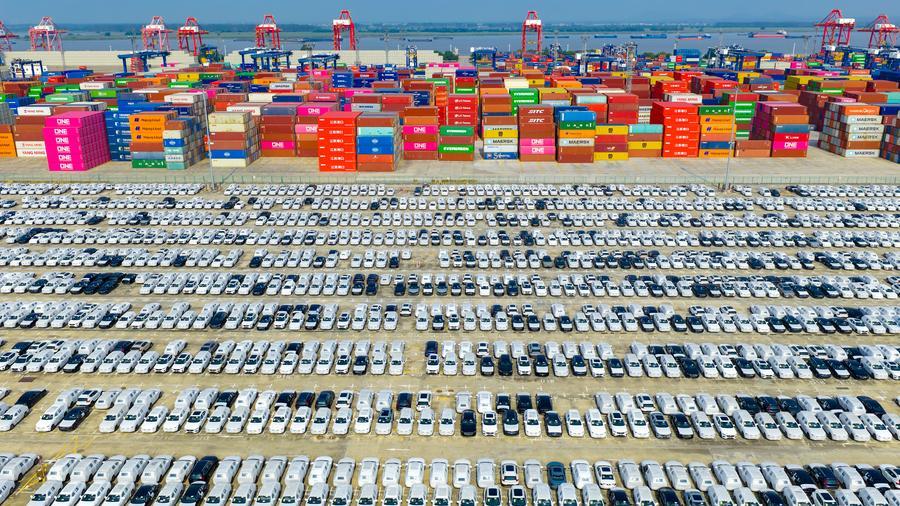
GUANGZHOU, Aug. 5 (Xinhua) -- In major ports of China, Chinese-made electric vehicles roll nonstop onto car carriers bound for destinations across the globe. But for the country's new energy vehicle (NEV) industry, loading vehicles onto outbound vessels is no longer the endgame. It is merely the first step.
As the world's largest NEV exporter, China is optimizing its global cooperation strategy, transitioning from a focus on product exports to advancing localized operations and ecosystem-driven shared development.
For many countries, this shift means more than just affordable electric cars. It brings fresh investment, local jobs and a faster track toward their own green transition.
Official data from the China Association of Automobile Manufacturers (CAAM) showed that China exported 2.615 million NEVs in 2025, up 103.7 percent year on year, and in the first half of 2026, exports reached 2.355 million units, an increase of 120 percent year on year. NEVs have become a major driver of China's export growth.
Chinese electric vehicles, notably, are no longer seen as cheap alternatives, competing strongly on performance, smart features and design.
XPENG Motors delivered over 45,000 overseas vehicles in 2025, up 96 percent year on year, with Europe contributing nearly half and Asia-Pacific posting strong growth. In March 2026, it unveiled a three-year plan to cover Latin America by 2028.
GAC Group, which regards overseas markets as a key growth driver, exported 121,500 vehicles under its own brands in the first half of 2026, soaring 132 percent year on year. It aims for 250,000 exports in 2026 and 1 million by 2030, with a presence in 120 countries and regions.
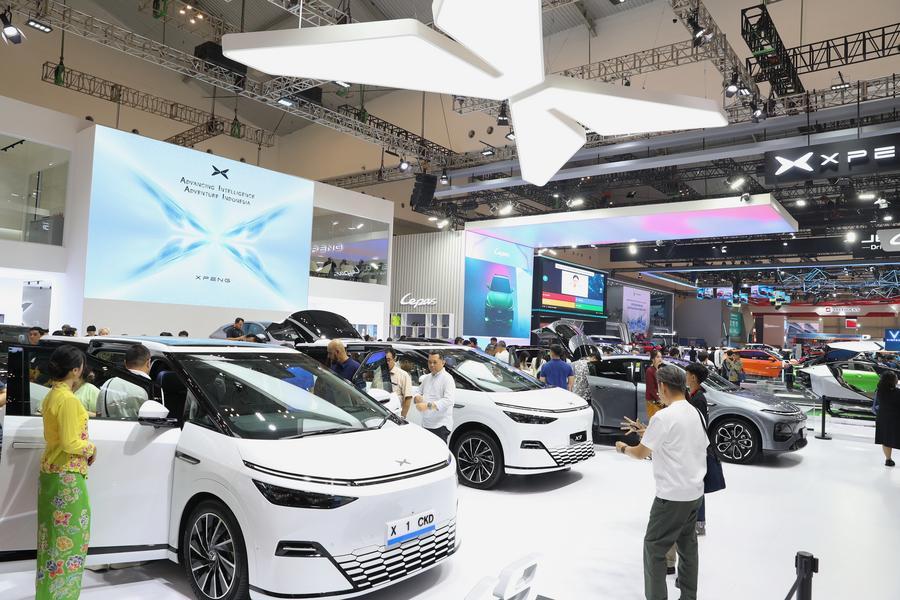
For leading Chinese automakers such as BYD, GAC and XPENG, their ambition extends far beyond volume. They are shifting from product exports to technology licensing, local manufacturing and deep brand building, creating a more sustainable and integrated model for going global.
BYD has licensed its e-platform 3.0 to Toyota and blade battery technology to Hyundai, while seven ASEAN countries have adopted its EV charging standard. These technology-sharing arrangements not only help global automakers accelerate their electric vehicle R&D cycles, but also advance the rollout of industry standards that deliver benefits to regional automotive markets.
Similarly, XPENG has supplied its second-generation autonomous driving system and self-developed Turing AI chip to Volkswagen for global deployment.
Today, sleek brand experience centers from BYD, GAC and XPENG dot commercial districts across Europe, Southeast Asia and the Middle East, reshaping the old perception of Chinese cars as "cheap and low-spec." On the service side, these companies have set up service centers and regional parts warehouses in key markets, cutting repair times and lowering maintenance costs for overseas users.
Beyond branding, Chinese automakers have also engaged in local communities. In February this year, GAC Mexico joined the Mexican Electric Mobility Association to support EV adoption and infrastructure deployment.
Chen Shihua, deputy secretary-general of the CAAM, attributed the NEV export boom to the country's robust supply chain, economies of scale, and swift iteration of smart features such as autonomous driving and smart cabin interaction.
"These advantages continuously enhance product competitiveness and help products adapt to the needs of overseas users," he said. ■