NANCHANG, July 25 (Xinhua) -- For more than 2,000 years, kiln fires have burned in China's Jingdezhen, transforming humble clay into exquisite works of art.
This is no ordinary city. Situated in a corner of east China's Jiangxi Province, the world-renowned "porcelain capital" has long been the heart of Chinese ceramic culture. Its storied history, in many ways, embodies the enduring continuity of the Chinese civilization itself -- a living tradition preserved, reshaped and renewed through generations.
The essence of Jingdezhen's millennia-old heritage lies in the hands of its artisans. As described in the Chinese scientific classic "The Exploitation of Nature's Works," or "Tian Gong Kai Wu," the porcelain-making process here entails 72 steps, with each demanding patience, precision and skill.
These very qualities continue to define craftsmen such as Sun Lixin. The 59-year-old began his apprenticeship more than four decades ago, learning every stage of porcelain production, from freehand delineation and the painting of classical motifs to clay forming and the compounding of glazes.
His craftsmanship caught the attention of President Xi Jinping during Xi's inspection tour of Jingdezhen in October 2023. At his workshop, the artisan demonstrated his techniques by painting playful images of children, a classical porcelain motif, in about 20 seconds with one continuous stroke.
"Your skills are truly remarkable," Xi said, while asking whether Sun followed a design or painted by feel.
"It is all in my heart," Sun replied.
As a provincial-level inheritor of the intangible cultural heritage of blue-and-white porcelain making in Jiangxi, Sun carries on the brand founded by his great-grandfather, a lineage now spanning over 120 years. His workshop tells the story via objects: hand-painted porcelain pieces in traditional forms, mass-produced daily-use porcelain with decal decorations, and even cartoon-style creations by his students.
"You are a guardian of a tradition rooted in this land, and a true embodiment of craftsmanship," Xi told him.
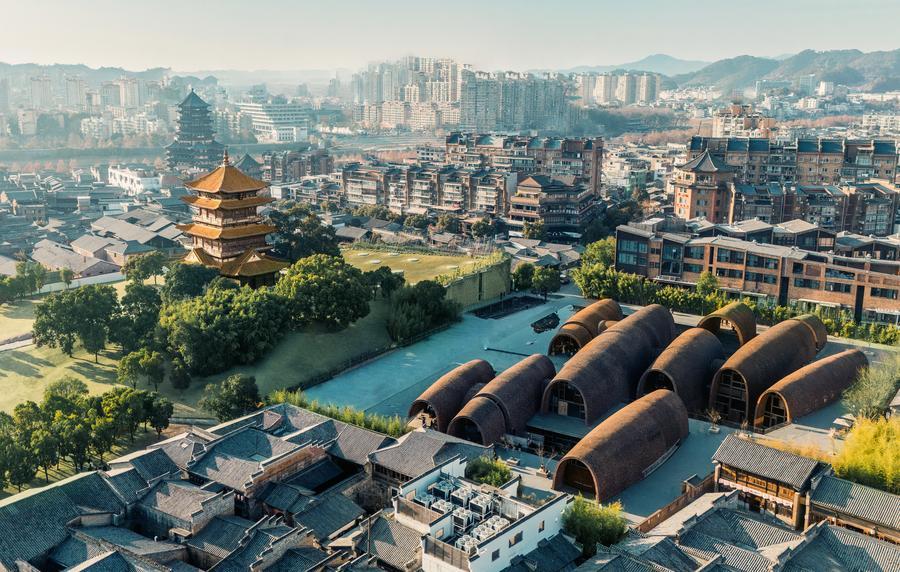
Sun's workshop is located in Taoyangli, a historic riverside quarter where centuries-old traditions flow with currents of contemporary creativity, all within sight of a waterway that links to the Yangtze River.
During his inspection trip, Xi walked through ancient kiln sites, a ceramic museum and a kiln cluster of the Ming and Qing dynasties (1368-1911). He learned about Jingdezhen's porcelain-making techniques, its efforts to preserve and renew traditional ceramic culture, and the city's role in cultural exchanges with the world.
The visit came four months after a national meeting on cultural inheritance and development, where Xi outlined five defining characteristics of the Chinese civilization, namely continuity, innovation, unity, inclusiveness and a peaceful nature.
As Weng Yanjun, head of the Jingdezhen Imperial Kiln Institute, put it, Jingdezhen porcelain embodies all of the five characteristics and is "a microcosm of Chinese culture." Weng has been to a U.S. university for an academic visit and conducted in-depth archaeological surveys of ceramics in the United States and Mexico.
While Xi was touring the ceramic museum, Weng provided a detailed account of excavation and conservation efforts involving local ceramic artifacts.
For centuries, the ceramic archaeologist added, ceramics have been "both a cultural symbol of China and a bridge connecting China with the world." Ceramics crafted in Jingdezhen have been exported to Central Asia, West Asia, Europe and beyond since the Song Dynasty (960-1279).
For Weng, the blue-and-white porcelain, or qinghua ceramics, in particular, bears the indelible marks of cross-cultural exchange.
During the Yuan Dynasty (1271-1368), cobalt pigment from West Asia reached Jingdezhen via the ancient Silk Road and was used in blue-and-white porcelain production. The result was the distinctive deep blue that defines Yuan wares. These pieces, once a prized commodity, represented a pinnacle of ceramic artistry.
"Very few blue-and-white vases of the Yuan Dynasty have survived. They are the 'panda of ceramics,'" Xi told foreign leaders in 2019, standing before one such masterpiece. The analogy, vivid as it is, captured the rarity of these treasured pieces.
That vase, more than 700 years old, was displayed at an exhibition held ahead of the Conference on Dialogue of Asian Civilizations in Beijing. On its surface, four ancient Chinese literati are paired with floral motifs.
Beyond the thriving trade in ceramics, Jingdezhen's craftsmanship was itself spread far and wide through cross-cultural encounters. The influence of Chinese porcelain can still be found overseas today, especially in Europe.
In Portugal, Chinese blue-and-white porcelain inspired the azulejo tradition, blending Chinese artistic elements with local craftsmanship. Local ceramic traditions of Faenza in Italy, a historical center of ceramics, were also influenced by centuries of exchange with Chinese porcelain techniques.
"Ceramics are a treasure of China and an important calling card of the Chinese civilization," Xi noted while in Jingdezhen. He has presented ceramic works as gifts on foreign visits and has written and spoken about how porcelain, along with silk, tea and other Chinese products, has enriched dialogue among civilizations.
"Civilizations have become richer and more colorful with exchanges and mutual learning," Xi said in his 2014 address at the UNESCO headquarters in Paris. "Such exchanges and mutual learning form an important drive for human progress and global peace and development."
Today, Jingdezhen remains a global hub for ceramic exchange, attracting artists, scholars and enthusiasts from around the world. Among them is Qurat Ul Ain from Pakistan, who came to Jingdezhen in 2023 to pursue a doctorate at Jingdezhen Ceramic University, focusing on Pakistan's ceramic heritage.
"Jingdezhen is like an unfolding world map of ceramic culture, and everyone who loves ceramics can find a place of their own here," she said. "It offers not only a rich ceramic tradition but also an open, international academic environment."
For some, what begins as a visit turns into a lasting connection. Australian ceramic artist Diana Williams bought an apartment in Jingdezhen 17 years ago, becoming the first foreigner to own property in the city. "What drew me here was the diverse and inclusive culture embodied in Jingdezhen porcelain," she said.
During his 2023 visit, Xi emphasized the need to pool talent from all fields and step up efforts in creative design, research and development, and innovation.
He called for redoubled efforts to "further grow and strengthen the ceramics sector, and burnish the already brilliant reputation of this 'millennia-old porcelain capital' to an even greater luster."
Building on decades of momentum, the city has taken bigger strides in recent years, including hosting the Congress of the International Academy of Ceramics from late June to early July 2026. The event attracted more than 400 international ceramic artists under the theme of "Inheritance and Innovation."
On Saturday, the city's living porcelain tradition earned a crowning global accolade -- Jingdezhen Handicraft Porcelain Industry Sites were added to the UNESCO World Heritage List, an affirmation of the enduring vitality of this "porcelain capital" on the world stage.
"This is China's first industrial heritage site to receive such recognition," said Liu Wenbin, a professor at Jingdezhen Ceramic University. The inscription, he added, is expected to promote broader global awareness of Jingdezhen's porcelain tradition, while supporting systematic documentation, digital preservation and the continued transmission of this centuries-old craft. ■