* The global reach of Chinese electric motorcycles is becoming increasingly difficult to miss.
* The shift from gasoline-powered vehicles to electric mobility has created an opportunity for China's two-wheeler industry.
* The global success of Chinese electric motorcycles demonstrates the growing international competitiveness of China's new energy industries.
NANJING, June 27 (Xinhua) -- As fuel prices have risen in many parts of the world, an unlikely export from China is quietly gaining traction overseas: the electric motorcycle.
The global reach of Chinese electric mobility is becoming increasingly difficult to miss. Across social media feeds and city streets alike, American teenagers ride Chinese-brand electric motorcycles to school, Southeast Asian couriers zip through traffic on battery-powered scooters, and young Parisians navigate narrow urban lanes on e-scooters.
For Wang Hao, an export manager in eastern China, demand has rarely been stronger. Orders from Europe continue to pour in, driven by consumers seeking cheaper, cleaner and increasingly capable alternatives to conventional motorcycles.
One of the company's flagship models, the Keeness, can travel up to 129 kilometers on a single charge and reach speeds of 100 kilometers per hour. "The model has become a bestseller in Europe, and our overseas order schedule is already booked through October," said Wang, who oversees overseas marketing for China's electric two-wheeler giant Yadea.
Once associated primarily with low-cost urban commuting, Chinese-made electric motorcycles are increasingly competing on performance, technology and design. Equipped with longer-range batteries, intelligent connectivity features and improved power systems, they are attracting riders ranging from daily commuters to recreational users.
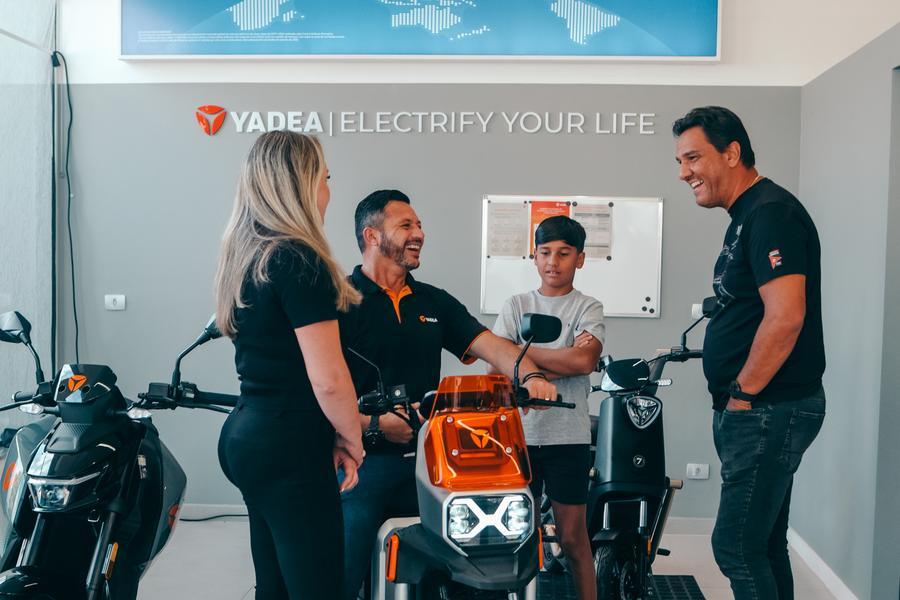
Yadea's products are now sold in more than 100 countries and regions worldwide. The company has built extensive sales and service networks throughout Europe. In the first quarter of this year, its overseas sales surged by 70 percent year on year.
"For Europe, we design with rainy weather in mind. For Latin America, we adapt to more complex suburban and rural road conditions," Wang said. "We also offer a growing range of smart features and accessories, giving customers stronger value for money."
Official data show that China exported more than 26.7 million electric two-wheelers in 2025, with export value reaching nearly 6.83 billion U.S. dollars. In the first quarter of 2026, such exports climbed to approximately 7.2 million units, a year-on-year increase of 68.2 percent.
According to industry observers, behind the surge lies a combination of global market forces and industry-specific trends that are reshaping transportation choices across both developed and emerging economies.
"Global energy supplies have been under pressure, keeping fuel prices at relatively high levels," Wang Hao said. "At the same time, electrification is becoming the future of transportation, while carbon-reduction goals are gaining broader public support."
The global shift from gasoline-powered vehicles to electric mobility has created a rare generational opportunity for the two-wheeler industry, said Han Jian, a professor at Nanjing University's Business School.
Across Southeast Asia, several countries have introduced policies ranging from subsidies for electric vehicles to plans to phase out the sale of gasoline-powered models. Meanwhile, persistently high fuel prices in Latin America and Africa have driven strong demand for affordable, practical modes of transportation, he added.
"These trends are creating favorable conditions for electric two-wheelers, particularly in emerging markets where cost efficiency remains a key consideration for consumers," Han noted.
Yet rising demand alone does not explain why Chinese brands have emerged as some of the biggest beneficiaries of the global shift toward electric mobility. Equally important is their ability to supply increasingly sophisticated products at competitive prices.
"The underlying logic of the export boom lies in China's integrated industrial ecosystem," Han said.
China's comprehensive supply chain, spanning batteries, electric motors, and control systems, enables manufacturers to produce high-performance vehicles at costs significantly lower than those of many of their Western competitors, providing a fundamental driver behind the sector's rapid export growth, according to the scholar.
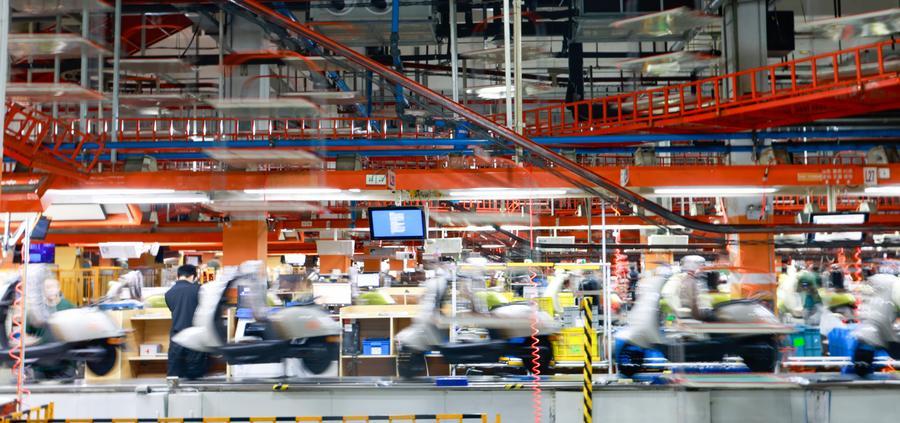
The advantages are particularly visible in Xishan District of Wuxi City, east China's Jiangsu Province. The industry's supply chain is concentrated within a 50-square-kilometer radius. The cluster hosts many of China's leading electric two-wheeler manufacturers, operating alongside suppliers that cover nearly the entire industrial chain.
The district now produces more than 15 million electric bicycles and motorcycles annually, making it China's largest hub for electric two-wheeler production, research and component distribution.
According to Segway-Ninebot, a renowned electric two-wheeler maker with cumulative global shipments exceeding 10 million units, China's electric two-wheeler industry benefits from a highly integrated and largely self-sufficient supply chain. A single model can draw on hundreds of specialized suppliers, allowing manufacturers to source components efficiently and bring products to market at speed.
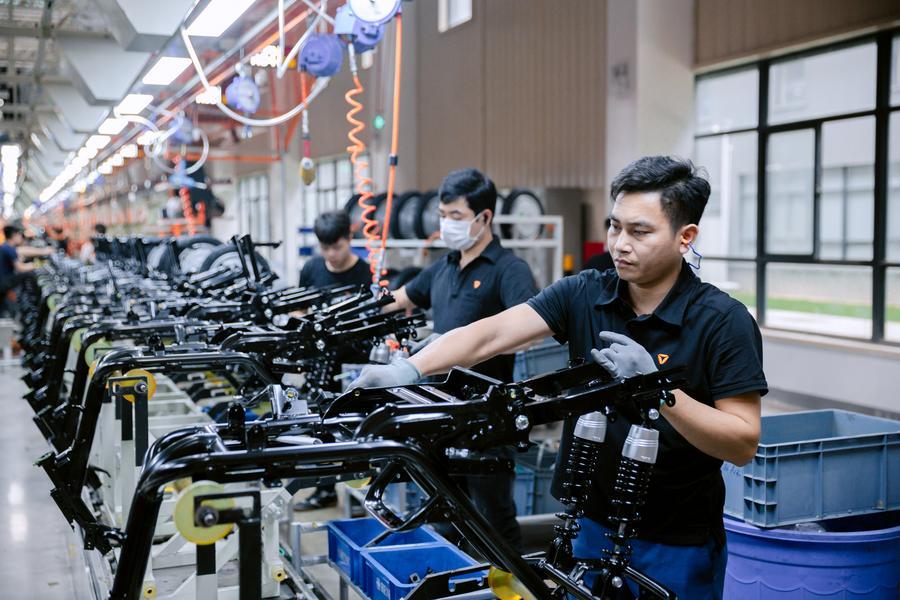
Meanwhile, innovation has become another differentiating factor. Product-development cycles of the company have been shortened to six to eight months, compared with 12 to 18 months for many overseas rivals, the company's e-mobility division said.
Local customs authorities in Wuxi said that electric two-wheeler exports from the city have maintained steady growth for nine consecutive years. During the first four months of 2026, exports from Xishan's two-wheeler sector reached 287 million U.S. dollars, up 33.7 percent from a year earlier.
The industrial cluster is also benefiting from policy support. To strengthen the sector's long-term competitiveness, local authorities have established a dedicated development fund focused on battery technologies, advanced materials, vehicle manufacturing, charging and battery-swapping infrastructure, and intelligent mobility solutions.
"The global success of Chinese electric motorcycles demonstrates the growing international competitiveness of China's new energy industries," Han said. "Chinese manufacturing has proved itself to be no longer defined by low-cost contract production. Increasingly, its strength lies in the integration of technology, products and services into complete solutions."
For companies like Yadea, the ambition extends beyond selling vehicles. "Ultimately, what we hope to export is not only stylish electric motorcycles," Wang Hao said. "We want to bring Chinese standards, Chinese innovation and Chinese brands to the global stage." (Reporting by He Leijing and Huang Zechen) ■