SINGAPORE, June 26 (Xinhua) -- "My screen doesn't show this circle." In the classroom, an elderly couple with graying hair looked down at their smartphones.
According to the slide, they should find a purple-blue gradient ring on their screens. Tap it, and the AI chat would open. They swiped across and up and down the screen. The icon did not appear.
"Because the app was updated," said 72-year-old Raymond Kan. "It used to be a closed ring. Now it's a circle made of purple leaves."
He leaned toward the microphone. "These apps change too quickly. I also struggle to keep up. I just keep learning."
After class, he told Xinhua that some older users tend to follow instructions literally. "You show them how to do it, and they just follow. Once something changes slightly, they can't find it anymore."
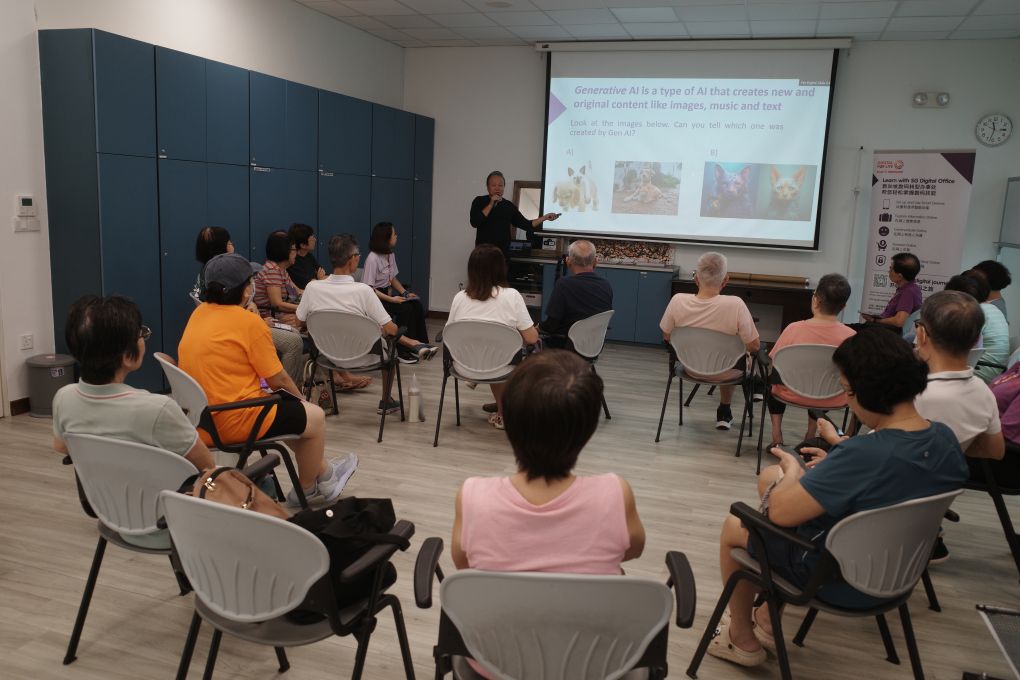
On Thursday, in a residential neighborhood in central Singapore, 16 seniors sat on chairs in a classroom. The session was a digital skills workshop on generative AI. It is part of a series jointly run by the SG Digital Office, set up in 2020 by Singapore's Infocomm Media Development Authority, and a social organization, designed to teach older residents digital skills.
At the start, Kan asked: "How many of you have used AI?"
A silence followed. A thin woman raised her hand. "I've used ChatGPT and Meta." Several participants turned to look at her. Kan gave her a thumbs-up.
"What can AI do?" he asked. It writes text, generates images and video -- including fabricated ones. On the slide, two animal photos appeared, somewhere between a cat and a dog.
"Do you think this is real or fake?"
A few people laughed. Kan did not. "This is fake. This animal does not exist," he said. "No need to have to trust AI. What is true, what is false -- this is something very challenging today. Many YouTube videos are also generated by AI."
The 16 participants split into three groups, each seated in a small circle with a facilitator. Kan asked them to scan QR codes on the slide to download different AI apps. The three facilitators stood up immediately, walking among the groups. Each held a tablet displaying the same QR codes for scanning.
The facilitators are known as "Digital Ambassadors," who are trained and deployed by the SG Digital Office to provide one-on-one and small-group guidance on digital skills. Many are older adults themselves. They first learn to use digital tools, then go on to teach their peers.
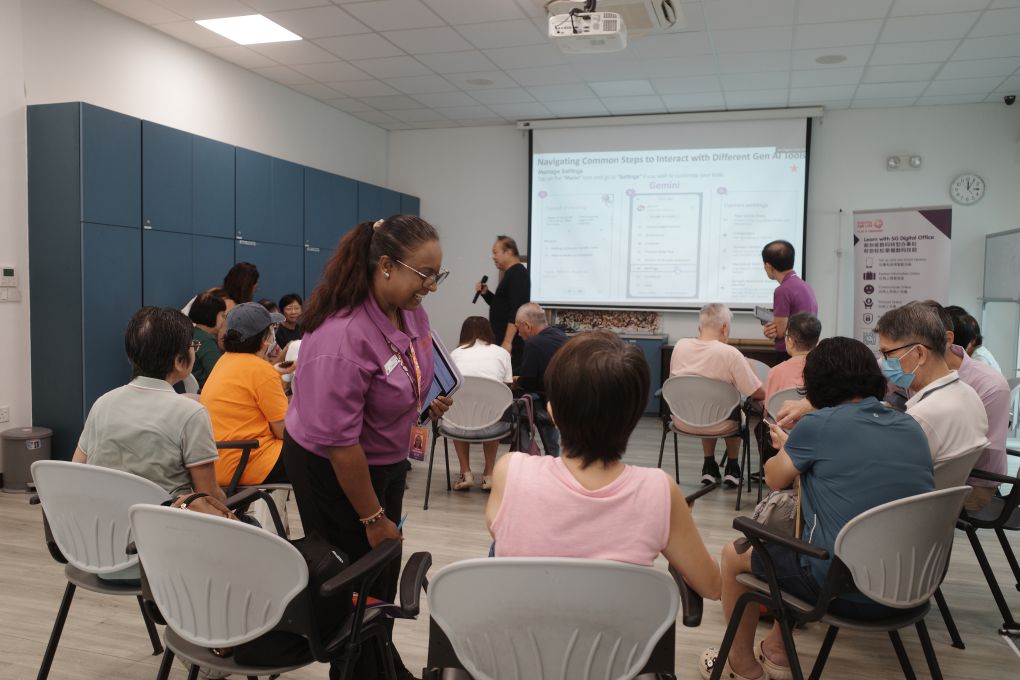
Digital Ambassador David Lee, 69, told Xinhua that elderly learners often face two barriers: fear of pressing the wrong button and losing everything on the phone, and reluctance to ask questions in case they are laughed at.
"In a group, they feel more at ease," he said.
He recalled a participant in the 70s who once asked him, "You are 68 and can use so many apps. If you can do it, I should be able to as well." He replied, "As long as you're willing to learn, we'll teach you."
The class continued. One focus was Meta AI, embedded directly in WhatsApp, one of the main daily communication tools in Singapore.
Kan played a screen recording showing how to access Meta AI in WhatsApp. He then gave a 10-minute exercise. Participants were asked to click the purple leaf-shaped icon and type: "Give me the top 10 best chicken rice in Singapore."
The room was filled with noise.
"Can I use the mic?" a woman asked. After confirmation, she spoke into her phone.
Lee said some participants resist typing. He usually tells them, "If you can't write it, just speak it."
Group discussion quickly shifted to the results they saw. "I've never heard of this chicken rice." "Have you been to that Thai restaurant?" A woman raised her voice across two chairs.
When the noise settled, Kan lifted the microphone again.
"Where does this information come from?" he asked.
No one answered.
"From the internet," he said. "AI gathers information from the internet and presents it to you. So you have to verify it."
He added that people define "good food" differently -- some prefer spicy chicken rice, others do not. Online ratings are aggregated preferences, not objective truth.
Kan himself joined the program in 2025 as a learner. He started with mobile polling and location sharing, then moved on to booking medical appointments and using AI. Later, he began teaching as a volunteer.
His son works as an IT manager at a bank. "He speaks very fast because he knows it well," Kan said. "He doesn't realize I'm older. My movements are slower than his speech."
"I don't have to follow him," he said with a slight smile. "I can find my own learning resources."
Lee agreed. Older learners, he said, learn more slowly and resist change more easily. "In 45 minutes, absorbing 30 to 40 percent is already good," he said. Patience is repeatedly emphasized in training for Digital Ambassadors.
He once taught a man in his 80s with mild Alzheimer's. It took him about 20 sessions to fully master how to send a sticker. "He improved slowly," Lee said. "But he kept coming. His children and grandchildren were either studying or working. He felt cooped up at home. He came here and made friends. Learning came second."■