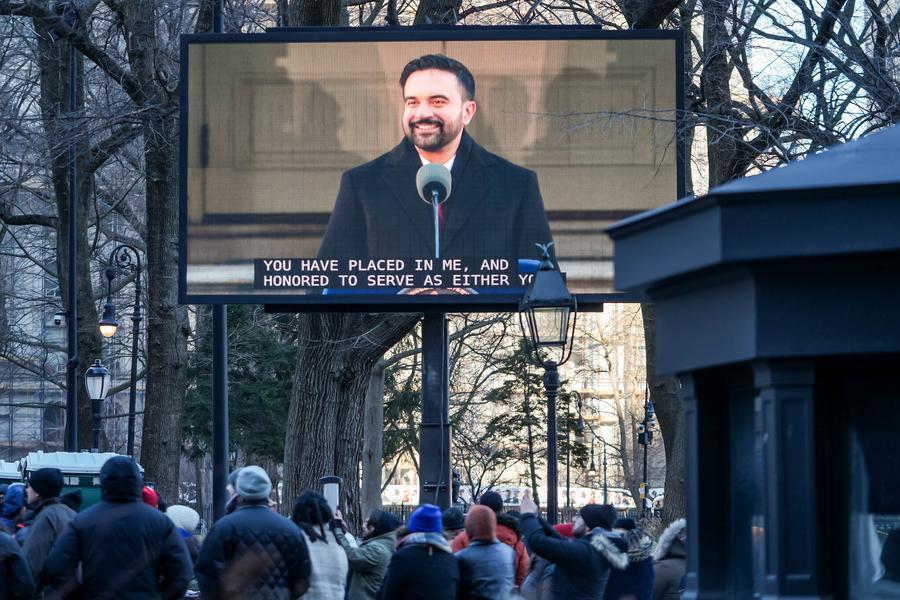
Zohran Mamdani's surprise victory marked a major shift in New York City politics in 2025, but governing has proved far more difficult, as his ambitious agenda faces financial, legal and political headwinds that underscore broader divisions in the United States.
NEW YORK, June 26 (Xinhua) -- Zohran Mamdani's victory in New York City's mayoral election has emerged as one of the most closely watched political upsets in the United States in 2025.
Yet winning the election may prove to be the easier task. Many of Mamdani's proposals face financial, legal and political hurdles, reflecting deep fractures within U.S. politics, declining trust in traditional institutions, and a broader disagreement over the role of government.
NO FREE BUSES
As a member of the Democratic Socialists of America (DSA), a left-wing political organization, Mamdani's campaign was built around a promise to tackle the city's affordability crisis. The zero-fare bus service was a centerpiece of his campaign.
"Today in the wealthiest city in the wealthiest country in the history of the world, one in five New Yorkers cannot afford the bus fare," Mamdani said during the campaign's final debate in October 2025.
However, the math is daunting. While Mamdani has estimated the program would cost about 630 million U.S. dollars annually, the Metropolitan Transportation Authority (MTA) said the true cost could approach 1 billion dollars a year. Most city buses are operated by the state-run MTA, not City Hall, limiting the mayor's direct authority over fares.
Experience elsewhere has also raised questions about the proposal. Kansas City, Missouri, reinstated bus fares in June after its fare-free program's annual operating costs rose to about 15 million dollars, nearly double the initial projections.
Acknowledging the obstacles, Mamdani said in April that his vision of fast and free buses would not be implemented this year.
"There are a lot of issues with the idea of free buses," said Janno Lieber, the MTA chairman. He warned that losing 600 million to 1 billion dollars in fare revenue would cut into the agency's budget for maintenance and upgrades.
HOUSING PLAN
New York has experienced years of rising housing costs, while inflation has kept pressure on household budgets. Housing, in particular, has become one of the city's defining political issues.
Delivering on a central promise in June, Mamdani secured a historic rent freeze for roughly one million rent-stabilized apartments. By appointing a progressive majority to the city's Rent Guidelines Board, he pushed through zero-percent increases for up to two years.
However, a landlord representative resigned in protest before the vote, dismissing the outcome as predetermined "theater." At the same time, property owner groups warned that freezing rents would financially cripple their ability to maintain aging buildings.
In May, Mamdani unveiled his "Block by Block" housing plan, committing 22 billion dollars over five years to build 200,000 new affordable homes and preserve another 200,000 over the next decade.
The plan has also drawn attention to the condition of the city's existing public housing stock, managed by the New York City Housing Authority (NYCHA). Public officials have criticized prolonged service disruptions, including multi-month gas outages in some NYCHA developments.
Critics argue that while expanding new construction, insufficient attention to existing maintenance needs leaves current residents in deteriorating living conditions.
IDEAL VERSUS REALITY
Why did voters support a leader who struggles to deliver on glaring campaign promises like free buses? This exposes the widening gulf between ideological ambition and institutional gridlock.
Mamdani's plan is highly costly, reflected in his record-setting 124.7 billion-dollar executive budget for Fiscal Year 2027. His proposed funding mechanism is progressive: taxing the rich.
Yet, implementing new wealth taxes requires approval from the state legislature, placing the City Hall's redistributive plans at the mercy of state-level moderates.
Without the state legislature's backing, Mamdani has relied on accounting measures that fiscal watchdogs describe as "gimmicks," most notably the deferral of more than 1.6 billion dollars in pension contributions.
Andrew Rein, president of the nonpartisan Citizens Budget Commission, warned that this short-term fix simply "makes future New Yorkers balance this budget" while politicians spend today.
Despite this gridlock, making grand but sometimes unfulfillable promises remains highly effective. For Mamdani's supporters, these pledges are moral declarations of priorities.
This rhetoric's marketability was proven in recent New York primaries, where Mamdani's progressive allies, backed by the DSA, scored sweeping victories against mainstream Democrats.
These victories were not solely a referendum on local governance. Foreign policy flashpoints, notably the Israel-Gaza war, heavily defined races, as in the case of former City Comptroller Brad Lander unseating incumbent Representative Dan Goldman.
Ultimately, U.S. voters increasingly prefer insurgents who aggressively challenge the status quo. Unmet promises are viewed not as personal failures, but as proof that the establishment itself is rigged and requires dismantling. ■