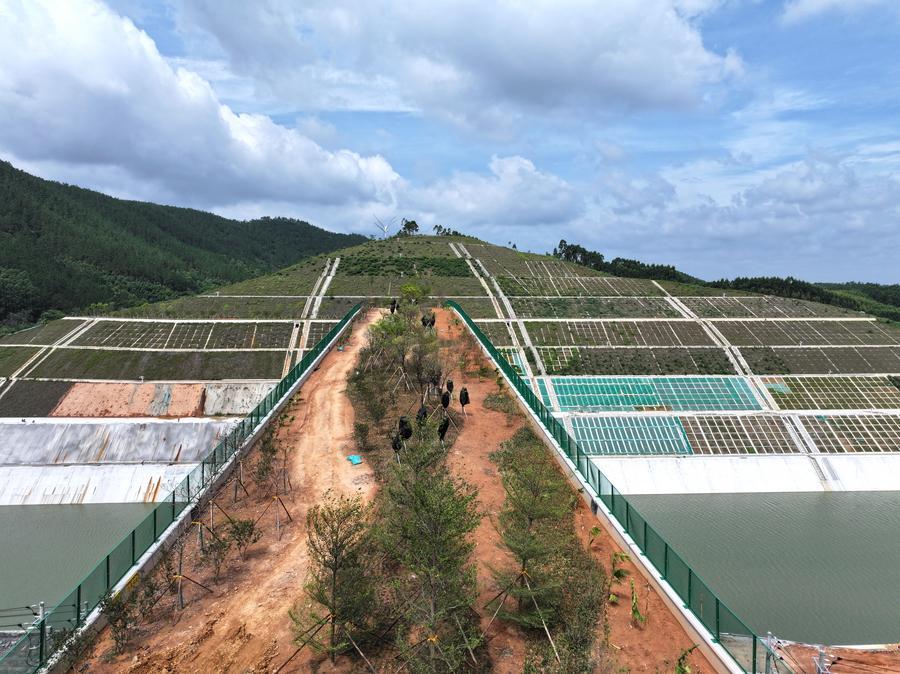
NANNING, June 24 (Xinhua) -- On a newly-excavated canal in southern China, a unique 240-meter bridge is in its final stages of construction, but it is entirely devoid of asphalt, lane markings or human foot traffic.
Instead, its surface is blanketed with a 60-centimeter to 1.2-meter-thick layer of nutrient-rich soil and planted with native berry bushes, loquats and rose myrtles, with several mountain cherry trees already sprouting buds on their branches.
This is China's first dedicated wildlife corridor over a major canal. Vital to the region's inland economy, the 134.2-kilometer waterway Pinglu Canal is nearing completion and stretches from the Pingtang River in Hengzhou City, Guangxi Zhuang Autonomous Region, to the Beibu Gulf in the South China Sea.
The 20-meter-wide box arch bridge, built exclusively for animals, is a gentle infrastructure designed to reconnect mountainous habitats severed by the watercourse. The nearby mountains are home to spotted linsangs, leopard cats and red-bellied squirrels.
"The bridge deck is covered with over 5,600 cubic meters of local topsoil, complete with native microorganisms and humus," explained Zhang Shoulong, a canal engineer.
The bridge's design incorporates "animal psychology" to overcome wildlife's natural avoidance of artificial structures. Its two trumpet-like, vegetation-shielded entrances encourage hesitant animals to enter, while layered soil creates species-specific routes: arboreal paths for squirrels, shrub-lined trails for leopards, and floral zones for pollinators.
Also, meticulous designs featuring water, rocks, logs and wetland plants provide essential water, food and shelter, ensuring the bridge feels like a natural extension of the forest, according to Zhang. As this was their first time designing vegetation specifically for wildlife, he and his colleagues conducted extensive research on animal behavior.
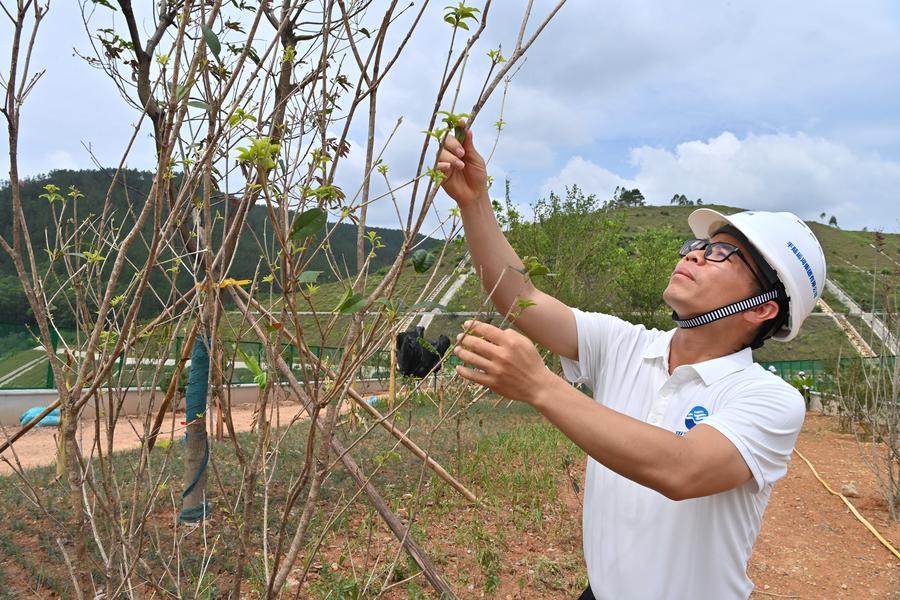
They selected native tree species for the project. Figs feed birds, while seeds attract squirrels. Flowering plants like cherry blossoms, hibiscus and crape myrtles draw insects and birds. Meanwhile, climbing vines are planted to form green walls along the bridge, reducing noise and blocking human sight.
The bridge will undergo five years of post-construction maintenance and will be equipped with cameras that stream live footage. The team is now eagerly watching to see how the wildlife uses the crossing.
NATIONAL DRIVE FOR BIODIVERSITY
This heart-warming passage reflects China's broader, nationwide commitment to ecological harmony.
As early as the first few years of this century, when China was building a railway across the Qinghai-Tibet Plateau, 33 wildlife crossings were incorporated into the route, using elevated bridges, with the space beneath allowing animals such as the Tibetan antelope and gazelle to pass safely.
In recent years, China has integrated biodiversity conservation into its national ecological strategy, reflecting a steadily growing commitment to the cause. In response, many regions have developed creative, locally adapted engineering solutions to coexist harmoniously with animals.
A comparable wildlife "artery" bridge in the country's high-density southern metropolis of Shenzhen has dedicated 90 percent of its surface to over 80 native plant species and a misting system that simulates forest humidity.
Since its opening in 2024, the urban bridge has recorded over 300 wildlife crossings, including leopard cats, wild boars, pygmy squirrels, lizards and black-crowned night herons.
This megacity, still home to 551 terrestrial vertebrate species, also features over 100 "tiny passages" built by local citizens, such as ladders and climbing ropes to help small creatures navigate the concrete jungle.
In east China's Zhejiang Province, a Z-shaped crab corridor was built on a steep breakwater at a river estuary famous for its tidal bores. Paved with pebbles and shaded to retain moisture, this gentle slope allows crabs to effortlessly cross the 3-meter barrier between the sea and inland rivers.
"If there were no gaps along the route, it would be extremely difficult for wildlife on both sides to forage and migrate," explained Xu Chao, the project manager. "Traveling along the zigzag path helps animals conserve energy."
This January, conservationists at the Gaoligong Mountains national nature reserve, located in China's southwestern borderlands, were thrilled to spot, in infrared camera footage, that the canopy rope bridges they had set up last year had become convenient valley passages for grey langurs living along the China-Myanmar border.
These soil-covered bridges, crab channels and rope pathways are China's silent promises to protect biodiversity. They are proving that economic development need not come at the expense of nature.
"A stable ecosystem takes hundreds of years to form," said Xia Dong, an engineer of the Pinglu Canal project. "If we cut off the genetic exchange between animal populations, no amount of money can make up for it." ■