by Xinhua writer Xiao Yue
CHENGDU, June 24 (Xinhua) -- At 4,450 meters above sea level, snow was falling in June in the southwest of China.
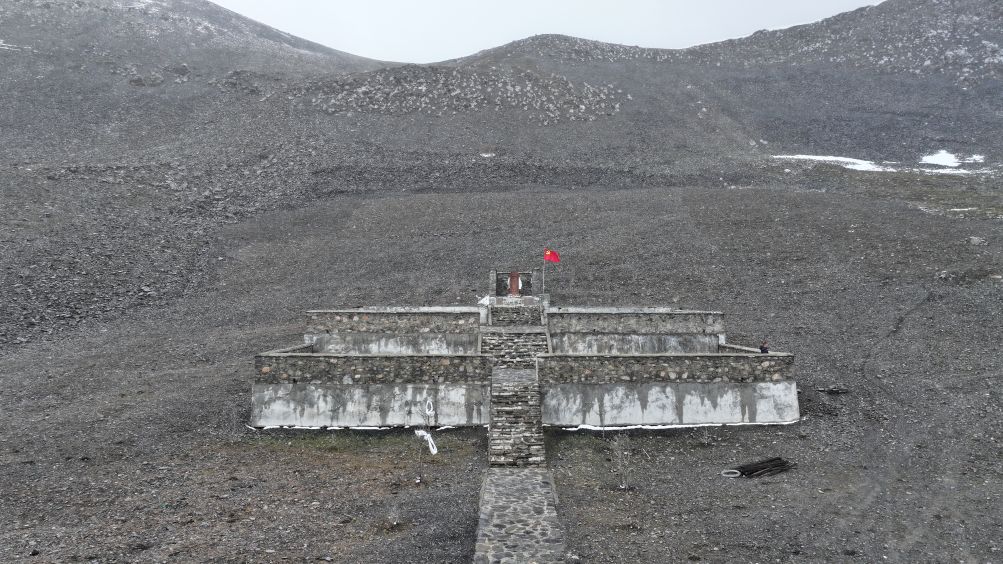
This snow came sideways across Yakexia Snow Mountain, striking our faces as we climbed the stone steps toward a martyrs' cemetery at the pass. Around it there was almost no vegetation. Saplings planted nearby had long withered in the harsh conditions. Yet on top of the stone tomb, a single wild plant was blooming in the snow.
Local Party history researchers say the tomb holds the remains of 12 unknown Red Army soldiers. They were discovered at the pass in 1952 by the Chinese People's Liberation Army troops during a campaign against armed remnants of Kuomintang forces and local bandits.
The remains were lying neatly, heads toward the north and feet toward the south, with no gunshot wounds. Belt rings, copper buttons and other military objects were scattered nearby.
Local historians, drawing on the on-site identification efforts of Tang Chenghai, a Red Army veteran who had crossed the mountain three times, as well as research by the local Party school and memoir records, believe the remains are those of a squad of soldiers from the Second and Fourth Front Armies of the Red Army. They were moving north after joining forces in the Long March in Garze county, southwest China's Sichuan Province, in 1936, and likely died from oxygen deprivation while camping overnight at the pass.
"No names. Nothing to identify them," said Yang Wenming, a local historian from Hongyuan County who has studied the Long March in this area for more than three decades. His face had turned slightly purple in the thin air, and he had to stop for breath every few words. "They fell asleep and never woke up."
In Tibetan, Yakexia means impassable, a name that feels less like metaphor than warning. Also known as Changban Mountain, it straddles the boundary between Heishui and Hongyuan counties in the Tibetan and Qiang Autonomous Prefecture of Aba, Sichuan. Its main peak rises to about 4,800 meters, while the pass stands at 4,450 meters. Local herders have long regarded it as a forbidding barrier -- a mountain so harsh that even yaks were said to struggle to cross it.
Yet between 1935 and 1936, the Red Army crossed Yakexia three times during the Long March, according to the prefectural Party school of Aba. On the mountain, the history often told through the phrase "Long March spirit" becomes physical. It is felt in breath, heartbeat and the few steps one can take before the thin air forces a pause.
We had arrived by car, wearing modern outdoor gear and carrying devices that could measure our bodies' response to the altitude. Even so, the mountain quickly narrowed the distance between present and past.
At roughly 3,500 meters, the snack packages in our car had swollen tight in the thin air, while someone rubbed their ears and another frowned. When I stepped outside, the wind cut through my collar. Above us rose a long slope of loose stones. Across the mountainside, pine trees swayed in the wind, their trunks draped with pale-green lichen, a quiet sign of the clean highland air.
I am a Sichuan native and exercise regularly, so before the trip I had carried a silent confidence that altitude sickness might not bother me. But less than five minutes after starting up a maintained trail, my breathing had grown heavy. My watch showed my heart rate had jumped to 139.
"Altitude sickness is not about age. It is about rhythm," said Peng Qili, a local resident serving as our guide. He has lived for years on the plateau, and his breathing remained steady, his steps light. "Take smaller steps. Breathe in through your nose, out through your mouth. Don't fight the mountain."
It was useful advice, and a check on any easy imagination of the past. We were carrying almost nothing. The path had been repaired. Vehicles were never far away. The soldiers who climbed there 90 years ago, however, wore straw sandals and thin clothes, and some were barefoot. They were hungry, carrying weapons and military supplies, and moving under the pressure of a march that left little room to wait out the weather or turn back.
Near a monument bearing the inscription "The Long March spirit shines forever," Wang Yang, a teacher from the local Party school, was giving an outdoor lesson. The wind was so strong that every sentence had to be shouted.
"The snow reached their knees," she said loudly. "They pulled one another forward, stepping into the footprints of the person ahead. They did not dare to stop. Once they sat down, they might never stand up again."
Her voice caught. After a few seconds, she continued.
"Many never came down from those snowbound heights," she said after a pause. "Once the snow covered them, there was not even a grave mound left. Not even a name."
That is the cruelty of mountains like Yakexia: they do not merely block a route, but can also absorb lives into the landscape, leaving later generations to search for traces in stone, snow and memory.
But the mountain has also become a vivid marker of how this once-isolated stretch of western Sichuan has moved from perilous passage to modern mobility.
In 2012, the Yakexia snow mountain tunnel opened to traffic. The 2,302-meter tunnel replaced 12 kilometers of perilous mountain road at the pass and cut the crossing from about half an hour to only a few minutes, ending the old pattern of winter closures and hazardous travel. By the end of 2025, progress on an expressway had shortened the drive from Chengdu to Hongyuan to approximately four hours, bringing this once-remote highland county closer to the provincial capital.
By evening, after we had descended from the pass, Hongyuan county seat seemed almost startlingly alive. Broad asphalt roads ran through town. Tibetan-style homes stood in orderly rows. At a yak market, traders called out prices. In a square, children chased a football as the light faded.
Yakexia was once called impassable. The soldiers who climbed it in straw sandals proved otherwise, though many never returned from the snow. They have long since vanished into history, some without even a name. Yet the route they took across the mountain has not ended. It now runs through tunnels and highways, and through the ordinary lives unfolding in Hongyuan below. ■