DALIAN, June 23 (Xinhua) -- Starting Tuesday, the focus of the world economic dialogue is on conference halls located on the northeastern coast of China.
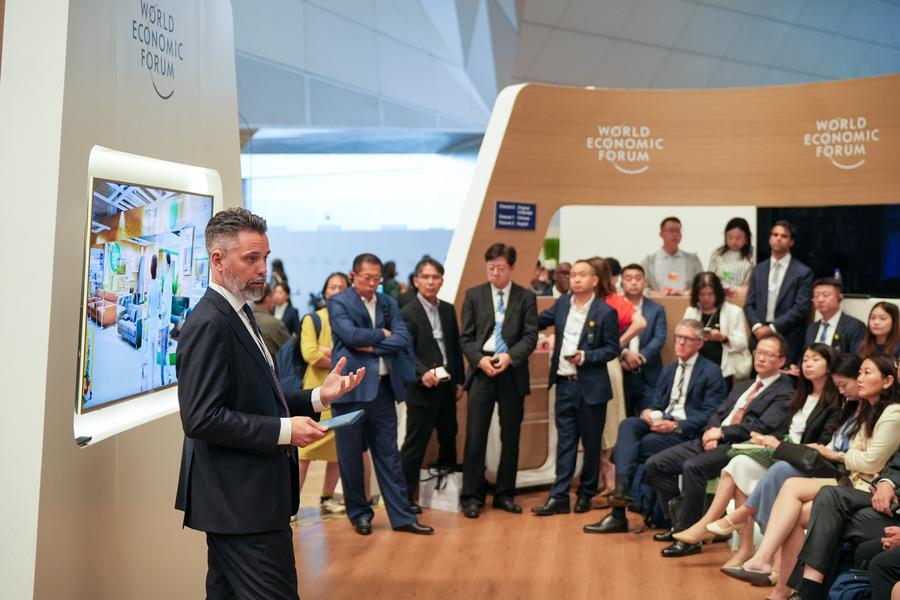
More than 1,700 representatives from political, business, academic and media circles of over 90 countries and regions have gathered in the port city of Dalian in northeast China's Liaoning Province to attend the 2026 Summer Davos forum. Many there believe that China's growing influence in sci-tech progress and green development may add impetus to the sluggish world economy.
For the participants, China is a major part of the answer to where the next wave of growth and innovation will come from. Being held just months after the launch of the country's outline of the 15th Five-Year Plan (2026-2030), the forum in Dalian serves as the first major global economic showcase of this new planning cycle.
This year marks the 17th Summer Davos forum, also known as the World Economic Forum's Annual Meeting of the New Champions. The first forum was held in Dalian in 2007, aiming to bring together global growth enterprises and industry leaders, and promote growth and innovation in emerging markets, while boosting participation in cooperation with China, the world's rapidly developing second-largest economy.
The theme for 2026 is "Innovating at Scale." Participants will encounter a wide range of topics such as artificial intelligence (AI), humanoid robots, green industries, quantum technology, biomedicine and advanced manufacturing. China is in a leading position in many fields and enjoys extensive cooperation with the international community.
The five-year blueprint adopted by China's national legislature in March 2026 is critical for the country's quest to basically realize modernization by 2035. It places strong emphasis on sci-tech breakthroughs by accelerating intelligent and digital transformation, implementing the "AI Plus" strategy, and fostering emerging and future-oriented industries.
"Since last year, our management team in China has been studying the outline of the 15th Five-Year Plan in detail," said Yu Feng, president of Honeywell China, who is participating in the forum. "We see clear opportunities across several sectors," he told Xinhua, pointing to domains that have already demonstrated strong growth momentum, including semiconductors, data centers, shipbuilding and energy transition.
"Innovation today is becoming more replicable, more scalable and more readily translated into real-world applications," said participant Xie Weishan, chairman of Kmind Strategy Consulting. "Boasting a vast domestic market and extensive industrial ecosystem, China is emerging as a testing ground where new technologies can be deployed, refined and commercialized at a scale difficult to replicate elsewhere."
For Jonas Prising, CEO of workforce solutions company Manpower Group, the tech advancement and innovation environments are equally impressive in China. Openness to innovation is one of China's most striking advantages, he noted.
"Attitudes to AI are much more positive in China. Chinese people are very used to applying applications like WeChat and Alipay, and all kinds of technologies for the benefit of their daily life, and you are now seeing that translate into professional lives as well," said the senior executive.
While China has one of the world's largest AI industries, its green transformation is also astonishing. Investment in clean energy made many years ago is now generating economic and strategic dividends.
"China's investment in clean energy is one example. In the beginning, it was expensive. It wasn't clear it was going to pay off. But years later, amid geopolitical tensions and growing concerns over energy security, China had a much more diversified energy base than if it had never started on a clean energy revolution," said Yuen Yuen Ang, Alfred Chandler chair professor of Political Economy at Johns Hopkins University.
According to Ang, China's diversified energy structure and growing leadership in renewable technologies are the result of years of patient investment, supported by a consistent policy framework rather than short-term market speculation.
The scale of this transformation is becoming increasingly difficult to ignore. China now accounts for more than half of global electric vehicle sales, while the penetration rate of new-energy vehicles in domestic new-car sales has reached a record high. In 2025, newly added wind and solar power generation accounted for more than 90 percent of China's increase in electricity consumption, becoming the primary source of new power supply.
"China possesses great green development potential," said forum participant Katherine Daniell, interim director of the School of Cybernetics at the Australian National University. "Its progress toward carbon neutrality and decarbonization has been remarkably rapid. The country has already built large-scale industrial clusters in photovoltaics, batteries and new-energy vehicles."
China's extensive electric vehicle fleet, complete battery supply chains and massive solar manufacturing capacity position it well to provide valuable experience for other countries pursuing their own energy transitions, she added.
"I have visited China five times, the first time in 2009," Daniell said. When she compares what she sees today with a decade ago, the changes are remarkable. "The cities are cleaner, greener and in many ways more livable." The pace at which new technologies are being adopted and integrated into broader development strategies is particularly striking, she noted.
Chinese officials will at this forum convey the message of continuing to contribute to the world economy via innovation and green development, while promoting a China that is more open to the outside world and facilitating an economic globalization that is inclusive and beneficial to all.
Elizabeth Thurbon, professor of International Political Economy at the University of New South Wales, said China's rise was inseparable from decades of engagement with the global economy.
China's swift economic development was not achieved through isolation or zero-sum thinking, she noted. It was built on opening up, attracting investment, participating in global markets and creating opportunities for hundreds of millions of people, Thurbon added.
The number of overseas-invested enterprises in China has risen for three consecutive years to surpass 530,000, with total accumulated foreign direct investment (FDI) exceeding 3.6 trillion U.S. dollars, according to data released by the Ministry of Commerce.
"China's integrated industrial ecosystem, rich data resources and clear policy direction have enabled it to rapidly incubate globally competitive domestic firms in recent years, while also providing international investors and technology companies with a sizeable platform for commercial deployment," said Deng Zhonghan, academician of the Chinese Academy of Engineering and chief strategic scientist at Vimicro. ■