* China is emerging as a leading source of automotive innovation and is helping reshape the global automotive industry.
* From integrating into China's digital ecosystem, to forming strategic alliances with local partners, multinational carmakers are increasingly embedding in China's innovation and supply chains.
* Chinese and foreign automakers are pooling their strengths and co-creating new value through shared innovation.
BEIJING, June 22 (Xinhua) -- In 1983, the first Santana sedan, a Volkswagen model that would later sweep the Chinese market, rolled off an assembly line in Shanghai, marking a new phase of China's car-making drive. Foreign automakers brought production lines and manufacturing know-how, producing models that were popular in their home markets.
More than four decades later, China has become the world's largest auto market. While joint ventures continue to work with Chinese carmakers and foreign brands still account for a significant share of car sales, research is now conducted and products developed more closely aligned with the evolving needs of Chinese consumers.
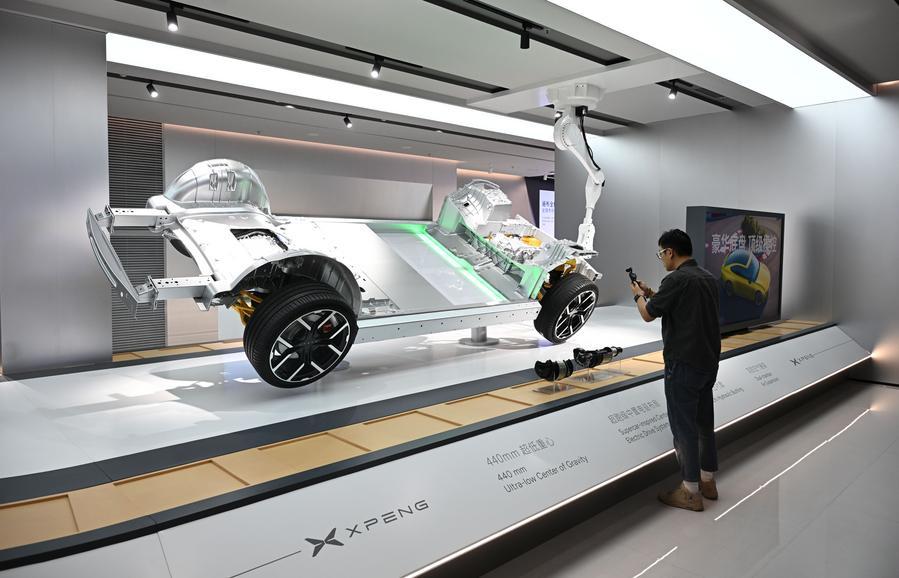
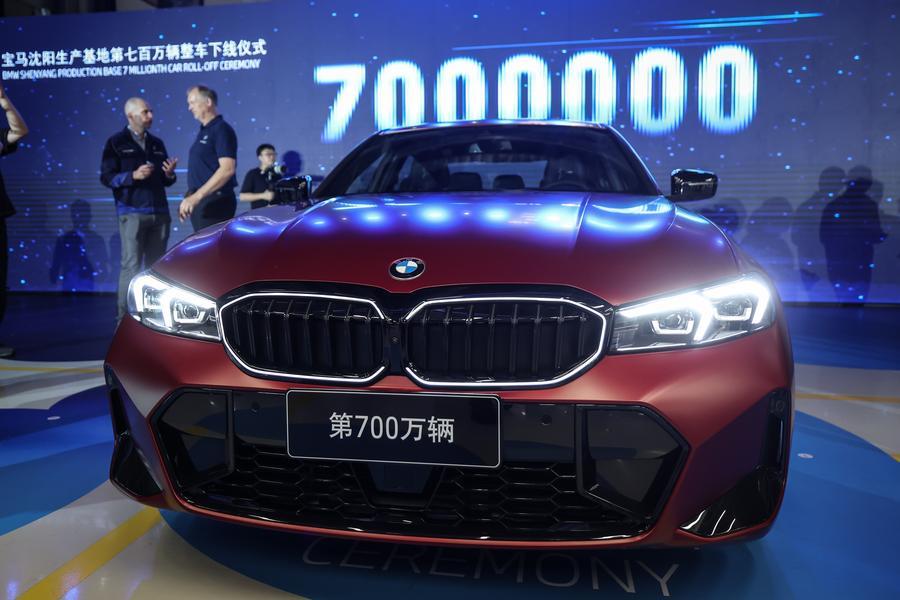
This year, Volkswagen and Chinese new energy vehicle (NEV) maker XPeng have begun mass production of their first jointly developed model. Mercedes-Benz has upgraded its Shanghai research & development (R&D) center into a global innovation hub. BMW executives have visited Great Wall Motor to explore deeper technology cooperation.
Behind these shifts lies a fundamental transformation. Backed by rapid advances and technological prowess in NEVs, China is emerging as a leading source of automotive innovation and is helping reshape the global automotive industry.
REWRITING THE RULES
Chinese consumers are increasingly opting for NEVs, attracted by lower prices, reduced running costs and rapid technological advancements. Recent sales figures confirm NEVs are steadily gaining popularity.
Data released by the China Association of Automobile Manufacturers on June 10 showed NEV sales in May reached 1.496 million units, up 14.4 percent year on year. NEVs accounted for 56.9 percent of all new vehicle sales, up from 40.9 percent in 2024 and 50.8 percent in 2025.
In contrast, gasoline-powered models fell out of China's top 10 passenger vehicle retail sales rankings in May.
Hua Guowei, a professor at Beijing Jiaotong University, attributed the shift to multiple factors. "High oil prices have accelerated consumers' move toward electric vehicles, while technological advances have eased concerns over driving range and charging convenience," he said. "Meanwhile, younger consumers have also embraced intelligent electric vehicles at a much faster pace."
"NEVs are becoming increasingly price-competitive with gasoline cars," said Jiang Tianci, president of the Anhui automobile dealers association, noting that the widespread adoption of new manufacturing technologies has steadily reduced production costs.
Beyond performance and cost-effectiveness, Chinese NEVs are also redefining the in-cabin experience, with lounge-style interiors, advanced infotainment systems, and comfort features transforming vehicles into digital living spaces. These innovations are increasingly winning over consumers.
As the market tilts toward electric vehicles, the question facing multinational automakers that once dominated the era of internal combustion engines is no longer whether to adapt, but how.
CREATED WITH CHINA
The new landscape in the automotive industry is evident in the strategies adopted by multinational automakers.
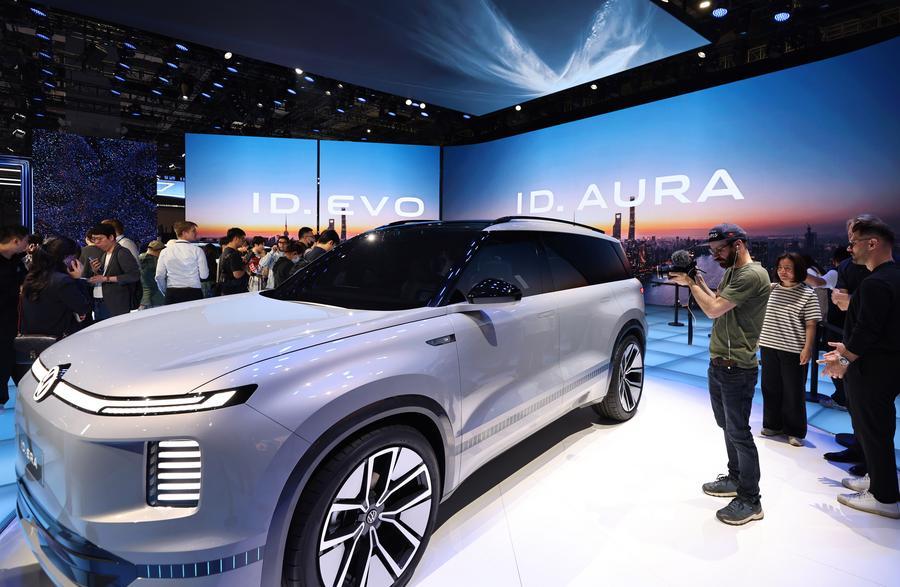
On April 8, Volkswagen unveiled three new models as part of its latest push in China, its largest single market. The German automaker plans to launch 13 NEV models in China this year, covering battery electric, plug-in hybrid and range-extended vehicles. By 2029, it expects to introduce more than 30 all-new NEV models in the country.
"This is the Volkswagen Group's largest-ever electric mobility offensive in China," said Ralf Brandstätter, chairman and CEO of Volkswagen Group China.
Much of that ambition is being driven by innovation partnerships in China. One of the three models unveiled in April was jointly developed with XPeng, while the other two came from Volkswagen's joint ventures with domestic automakers FAW and SAIC. Volkswagen and XPeng have also co-developed the China Electronic Architecture, with the first model based on the platform scheduled to hit the market later this year.
Such collaboration reflects a broader trend sweeping the industry.
Unlike decades ago, when foreign automakers mainly established joint ventures to manufacture cars for the Chinese market, today's cooperation runs much deeper. From integrating into China's digital ecosystem, to forming strategic alliances with local partners, multinational carmakers are increasingly embedding in China's innovation and supply chains.
Dongfeng Motor, headquartered in Wuhan, central China's Hubei Province, has maintained partnerships with Nissan and Honda for decades. Facing fierce competition brought by electrification, the Japanese brands have opted to deepen cooperation, tapping Dongfeng's strengths in NEV and intelligent connected vehicle technologies.
The old pattern of exchanging market access for technology has become history, said Yang Qing, chairman of Dongfeng Motor. "Chinese and foreign automakers are pooling their strengths and co-creating new value through shared innovation," he said.
The industry has moved from "Made in China" to "Created with China," analysts said.
Mercedes-Benz has established its most comprehensive R&D network outside Germany in China. Toyota has adopted a unique chief engineer system that grants Chinese engineers authority over product development. Renault has upgraded its China R&D center into a global technology-export hub.
"Joint research, technological collaboration and joint exploration of global markets are becoming the new mainstream of cooperation," said Yang Zhi, dean of the School of Management at Huazhong University of Science and Technology. "These trends will continue to reshape the global automotive industry."
DEFINING THE FUTURE
For multinational automakers, China has become a strategic hub that increasingly sets the pace for the global market.
Volkswagen Group CEO Oliver Blume said China plays a central role in the company's path toward becoming a global technology leader in the automotive industry. "The progress we achieve here strengthens our competitiveness worldwide."
Guan Mingyu, senior partner and leader of McKinsey's automotive practice in China, likens the Chinese market to a gymnasium for the global auto industry.
"China is not only the world's largest automotive market, but also a place where companies build muscle," he said. "Those that succeed in China will be better prepared for competition elsewhere. Those that fail to keep up here are likely to face pressure globally."
According to Yang Zhi, China's role has expanded far beyond that of a sales market and the country is now deeply involved in vehicle model definition, technology development and industry standard-setting.
Backed by its vast consumer base, complete industrial chains and rapidly evolving intelligent vehicle technologies, China is increasingly shaping the ideas, products and direction of the global automotive industry, Yang said.
(Reporting by Fang Dong, Tian Ye, Huang Zechen, Gong Liankang, Shao Meiqi, Wang Chenyang and Wang Haiyue; Video editors: Liu Ruoshi, Luo Hui and Zhang Ning).■