by Fayez Elzaki
KHARTOUM, June 20 (Xinhua) -- Reaching the Al-Karama displacement center south of Damazin in Sudan's Blue Nile State was far from easy.
After hours of rain, the dirt road had turned into a strip of mud across the open plains. The vehicle moved slowly through potholes and pools of water as signs of another downpour grew stronger with every kilometer.
At first sight, the camp appeared like a vast field of tents rising from wet earth. Residents moved carefully along mud-covered paths, while children played between shelters and women prepared evening meals. The smell of rain-soaked soil filled the air, a quiet reminder that life here is shaped not only by displacement but also by harsh seasonal conditions.
The shelter center is one of the largest in Blue Nile State. Established in early 2025 amid escalating clashes between the Sudanese Armed Forces and the Rapid Support Forces in the south of the state, it has since received thousands of families fleeing the fighting.
Today, it hosts about 9,000 displaced people living in roughly 1,500 to 1,800 tents spread across an open area. Each tent holds its own story. Some shelter single families, while others house two families sharing the same limited space.
Among the busy crowd, an elderly man sat quietly at the entrance of a modest shelter.
He was Suleiman Saleh, 73. The current civil war has forced him to relive an experience that he had long thought belonged to the past. Leaning on a wooden pole, he recalled fleeing to Ethiopia in the late 1980s during the war between government forces and the Sudan People's Liberation Movement.
"I got this card around 1988, when I was a refugee in Ethiopia," he said, holding a faded, yellowed refugee card from the Assosa camp in western Ethiopia. "At the time, I didn't know whether I would return to my country or spend the rest of my life there."
"I was in my mid-30s. I thought the hardest thing a person could face was being forced to leave their land," he continued. "But I later discovered that the hardest thing is fearing that your children and grandchildren will go through the same thing."
Saleh returned in 1991 and helped rebuild his village. His son Mohamed, now 35, said he never expected history to repeat itself.
"I never imagined I would be sitting with my father 40 years later in a new camp, talking about displacement again," he said.
When war erupted in Sudan in April 2023, conditions gradually worsened. "At first we tried to continue our normal lives," Mohamed said. "But roads became unsafe, prices rose, and services disappeared."
By October 2025, the family had left their home, farm, and belongings and traveled to the camp near Damazin. "We depended on farming and livestock, but now we struggle to secure income, food, and medicine," he murmured.
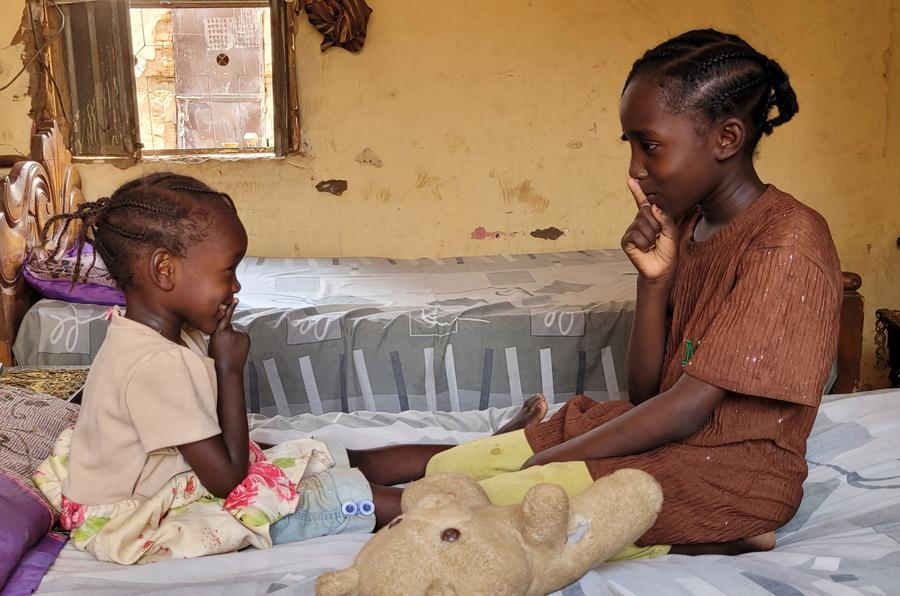
For Saleh's grandson Ali, around eight years old, daily life now revolves around survival. Carrying water along muddy paths, he said, "I go with my brothers to the water point more than once a day."
Asked what he misses most, the boy replied, "My school ... I used to love math and drawing. I dreamed of becoming a teacher or an engineer."
As evening fell, residents gathered for water or sat in small groups, exchanging news of the war and of relatives scattered elsewhere.
Fatima Abdul-Rahman, a Red Crescent volunteer in the camp, said, "The story of Suleiman Saleh's family summarizes the suffering of thousands of Sudanese families."
"Displacement is not limited to one generation," she said. "It is repeated within the same family across different times. It is as if the memory of displacement is being passed down from one generation to the next."
Further west in the camp, Aisha Idris, 58, has also lived through a similar cycle. She first fled to Ethiopia in her youth, returned, and rebuilt her life -- only to be displaced again by the current war. Her family is now scattered across cities and neighboring countries.
"I used to think the hardest part of exile was leaving home," she said. "But the hardest thing is watching your family scatter before your eyes, without knowing when you will meet again."
She said her greatest wish is for the war to end so she can return home. "I want nothing more than to see my family gathered again under one roof."
The stories of Suleiman Saleh and Aisha Idris reflect a broader tragedy Sudan has witnessed over decades, as successive generations have been affected by waves of displacement and refuge caused by armed conflicts.
According to the International Organization for Migration, Sudan had about 2.8 million internally displaced people before the war broke out in April 2023. The figure peaked at around 16 million displaced people and refugees in late 2024, including about 12 million inside the country and 4.3 million in neighboring states, making Sudan one of the world's largest displacement crises.
As night deepened, the camp faded into darkness, with scattered lights glowing between tents sheltering thousands of overlapping stories.
On our way back, I couldn't help but ask my colleagues: will this be the last chapter of displacement for these families, or will another generation one day inherit the same memory of departure?
Inside the car, silence settled in, broken only by the sound of the engine and the wheels cutting through the mud.
No one answered.■