BEIJING, May 27 (Xinhua) -- A Chinese-led international collaboration has unveiled Asia's first decade-long roadmap for building synthetic cells, a landmark blueprint that charts a systematic path toward creating artificial life from scratch.
Spearheaded by Liu Chenli, director of the Shenzhen Institute of Advanced Technology (SIAT) at the Chinese Academy of Sciences, the initiative brought together over 100 laboratories across six Asian countries: China, Japan, the Republic of Korea, Singapore, Malaysia and Thailand. The roadmap was published on Tuesday in the journal Nature Biotechnology.
This marks the first time Asia has produced a systematic development blueprint around the concept of an artificial single-cell life form, setting new scientific benchmarks for synthetic cell research over the next decade, China Media Group (CMG) reported on Wednesday.
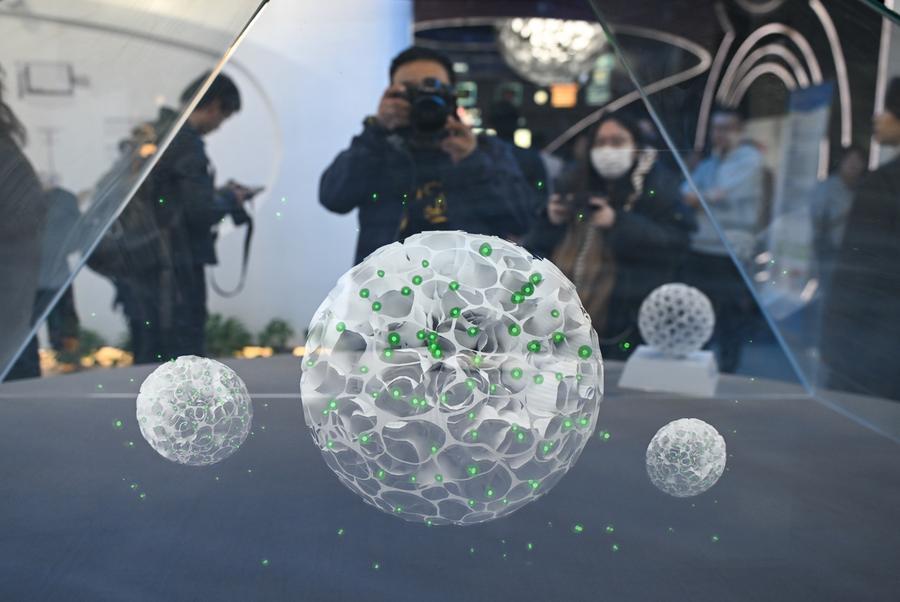
Synthetic cells are often described as "building a living cell from scratch." Unlike genetic modification, which tweaks existing organisms, this field assembles life from biological macromolecules, such as phospholipids, proteins, and DNA, to create a basic single-cell system that functions like a living organism, aiming to answer a fundamental question that has intrigued humanity for centuries: how life arises from non-living matter?
The blueprint sets forth a two-phase strategy for the next decade.
The first phase targets the creation of a "proto-cell" featuring a stable phospholipid vesicle structure, a minimal genome of no fewer than 200 genes, and over 90 percent of its proteins expressed through a cell-free transcription-translation system.
That means this proto-cell has a soap-bubble-like shell to separate the inside from the outside, a stripped-down instruction manual of only 200 essential genes, and an external helper that makes the most of its proteins. It is not yet a truly independent living cell, but rather a partial prototype that proves the basic framework can work.
The second phase aims to build an "auto-cell" capable of autonomous ribosome regeneration, meaning the cell can produce its own protein-making machinery internally, and complete more than 10 continuous, coordinated growth-division cycles. This transition would advance synthetic cells from mere operation to genuine self-replication, representing a giant leap forward in the field.
The roadmap identifies four core challenges for scientists: maintaining continuous metabolism, which the field calls "metabolic continuity"; ensuring the self-renewal of protein factories, known as "autonomous ribosome regeneration"; and solving issues related to modular design and complex timing coordination.
To tackle these obstacles, the blueprint proposes an AI-powered "biofoundry" operating under a "central factory plus distributed workstations" model. While a central platform at SIAT prepares standardized parts and chassis, research teams across Asia collaborate on design, synthesis and testing.
Over the past decades, Europe and the United States have made breakthroughs in individual functional modules of a synthetic cell, such as a membrane that forms a bubble, a set of genes that replicate, or a system that makes proteins. However, piecing those modules together into a fully functional, self-replicating cell remains an unresolved global bottleneck.
In 2023, Liu initiated a synthetic cell consortium in Asia to pool regional expertise. The release of the roadmap charts a clear course for the next decade of work in this field and will bolster international cooperation and shared benefits, according to the CMG report. ■