* China's biodiversity protection is presented as a policy-driven model that combines legal guarantees, national parks, species recovery and forest expansion, offering a systematic approach to addressing ecological challenges.
* China's role extends beyond domestic conservation, contributing to global biodiversity governance through COP15, the Kunming-Montreal framework, biodiversity funding and cooperation with developing countries.
BEIJING, May 22 (Xinhua) -- From the snow-covered Tibetan Plateau to tropical rainforests in southern China, biodiversity protection efforts are helping restore ecosystems in China and driving global cooperation in the area.
As the International Day for Biological Diversity falls on Friday, China's successful practice is increasingly viewed by international experts as a fine example of how environmental protection promotes development, governance and cross-border collaboration.
POLICY GUARANTEE
Addressing via video link the leaders' summit of the 15th meeting of the Conference of the Parties to the Convention on Biological Diversity (COP15) in 2021, Chinese President Xi Jinping stressed the need to respect Nature, follow Nature's laws and protect Nature so as to build a homeland of harmonious coexistence between man and Nature.
China has made remarkable achievements in biodiversity conservation. For instance, China has scaled up its national park system.
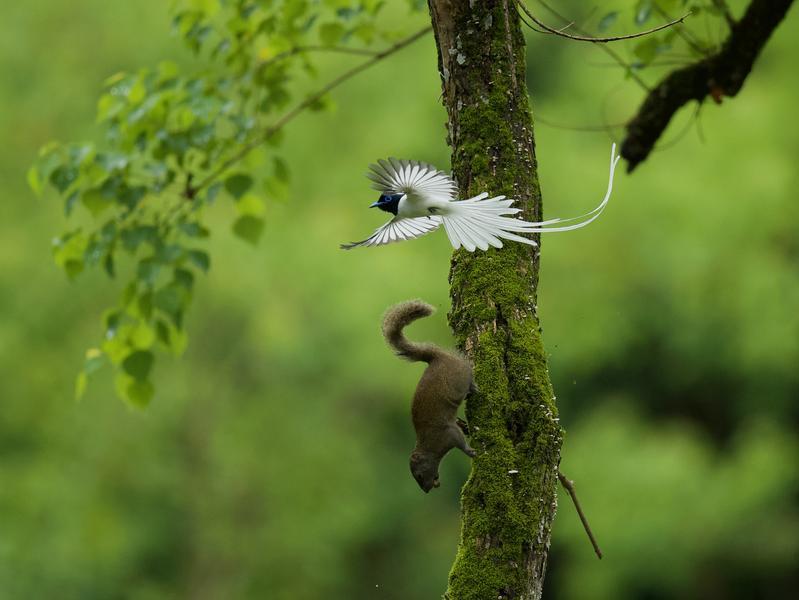
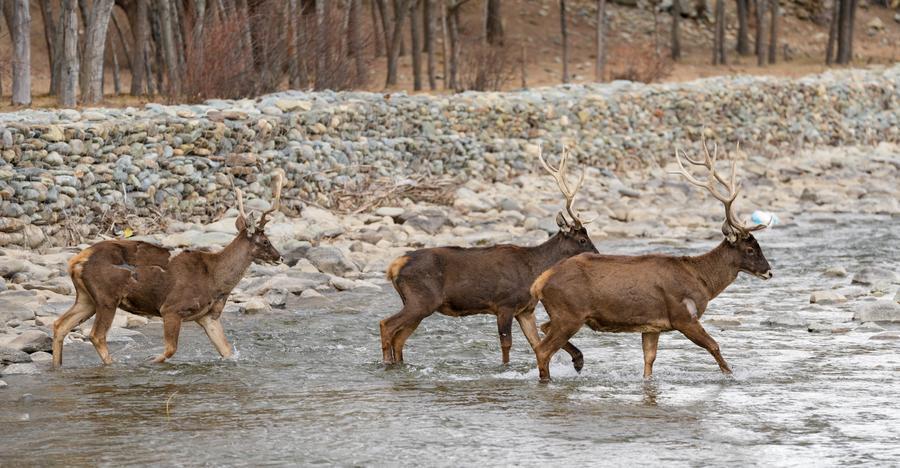
Official data show that populations of key endangered species, including giant pandas, snow leopards and the Yangtze finless porpoise, are gradually recovering. China also recorded the world's largest net increase in forest area between 2015 and 2025, according to the Food and Agriculture Organization of the United Nations.
Moreover, China has continued to expand its institutional framework for biodiversity protection, integrating conservation into national planning and strengthening legal and regulatory tools. Earlier this year, China adopted the landmark Ecological and Environmental Code, further strengthening the legal framework for ecological civilization.
Daniele Brombal, a researcher on environmental humanities at Ca' Foscari University of Venice, said in a written interview with Xinhua that one of the most notable features of the environmental code is its potential to address the "triple crisis" of climate change, pollution and biodiversity loss in a more integrated and systematic manner. He added that the code offers new opportunities for international dialogue and mutual learning.
GREEN DEVELOPMENT
Beyond ecological protection, China's biodiversity strategy is closely tied to economic development and local livelihoods.
In southwestern Sichuan Province's Wenchuan County, heavily damaged by a 2008 earthquake, Shuimo Town has transformed into a tourism-driven community where most residents now work in services linked to eco-tourism and cultural industries.
A group of international youths including scientific and technological workers from China, the Netherlands, Italy and Greece, and student representatives majoring in art from both China and abroad, visited Wenchuan in early May, highlighting the broader implications of such transformations.
Arnold Tukker, a professor at Leiden University in the Netherlands and a member of Academia Europaea, said that China, with green development and ecological protection as its foundation and science and technology as key enablers, has provided valuable experience for the integration of global sustainable development and technological innovation.
Echoing Tukker's view, many experts said China's broader ecological governance approach offers a wider reference for global sustainability.
Ndranto Razakamanarina, a researcher specializing in environmental studies at the University of Antananarivo in Madagascar, said the ecological civilization promoted in China for over a decade has become a global reference in environmental governance, noting that its systematic approach to optimize pollution control, ecological protection and green development offers lessons for other countries, especially biodiversity-rich African countries.
Jean Paul de Jorio, chief legal officer of the Italian National Biodiversity Future Center, said in line with ecological civilization principles, China has long realized that environmental protection, economic growth, social prosperity and human well-being are inextricably linked and should be promoted in a coordinated manner, and that protecting biodiversity is essential to achieving these goals.
GLOBAL CONTRIBUTION
China has also emerged as an active contributor to global biodiversity governance, particularly through cooperation with developing countries.
In Rwanda, Chinese and local scientists have worked together since 2023 to update biodiversity baselines and improve monitoring capacity, bridging long-standing data gaps that previously limited conservation planning.
Similar cooperation projects are underway across Africa, Southeast Asia and Central Asia, focusing on ecosystem restoration, forestry management, personnel training and scientific exchanges.
China hosted COP15 in 2021-2022, which culminated in the adoption of the Kunming-Montreal Global Biodiversity Framework, a milestone agreement aimed at halting and reversing biodiversity loss by 2030.
Doreen Robinson, deputy director for the ecosystems division at the United Nations Environment Programme (UNEP), said the framework represents "a significant milestone" and provides a "clear roadmap" toward the 2030 goals. She said China has contributed to strengthening biodiversity governance capacity in regions including Africa, Asia-Pacific, Central Asia and Eastern Europe via ecosystem restoration, financing and technical cooperation.
The Kunming Biodiversity Fund, launched in Beijing in 2024, is already supporting projects in dozens of countries, according to UNEP.
Bakhytzhan Khabibullaev, director of the International Innovation Center for the Aral Sea Basin, said China has made significant progress in biodiversity conservation, as reflected in the recovery of endangered species and improvements in their habitats, adding that China's role in global biodiversity governance is growing as the country takes on increasing responsibility in the field.
(Video reporters: Zhao Yuhe, Yu Xiaosu; video editors: Zhang Nan, Zhu Cong, Zhang Ning)■