"I have been studying Chinese painting for 20 years and teaching it for 12 years," Russian artist Anna Donchenko said. "The artistic conception conveyed by Chinese painting strikes a chord with people from all cultural backgrounds." Against the backdrop of in-depth people-to-people and cultural exchanges amid the China-Russia Years of Education, Donchenko hopes more people can discover the sheer joy hidden within traditional Chinese arts.
by Xinhua writers Geng Huihuang, He Yiran, Zhang Chaoqun
MOSCOW, May 20 (Xinhua) -- As dusk fell, a soft, warm glow gently permeated a painting studio at the China Cultural Center in Moscow. Holding a Chinese writing brush dipped in ink, Russian artist Anna Donchenko subtly adjusted tonal gradations before letting the brush glide across the paper.
With her brushwork shifting from delicate touches to bold strokes, distant sceneries gradually took shape, breathing life into mountains and rivers on China's traditional Xuan paper.
"I hope I can keep painting for the rest of my life, and inspire more people to take an interest in China," said Donchenko. "That would be the most meaningful thing to me."
For her, Chinese painting is far more than an artistic craft; it is an everlasting emotional and spiritual bond with China.
Donchenko began learning to paint as a child and was originally trained in realistic art. In her middle school years, a visit to the State Museum of Oriental Art in Moscow opened the door to the realm of Chinese painting. "I was instantly captivated," she said.
In her adolescence, the scarcity of Chinese painting supplies in Russia only strengthened her resolve. "I would linger repeatedly before museum display windows just to study the paintings closely," she said. "Back then, relevant exhibitions and learning resources were in extremely short supply."
Her maiden trip to China in 2007 marked a turning point in her life. The moment she set foot in China, she purchased calligraphy and painting books, brushes and mineral pigments, filled her suitcase with these items, and later brought them all back to Russia.
In 2014, she enrolled at the China Academy of Art in Hangzhou to pursue systematic academic training in Chinese painting. During her stay, she traveled extensively across China, immersing herself in local folk customs, natural landscapes and time-honored traditional culture. Over time, she gained a deeper insight into the philosophical wisdom and humanistic essence embedded in traditional Chinese fine arts.
"What moves me most about Chinese painting is its focus on sentiment, rhythmic charm and the subtle spiritual resonance between humanity and nature," she noted, adding that Chinese ink painting prioritizes creative imagination, blank space aesthetics and the sincere expression of artists' inner feelings, rather than rigidly pursuing lifelike likeness.
Now known to the public by her Chinese name Dong Qingguo, Donchenko works as a researcher at the Center for Chinese Culture Studies under the Institute of China and Contemporary Asia, Russian Academy of Sciences.
"Dong stands for winter, a reminder of the long cold winters in my homeland Russia. Qing embodies youth and vitality, while Guo carries my sincere blessings for my motherland," she explained with a warm smile.
In her view, practicing ink wash painting has also reshaped her cognition of self and the world. "The philosophy of harmony between man and nature embodied in Chinese painting is not merely an artistic creation technique, but also a way to perceive and embrace life," Donchenko said.
"I have been studying Chinese painting for 20 years and teaching it for 12 years," she said. "The artistic conception conveyed by Chinese painting strikes a chord with people from all cultural backgrounds."
In her artistic creations, she depicts Russia's white stone castles, wooden cottages and onion-domed church domes via fluid Chinese ink painting techniques, perfectly integrating Eastern aesthetic charm with distinctive Russian pastoral scenery.
Over the years, she has also observed a growing enthusiasm among Russians for Chinese ink painting.
The China Cultural Center hosts Chinese painting classes three evenings a week. In class, students learn to sketch plum blossoms, paint natural landscapes and create persimmon tree paintings that symbolize good fortune.
Under Donchenko's patient guidance, Anastasia Smirnova, one of her students, captured two hedgehogs carrying apples on their backs with just a few vivid brushstrokes. "Chinese painting can convey emotions in such an intuitive way," Smirnova said. "Learning this art has offered me a brand-new perspective to observe the world."
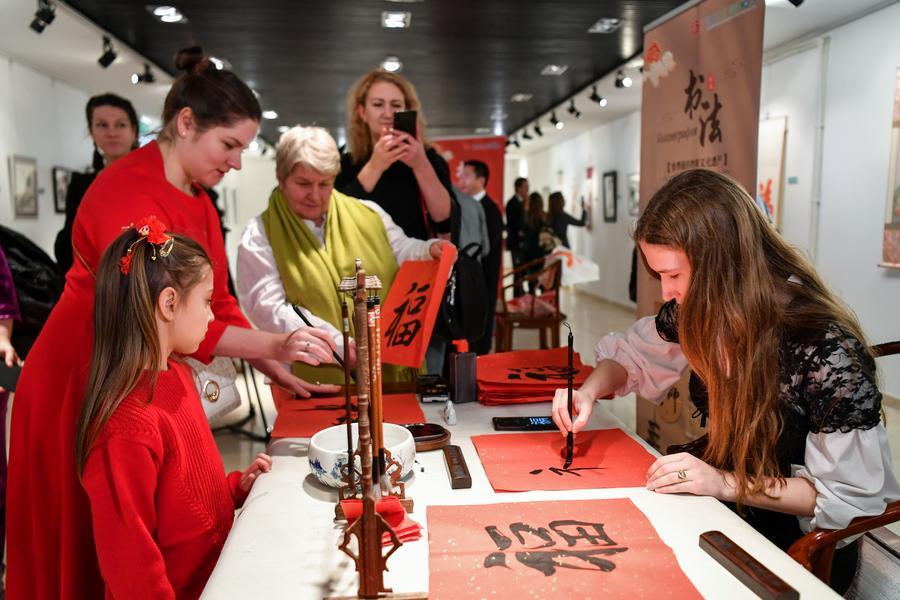
Beyond classroom teaching, Donchenko has spared no effort to popularize Chinese painting across Russia by holding exhibitions in museums, public libraries and local communities. Over the past two decades, she has participated in or curated more than 30 art exhibitions in China and Russia.
This April, she hosted a Chinese painting exhibition paired with on-site painting demonstrations at Moscow No.69 Library, drawing hundreds of visitors on its opening day alone.
Yulia Zharkova, director of the Moscow No.69 Library, said these paintings bring audiences inner peace and tranquil contemplation.
"Standing in front of these artworks, people feel all worldly worries drift away," she said. "This is the unique artistic charm and profound artistic conception of Chinese painting. We are deeply honored that Ms. Donchenko chose our library to hold this exhibition, which has greatly enlivened our cultural venue."
Against the backdrop of in-depth people-to-people and cultural exchanges amid the China-Russia Years of Education, Donchenko hopes more people can discover the sheer joy hidden within traditional Chinese arts.
"Art teaching is far more than imparting professional skills," Donchenko said. "It is about passing down the passion you truly cherish. I wish more people could embrace joy and perceive beauty through learning Chinese painting, just as I once did."■