
* China plays an irreplaceable role in global migratory bird conservation. And as the country doubles down on biodiversity and green ecosystems, migratory bird protection initiatives have been rolled out across the country.
* According to China's National Forestry and Grassland Administration, the country's total wetland area now ranks first in Asia and fourth globally. It is home to 22 accredited international wetland cities, the highest number worldwide. Additionally, 903 national wetland parks have been established, with approximately 90 percent offering free admission to the public, attracting around 320 million visitors each year.
* During the 15th Five-Year Plan period (2026-2030), China will further improve its legal and regulatory framework regarding wetlands, and strengthen monitoring and early warning systems for wetland protection. These efforts will help provide more and safer rest stops for migratory birds.
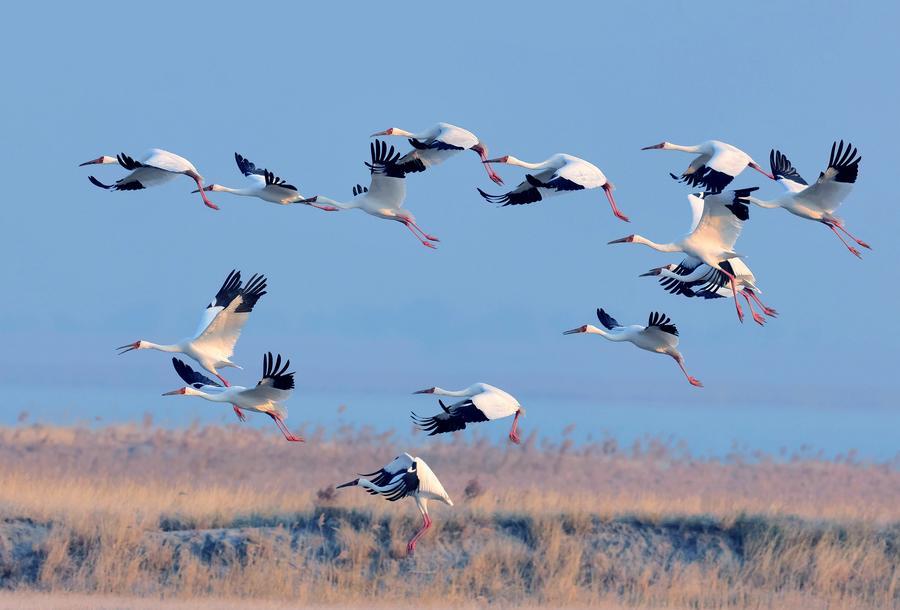
BEIJING, May 9 (Xinhua) -- Every May, Zhao Guoqing and his team play an unusual role as matchmakers in a wind-scoured wetland in northern China for the oriental white stork, which is listed by the International Union for Conservation of Nature as an endangered species.
Zhao's team is now keeping a close eye on 23 artificial nests, each perched atop a 15-meter-tall steel pole. These man-made towers rise from the Tumuji National Nature Reserve, a critical stopover along the East Asian-Australasian Flyway, the stork's long-distance migratory route.
Last year, the experiment paid off. "Of the 23 artificial nests we installed, 20 attracted stork pairs that successfully mated and hatched 40 healthy chicks," said Zhao, deputy director of the reserve's administrative bureau.
Sprawling across 76,000 hectares, Tumuji sits at the junction of Inner Mongolia Autonomous Region and Heilongjiang and Jilin provinces. Serving as a key ecological barrier, this rare mix of grassland and wetlands plays a crucial role in northern China's environmental protection.
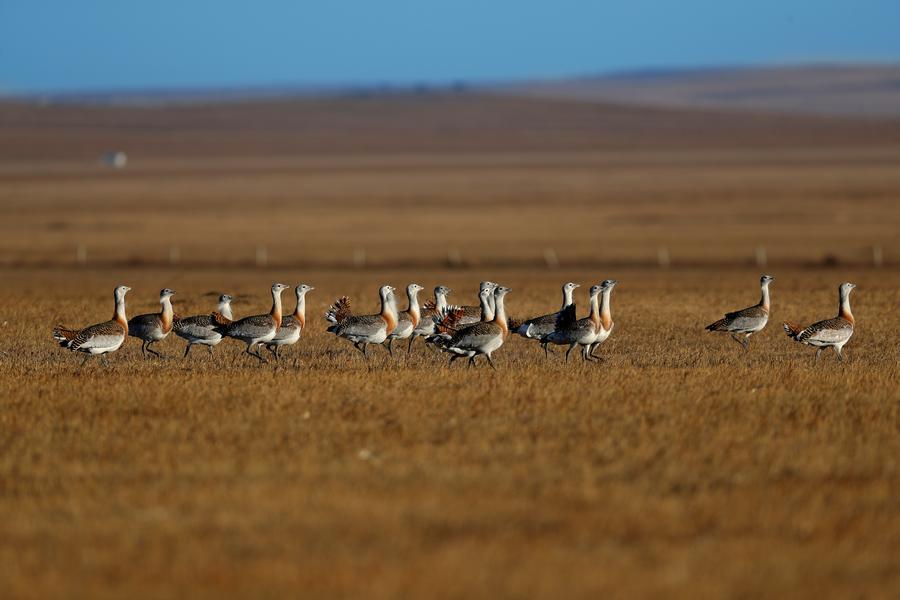
Out of an estimated global population of about 9,000, more than 2,000 wild oriental white storks flock to Tumuji every year. That has earned the reserve a reputation as one of the bird's most vital breeding strongholds.
May is crunch time for nesting and incubation. "So far, we've seen 16 artificial nests occupied by successfully paired storks, though no chicks have hatched yet," Zhao said.
He explained that oriental white storks are picky about where they nest, favoring quiet, elevated tree canopy habitats. But Tumuji is mostly open grassland and wetlands where tall trees are scarce, so the birds simply wouldn't breed there in large numbers without human intervention.
To address this, the reserve staff got creative. They spent years scouting optimal sites and erecting steel poles that can withstand harsh weather conditions. On top of each pole sits a spacious nest, an exact replica of a natural stork nest.
With Saturday marking World Migratory Bird Day, it is a fitting moment to note China's broader push to protect ecosystems to better protect the migratory species that depend on them, said Zhao.
He said these achievements were hard-won. "Drought kept shrinking our water supply, which led to grassland degradation and wetland loss," Zhao recalled. "That put the storks' survival at risk."
In response, local authorities launched a series of water-diversion projects. Over the past five years, 120 million cubic meters of water have been channeled into the Tumuji area, helping boost the grassland's vegetation coverage from 71 percent to 75 percent.
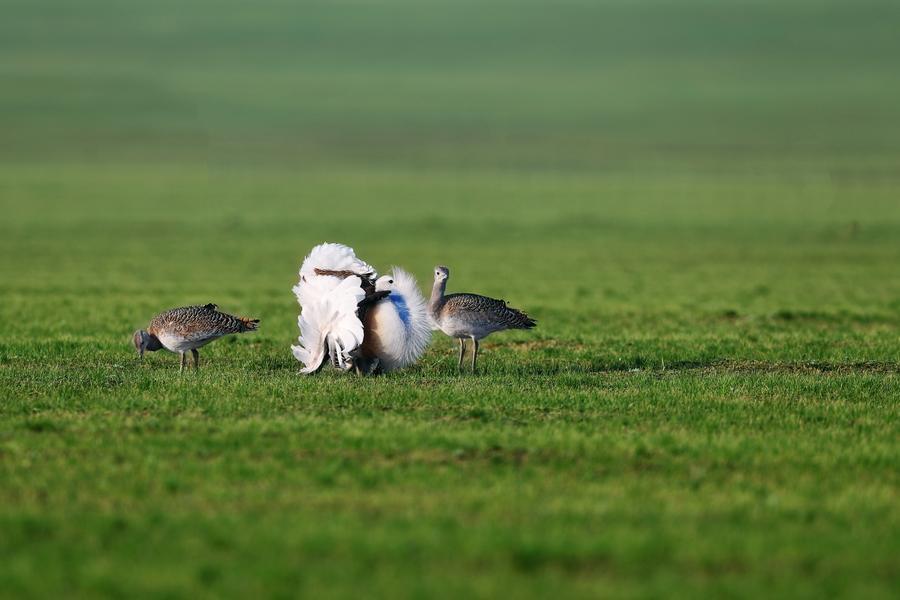
Since 2012, the reserve has also brought in a series of scientific measures that extend beyond building nests. Researchers have attached satellite transmitters to 50 oriental white storks to track their migration, providing data that helps guide international efforts to protect migratory corridors and improve wetlands along the flyway.
China plays an irreplaceable role in global migratory bird conservation. And as the country doubles down on biodiversity and green ecosystems, migratory bird protection initiatives have been rolled out across the country.
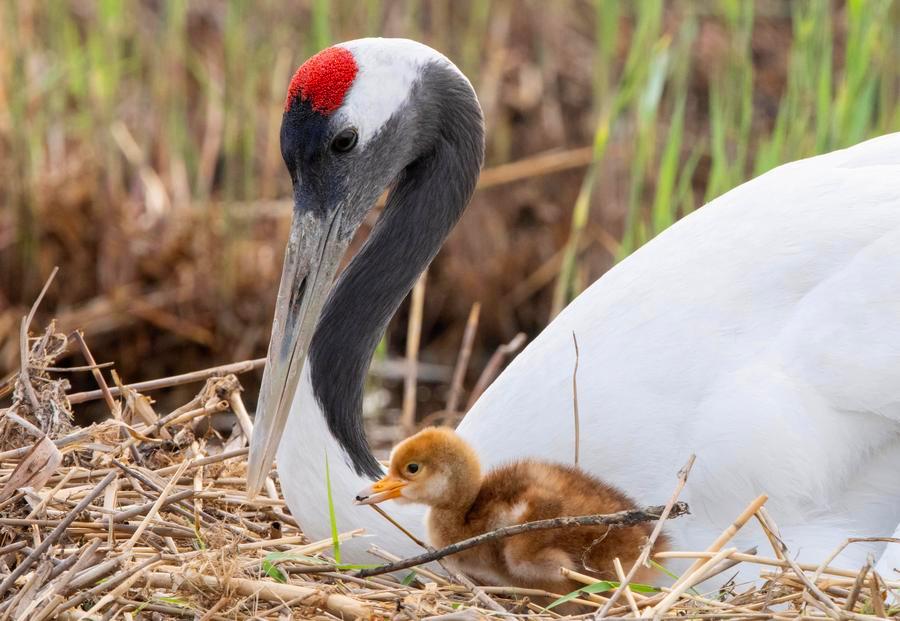
In northeastern China's Heilongjiang Province lies Zhalong, a vast, soggy sprawl of 210,000 hectares. It is one of the last great breeding grounds for the red-crowned crane, an elegant, endangered bird that numbers barely 3,000 in the wild.
Protecting the species here is a tall task, given Heilongjiang's long and bitter winters and the cranes' highly vigilant nature.
The Zhalong National Nature Reserve has turned to digital support to address the challenges. A real-time surveillance system now blankets the vast wetland, with satellite monitoring overhead, drones at low altitude, video towers, ground sensors and thermal detectors scattered through the reeds. Whenever an illegal heat source is detected, either from a campfire or a poacher's stove, alarms trigger instantly at the monitoring center and a dozen screens light up.

"The system has reduced human disturbance to the major rare bird habitats," said Zhang Jianfei, director of the reserve's management center.
Meanwhile, Zhalong also welcomes tourists. It was approved as China's first official bird-watching site back in 1981, and it has since grown into a well-known ecotourism destination featuring comprehensive wetland tour routes, museum exhibitions and educational programs. In December 2024, it earned a "5A" rating, the highest in China's tourism evaluation system.
"The key lies in scientific guidance, standardized management and public awareness," explained Tian Jialong, a researcher at the Heilongjiang Wildlife Research Institute. "More bird lovers mean more responsible birdwatchers." Last year, 1.1 million visitors flocked to the reserve, generating 64.8 million yuan (roughly 9.5 million U.S. dollars) in tourism revenue and filling every guesthouse in peak season.
Since 1984, the reserve has hatched and raised more than 1,000 red-crowned cranes in captivity. Over 380 of them have since been released into the wild, supplementing the wild population of the rare species. Today, about 300 captive-bred cranes remain at Zhalong, allowing visitors to observe them without entering core areas and disturbing the wild birds.
According to China's National Forestry and Grassland Administration, the country's total wetland area now ranks first in Asia and fourth globally. It is home to 22 accredited international wetland cities, the highest number worldwide. Additionally, 903 national wetland parks have been established, with approximately 90 percent offering free admission to the public, attracting around 320 million visitors each year.
During the 15th Five-Year Plan period (2026-2030), China will further improve its legal and regulatory framework regarding wetlands, and strengthen monitoring and early warning systems for wetland protection. These efforts will help provide more and safer rest stops for migratory birds. (Video reporters: Bei He, He Shan, Zhang Qiming, Ha Lina; Video editors: Liu Ruoshi, Roger Lott, Zhang Mocheng and Hong Liang)■