CHENGDU, April 24 (Xinhua) -- The China National Space Administration (CNSA) on Friday announced the results of its international collaboration selection for Tianwen-3, China's first Mars sample-return mission.
Following a call for cooperation proposals in April 2025, in which the CNSA announced it would open up 20 kilograms of payload resources for international collaboration, the agency received 28 applications.
Five projects were subsequently selected based on the criteria of high scientific value, effective mission support, solid engineering feasibility and high technological maturity, the CNSA said during the opening ceremony of the 11th Space Day of China held in Chengdu, capital of southwest China's Sichuan Province.
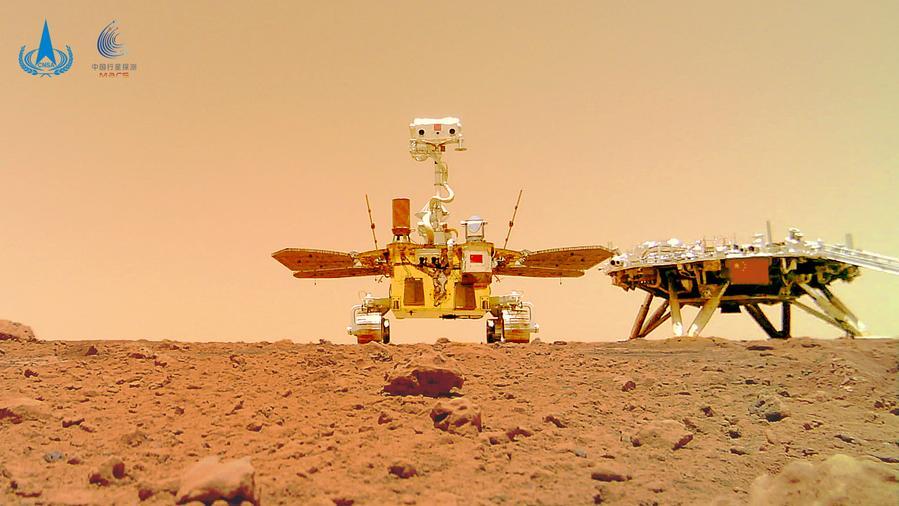
The Tianwen-3 mission, part of China's planetary exploration program, is planned for launch around 2028. It aims to bring Martian samples back to Earth around 2031. The Tianwen-3 spacecraft comprises a lander, an ascent vehicle, a service module, an orbiter and a return module.
According to the CNSA, three scientific instruments will be carried on the orbiter. The first is a Mars PEX Spectrometer developed by a team from the Committee on Space Research Panel on Exploration. It will search for signs of life and study surface minerals. The second is a Mars Molecular Ion Composition Analyzer led by Macau University of Science and Technology, designed to study the atmospheric escape process of Mars. The third is a Laser Heterodyne Spectrometer led by the Chinese University of Hong Kong, which will measure the profile distribution of water isotopes and wind fields in the Martian atmosphere.
The mission's service module will carry a Mars Terrestrial Hyperspectral Imaging Spectrometer developed by the University of Hong Kong. This instrument will look for signs of life, water-containing minerals and help map Mars' surface resources.
The lander will carry a Tianwen Laser Retroreflector Array-3 led by the National Laboratory of Frascati under the National Institute for Nuclear Physics of Italy. This device will create precise reference points on the Martian surface.
The CNSA said it will continue to work with international partners to advance collaboration on the Tianwen-3 mission, jointly explore the mysteries of deep space, and expand the frontiers of human knowledge.
All five international cooperation projects for Tianwen-3 are progressing smoothly, said Guan Feng, director of the Lunar Exploration and Space Engineering Center of the CNSA. He added that the Tianwen-3 mission has now entered the prototype development phase.
The Tianwen-2 mission, launched last year, will arrive at its first target asteroid, 2016HO3, this year. The probe will fly around the asteroid, collect samples and then bring them back to Earth at an opportune time, Guan said.
He also noted that China will subsequently carry out the Tianwen-4 mission to explore the Jovian system.
"We will organize leading Chinese experts and teams to demonstrate and develop the second phase of the planetary exploration program, a near-Earth asteroid defense project and a mission to explore the edge of the solar system," Guan revealed.
In addition, China's Chang'e-7 lunar probe is planned for launch in the second half of 2026. It will head to the lunar south pole to explore water ice and investigate the environment. No human probe has ever reached the lunar south pole, presenting a new challenge, Guan said.
"In the field of launch vehicles, we are developing a heavy-lift rocket that will significantly enhance China's capacity to access space and enable Chinese spacecraft to reach even farther into deep space," Guan added. ■