
The institute is among at least 10 hospitals in Poland that have introduced Chinese surgical robots in recent years, according to Pawel Rusinek, business development director at Meden-Inmed.
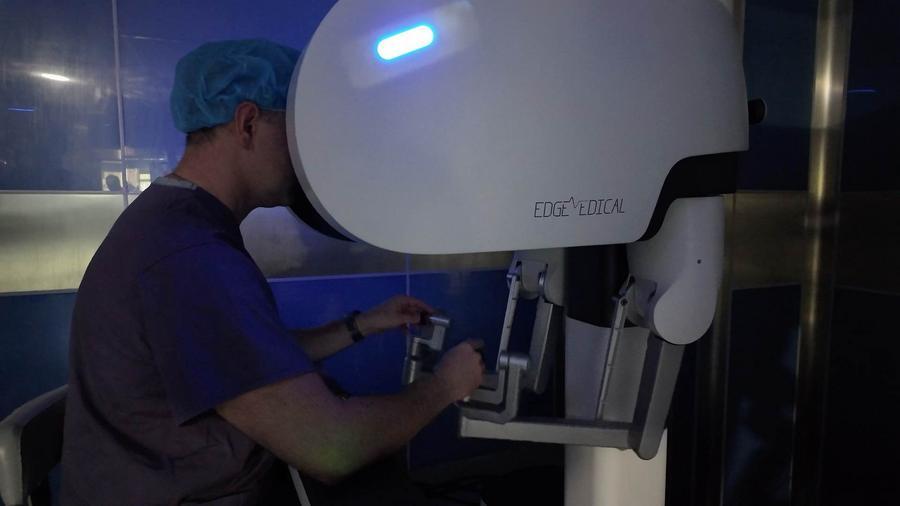
WARSAW, April 16 (Xinhua) -- In an operating room at a leading medical institute in Warsaw, Poland, a Chinese-made surgical robot moves with quiet precision under the control of urologist Pawel Wisz.
The system, developed by Chinese surgical robotics company Edge Medical, was introduced at the National Medical Institute of the Ministry of Interior and Administration in 2025. It has since joined the hospital's daily surgical practice.
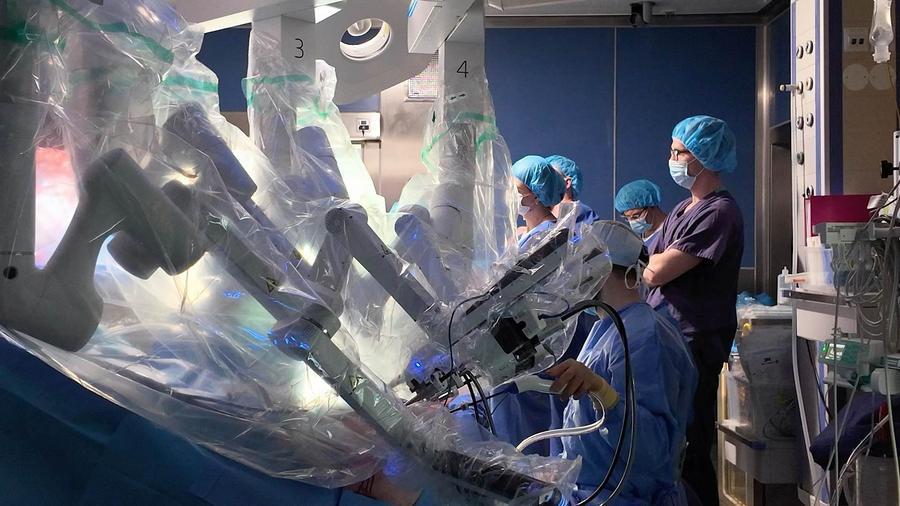
With a 3D view magnified up to 10 times, it allows surgeons to operate as if they were inside the patient's body, Magdalena Augustyn, a senior clinical robotics manager at Polish medical device distributor Meden-Inmed, explained to Xinhua.
While routinely used in the operating room, the robot has also made it possible for the team to carry out remote procedures.
Just a month earlier, Wisz operated from a remote surgery control center in China's southwest city of Chengdu, nearly 7,000 kms away, controlling the robot back in Warsaw.
As part of an international surgical robotics conference hosted by the West China Hospital of Sichuan University, Wisz and his team carried out two cross-border operations at a remote surgery center: one heart procedure and one on the urinary system.
"It was a fantastic experience, and we had strong technical support throughout," institute director Piotr Suwalski told Xinhua.
"The requirement for signal reliability is extremely high," Wisz noted. During the cross-border procedures, network latency was kept to just 30 milliseconds.
"For comparison, a human blink takes about 15 milliseconds," he said. "In practice, you don't feel the delay. It feels like a normal local operation."
The strong performance of China's remote robotic surgery technology has strengthened the Polish team's confidence in its reliability. Wisz noted that the technology is already well established in clinical practice in China, while Europe is still at an early stage of adoption.
The institute is among at least 10 hospitals in Poland that have introduced Chinese surgical robots in recent years, according to Pawel Rusinek, business development director at Meden-Inmed.
"The quality of Chinese products has improved significantly, and they are now able to compete with leading global brands," he told Xinhua, adding that orders have also come in from other Eastern European countries, including Romania and the Czech Republic.
Rusinek noted that flexibility is another key reason the distributor chose to work with Chinese suppliers. "When we suggest changes, whether technical or related to the business model, the response is quick. They listen and adapt more easily than European or American companies," he added.
"Having the equipment is one thing. Training doctors to use it is even more important," Suwalski said, pointing to China's structured training systems. He added that the institute plans to establish its own robotic surgery training center by the end of the year for doctors in Poland and across Europe.
Suwalski also said the institute is preparing to receive its second Chinese-made robot, a single-port system designed to operate through a single incision, which could reduce trauma and speed up patient recovery.

"This would be a unique installation in Eastern Europe," Suwalski said. He is expected to lead a delegation to South China's Shenzhen for training on the new system.
"It's a very interesting technology, and I'm sure it will develop quickly," he said. "We are excited to see it." ■