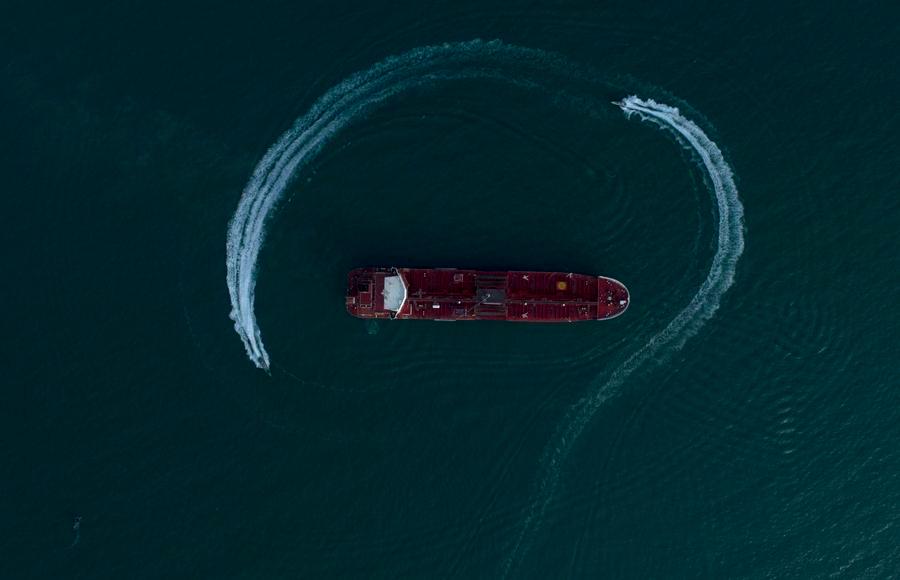
After the U.S. announcement of the blockade of the Strait of Hormuz, oil prices rose in early market trading on Sunday. Brent crude, the global oil benchmark, rose 7 percent to 102.29 U.S. dollars a barrel.
BEIJING, April 13 (Xinhua) -- U.S. President Donald Trump announced on Sunday that the U.S. Navy would begin blocking ships trying to enter or leave the Strait of Hormuz, after peace talks with Iran failed to produce a deal, jeopardizing a tenuous two-week ceasefire reached on Tuesday.
Why is Trump threatening to close off the global energy chokepoint that he has repeatedly demanded Iran reopen with no limitations or delays? And what is the impact of the potential blockade?
WHAT HAPPENED?
After marathon talks with Iran failed to reach a deal, Trump said in a post on Truth Social that the U.S. Navy would "immediately" begin a blockade of ships entering or leaving the Strait of Hormuz.
"I have also instructed our Navy to seek and interdict every vessel in International Waters that has paid a toll to Iran," Trump continued, adding that "no one who pays an illegal toll will have safe passage on the high seas."
U.S. Central Command said in a statement later on Sunday that U.S. forces will begin implementing a blockade of "all maritime traffic entering and exiting Iranian ports" on Monday at 10 a.m. Eastern Time (1400 GMT).
In accordance with Trump's proclamation, the blockade will be enforced "impartially" against vessels of all nations entering or departing Iranian ports and coastal areas, including "all Iranian ports on the Arabian Gulf and Gulf of Oman," according to the statement.
It added that the U.S. forces "will not impede freedom of navigation for vessels transiting the Strait of Hormuz to and from non-Iranian ports."
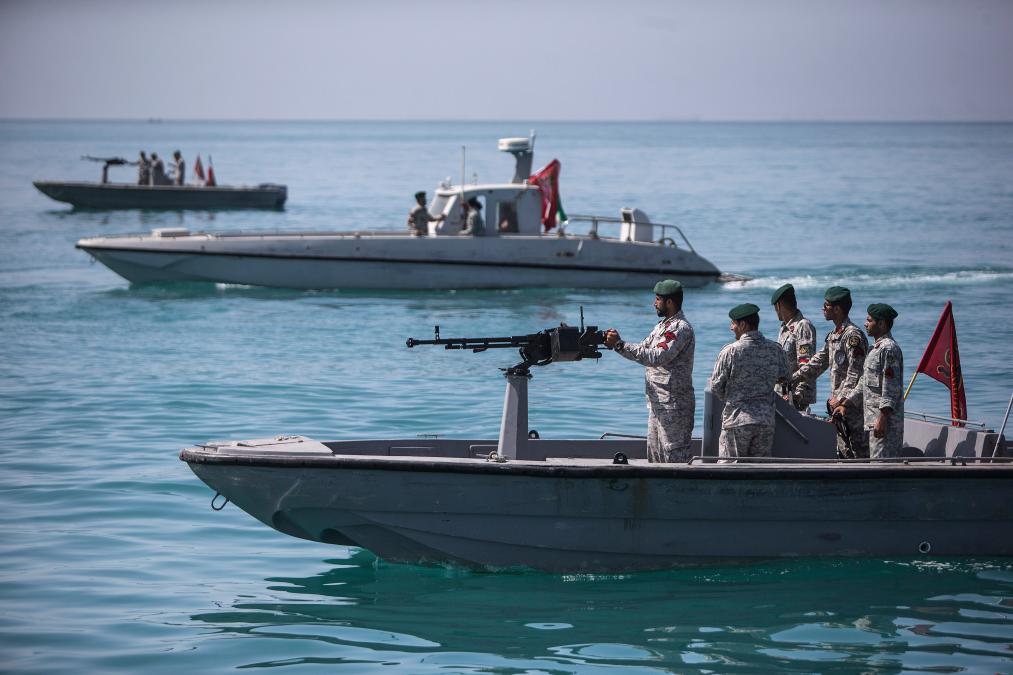
In response to Trump's statement regarding the naval blockade of the Strait of Hormuz, Iran's Islamic Revolutionary Guard Corps warned Sunday that any warships approaching the strait to enforce a blockade would be considered a ceasefire breach and would be dealt with harshly and decisively.
WHY A BLOCKADE?
Trump's remarks came a few hours after U.S.-Iran talks in Islamabad, Pakistan, concluded without an agreement on Sunday. The two sides confirmed that they reached an understanding on several issues, but their views diverged on major sticking points.
Citing a U.S. official familiar with the issue, The Washington Post reported that the two sides failed to reach agreement on several U.S. demands, including that Iran end all uranium enrichment and allow the United States to retrieve its highly enriched uranium, dismantle all major nuclear enrichment facilities, and fully reopen the Strait of Hormuz without charging transit fees.
By closing off the Strait of Hormuz, which typically carries more than 20 percent of globally traded energy, Trump could strip Iran of critical leverage in negotiations and stop Iran from selling oil to its customers.
If Trump's strategy works, it may force Tehran to make concessions by cutting off a key source of funding for its government and military operations, analysts said.
In addition to the U.S. blockade of the strait, Trump also floated on Sunday the possibility of resuming U.S. strikes in Iran "as a way to break a stalemate in peace talks," according to the Wall Street Journal.
WHAT IMPACT?
Analysts said the blockade could deepen the global energy supply shock by driving up oil and gas prices, while risking a renewed outbreak of hostilities that could derail the fragile two-week ceasefire.
While the blockade might be effective as a long-term strategy to impose pain on the Iranian economy, the move may come as a blow to the rest of the world as well, warned Jim Krane, energy research fellow at Rice University.
"If the deficit to the oil market takes another jump, it is going to impose pain on every person on Earth that's subject to market oil prices," he told The Associated Press.
After the U.S. announcement, oil prices rose in early market trading on Sunday. Brent crude, the global oil benchmark, rose 7 percent to 102.29 U.S. dollars a barrel.
Trump said on Sunday that the price of oil and gasoline may stay elevated through the U.S. midterm elections in November, a rare acknowledgment of the potential fallout.
Washington's signals of potential military actions, including interdiction and possible blockade measures in the Strait of Hormuz, are adding to instability in the shipping environment, Windward, a London-headquartered maritime analytics firm, said on Sunday.
The firm described the Strait of Hormuz as a "controlled and unstable" system, where the risk of direct confrontation between state actors is growing.■