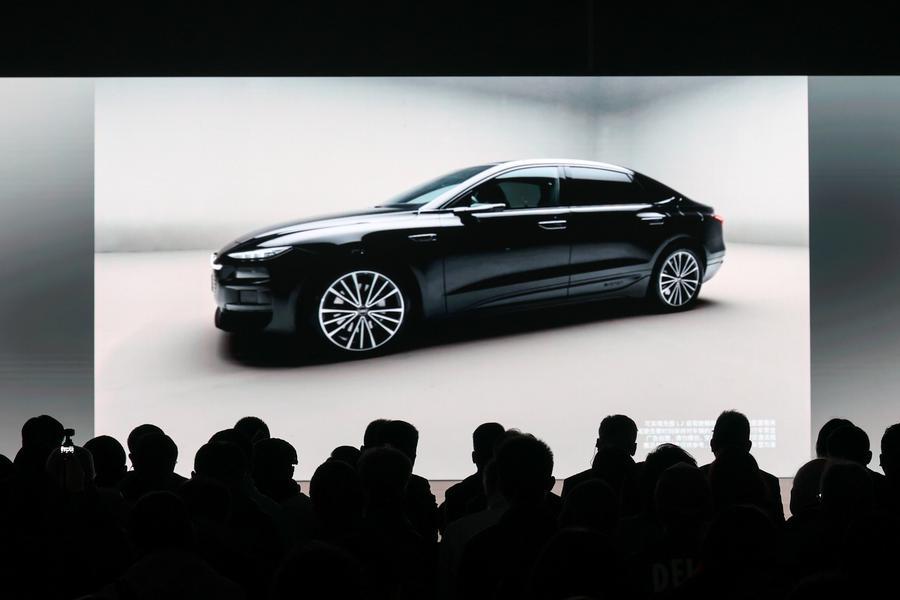
CHANGCHUN, April 11 (Xinhua) -- German carmaker Audi on Friday launched A6L e-tron, a luxury pure electric sedan, for the Chinese market, as it steps up its electrification push in the world's largest auto market with booming sales of new energy vehicles (NEVs).
The model is produced by Audi FAW NEV Company in Changchun, capital of northeast China's Jilin Province. The company, built with an investment of over 30 billion yuan (about 4.4 billion U.S. dollars), is Audi's first production base in China dedicated exclusively to fully electric vehicles.
The Audi A6L e-tron is equipped with Huawei's Qiankun smart driving system. It boasts a CLTC range of up to 815 kilometers and can accelerate from 0 to 100 km/h in just 4.3 seconds.
The A6L e-tron is the second model produced at the plant following the Q6L e-tron. The joint venture between Audi and Chinese manufacturer FAW also launched the new Q6L e-tron version on the same day.
The launch underscores Audi's efforts to bolster its competitiveness in China's fast-growing electric vehicle segment, where domestic brands have intensified competition with advanced software and longer driving ranges.
Audi FAW is implementing the strategy to develop traditional fuel-powered, electric and hybrid vehicles in parallel, while also expanding intelligent driving capabilities.
Audi's move reflects a broader trend among foreign automakers intensifying their electrification efforts to win back market shares from Chinese manufacturers, as NEV penetration continues to rise rapidly. Chinese carmakers are offering more choices of intelligent NEVs, gaining more market shares.
Data from the China Association of Automobile Manufacturers (CAAM) show that NEVs accounted for more than half of new car sales in China in 2025. Chinese brands grabbed 69.5 percent of the passenger car market, up 4.3 percentage points from 2024.
China has been the world's largest NEV market for 11 consecutive years, a dominance that helps explain why global carmakers are recalibrating their strategies in the market.
In 2025, NEV production and sales reached 16.63 million and 16.49 million units, respectively, up 29 percent and 28.2 percent year on year, according to the CAAM.
Against this backdrop, the launch of electrified models such as the Audi A6L e-tron is less an isolated milestone than part of a broader strategic pivot.
Volkswagen Group, parent company of Audi and one of the world's largest carmakers with an annual output of nearly 9 million vehicles, is expanding its NEV lineup in China to deepen its foothold in the world's largest and arguably most competitive auto market.
"In 2026, we will launch a new vehicle on average every two weeks. This is the Volkswagen Group's largest-ever electric mobility offensive in China," said Ralf Brandstätter, Volkswagen Group Board Member for China.
Industry observers view the electrification of established nameplates such as the A6L as one element of this push.
Another major step was unveiled in Beijing on Wednesday, when Volkswagen introduced three new NEV models, ID. UNYX 08, ID. ERA 9X and ID. AURA T6. Together, they signal not just product expansion but the German carmaker's transformed strategy and strong confidence in the Chinese market.
To deepen its presence in the Chinese market, Volkswagen has forged partnerships with local players, including EV maker XPeng. ID. UNYX 08 is the first vehicle model jointly developed by Volkswagen and XPeng.
The cars were developed in China for China, with German engineering and Chinese cutting-edge technology, said Oliver Blume, chief executive officer of Volkswagen Group. "The Volkswagen Group is making good progress on its path to becoming a global tech driver in the automotive industry. China plays a central role in this. Because the progress we achieve here strengthens our competitiveness worldwide."
According to Thomas Schäfer, CEO of the Volkswagen brand, China is Volkswagen's largest single market and a bellwether for global automotive trends, and occupies a central place in the company's strategy. By 2029, the Volkswagen brand plans to launch more than 30 NEV models in the country.
Other global carmakers are also stepping up their electrification strategies. Toyota has established an R&D company in China for Lexus purely electric vehicles, while Nissan has pledged to invest an additional 10 billion yuan into NEV development and made its Chinese team mainly responsible for the NEV development. ■