BEIJING, March 31 (Xinhua) -- As spring sweeps across China, the ancient rhythm of manual ploughing is being replaced by the whir of automated machinery and the invisible guidance of satellites.
This transformation is redefining the season itself, as smart agriculture takes root in an increasing number of fields, steering the nation's grain production toward a high-tech future.
In the city of Bayannur, north China's Inner Mongolia Autonomous Region, modern seeders glide steadily on leveled fields. Guided by the BeiDou Navigation Satellite System, these machines plant plump spring wheat seeds with centimeter-level precision, creating arrow-straight rows that promise a uniform harvest.
By leveraging satellite positioning and intelligent control, operators simply input plot data and preset routes. Tractors then autonomously complete sowing tasks, drastically reducing the margin of error compared with human alternatives.
According to regional statistics, the planting area utilizing BeiDou technology in Bayannur alone had exceeded 3.7 million mu (about 246,667 hectares) in 2025.
AUTOMATION FROM SOWING TO TRANSPORT
From the black soil of northern and northeastern China to the rice paddies of the south, digital intelligence is permeating every stage of agricultural farming throughout the country.
Inside a modern seedling nursery in Xiushan Town in the city of Yiyang, central China's Hunan Province, rows of emerald-green rice shoots stretch across precision cultivation beds like a vast expanse of green velvet.
Here, a sleek, silver-gray autonomous transport vehicle glides along a path connecting the fields to a road. It comes to a precise halt at the designated entrance, where its platform gently lowers. A tray loaded with over a hundred seedling trays rolls out, docking perfectly with the receiving racks inside the greenhouse.
Equipped with advanced path-planning and climate control systems, this unmanned vehicle solves perennial challenges in local spring farming, such as labor shortages and seedling damage during transit. It transports not only seedlings but also fertilizers and other essential supplies.
"This introduction of a driverless vehicle aims to unlock the full potential of smart agriculture," said Gao Gui, general manager of a local agricultural company. "We are building a fully intelligent, closed-loop system that manages the entire process from seed to silo."
This technological surge aligns with China's top-level planning. The 15th Five-Year Plan (2026-2030) explicitly calls for enhancing agricultural efficiency through a combination of high-quality land, superior seeds, advanced machinery and effective methods. This vision is now translating into tangible productivity gains in China's fields.
SYNERGIZING TECH FOR TANGIBLE BENEFITS
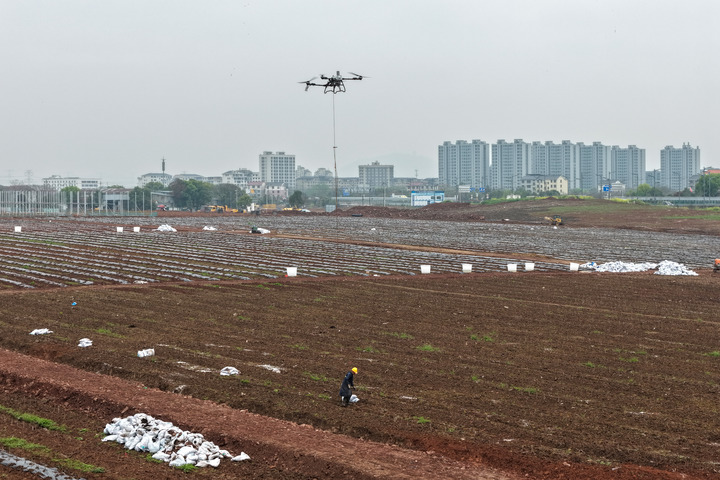
In Qingdao, east China's Shandong Province, over 16,000 units of smart agricultural machinery are working in multiple farmlands. Plant protection drones carry out low-altitude pesticide spraying, while integrated water-fertilizer systems deliver nutrients with pinpoint accuracy. Smart farming machines are interconnected with on-site weather stations and pest and disease monitoring equipment, boosting production efficiency by more than 15 percent compared with traditional farming methods.
Beyond such localized applications in Qingdao, smart agriculture has emerged as a standout highlight across China's ongoing spring ploughing endeavors this year. It effectively resolves the persistent pain points of traditional farming, accelerates the transition from labor-intensive to technology-intensive agricultural production, and provides solid scientific support for ensuring national food security and advancing rural revitalization.
In Wangyaowan Village in the city of Ordos, Inner Mongolia, automatic planters execute fertilization, sowing and soil covering in one seamless flow.
Gao Shijun, a local seedling breeding base manager, said that full automation has been achieved. Through unified seedling cultivation and scientific management, they have established an end-to-end system from sowing to mature seedlings.
"A team of four or five can plant 2,000 trays a day, with a germination rate exceeding 95 percent," he said, adding that after early April, the first batch of over 20 million seedlings will be ready to supply more than 2,000 mu of surrounding farmland. ■