
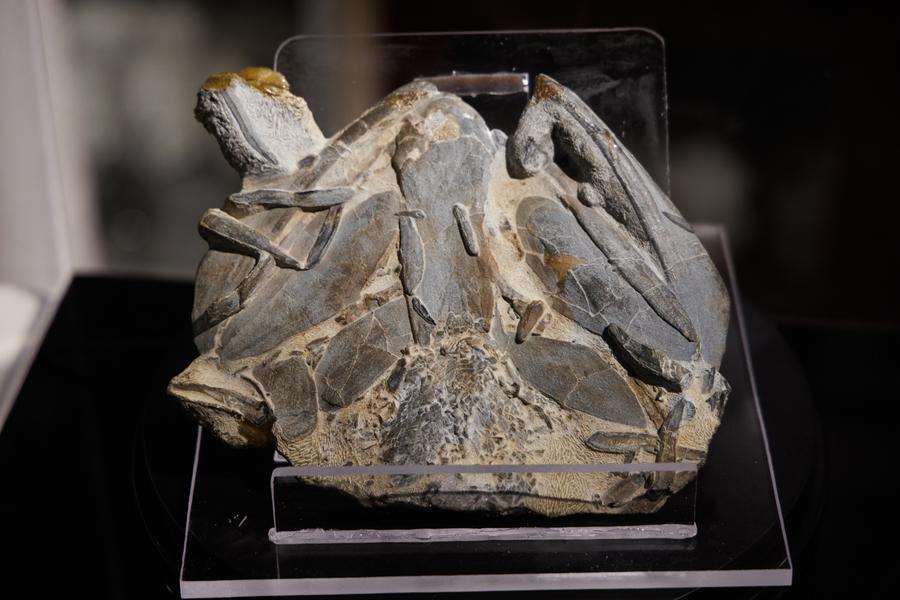
BEIJING, March 5 (Xinhua) -- Fossils of two fish from over 400 million years ago -- one a tiny streamlined creature, the other a giant among vertebrates of its time with bizarre teeth -- have been discovered in China, filling a critical gap in the evolutionary journey "from fish to human."
A research team from the Institute of Vertebrate Paleontology and Paleoanthropology (IVPP) of the Chinese Academy of Sciences (CAS) has achieved these two key discoveries after more than a decade of fieldwork and laboratory research.
They found the world's earliest known complete bony fish fossil, named Eosteus chongqingensis, in southwest China's Chongqing Municipality. They also comprehensively analyzed the complete head structure and tooth morphology of Megamastax amblyodus, the largest known vertebrate of the Silurian Period, found in Qujing in southwest China's Yunnan Province. These findings make China a "cradle" of early vertebrate evolution.
Two studies on the origin of bony fishes were published in the journal Nature on Thursday.
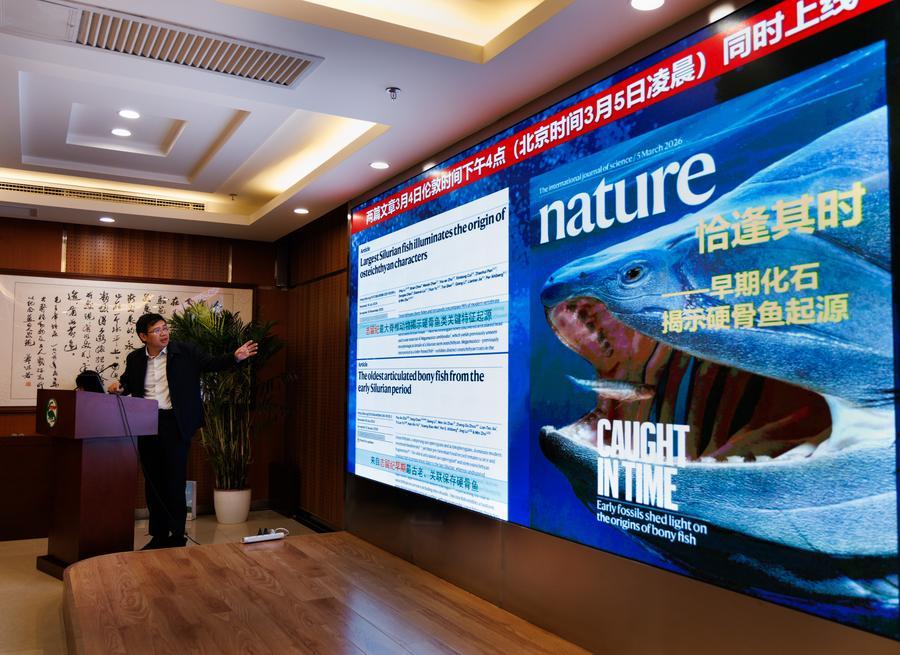
According to Zhu Min, an academician of CAS from the IVPP, bony fishes form the main trunk of the vertebrate tree of life. Their two surviving lineages, ray-finned fishes and lobe-finned fishes, have conquered a wide range of niches in aquatic and terrestrial ecosystems, respectively. Ray-finned fishes evolved into over 30,000 species, including the vast majority of fishes we see today. One lineage of lobe-finned fishes eventually ventured onto land during the Devonian Period, evolving into all tetrapods and humans.
However, the origin of bony fishes has long been shrouded in mystery, since most bony fish fossils found previously were already specialized ray-finned or lobe-finned fishes from the Devonian Period.
The information on the primitive bony fishes, or the bony fish stem group, which existed before the divergence of these two major lineages, was missing, leaving scientists unable to determine the morphology of the most recent common ancestor of ray-finned and lobe-finned fishes, Zhu said.
According to Zhu You'an, a researcher with IVPP, Eosteus chongqingensis, which lived 436 million years ago, measured only about 3 cm in total length, but was preserved with its head and tail intact. This tiny, ancient fish exhibits both primitive and advanced features. The discovery of Eosteus chongqingensis proves that the core suite of bony fish characteristics emerged 10 million years earlier than previously thought.
Lu Jing, another researcher of the team, said that Megamastax amblyodus, discovered in strata dating back approximately 423 million years, exceeded one meter in length, making it the largest vertebrate of the Silurian Period.
After nearly a decade of effort, the team used advanced imaging technology and computer-based 3D reconstruction to reveal its complete three-dimensional head structure and the deeply hidden internal features. The scientists found that Megamastax amblyodus had teeth arranged in two rows, inner and outer, with each tooth "cushion" in the inner row bearing many sharp "spines."
Phylogenetic analysis places both these ancient fishes within the bony fish stem group, representing primitive types that existed before the divergence of ray-finned and lobe-finned fishes, Zhu said.
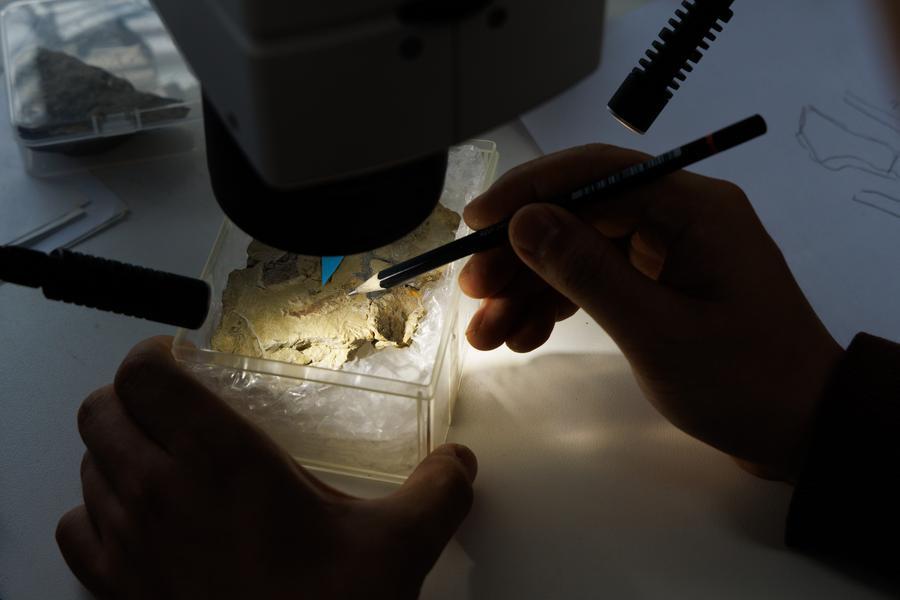
These discoveries illuminate the morphology of the most recent common ancestor of ray-finned fishes, including most modern fish species, and lobe-finned fishes, including all tetrapods and humans, and enrich the understanding of the early radiation of jawed vertebrates, and clarify the evolutionary trajectory of jaws and teeth in early bony fishes, Zhu said.
"These two discovered fish fossils represent a crucial point in the evolutionary path from fish to human. They show that bony fishes had already diversified by that period, laying a solid foundation for fish to eventually venture onto land and evolve into prosperous types of vertebrates on Earth, and the ultimate journey from fish to human," Zhu said. ■