SHENZHEN, Feb. 5 (Xinhua) -- When a Chinese robotics innovator faced an urgent space crunch for his laser sensor startup a few years ago, he did what many entrepreneurs in the country's southern tech hub of Shenzhen do: he called the local government.
By the next day, multiple authorities responded. Within three months, Qiu Chunxin's RoboSense was moving into a new facility. Today, the tech firm born of his doctoral research is a publicly listed leader in LiDAR technology, with its sensors acting as the "eyes" for a new generation of autonomous machines.
What happened in between wasn't just a startup success story. It was a rapid trajectory of how a small district in Shenzhen -- specifically a 10-kilometer stretch of asphalt known as Liuxian Avenue -- has become the world's most concentrated ecosystem for hardware innovation, driven by the city's dense, readily available industrial chain and hands-on government incubation policies.
TRILLION-YUAN DISTRICT
The strip's output is impressive. In 2025, the GDP of the Nanshan district exceeded 1 trillion yuan (approximately 144 billion U.S. dollars), making it the first county-level economy in the nation to exceed this economic threshold.
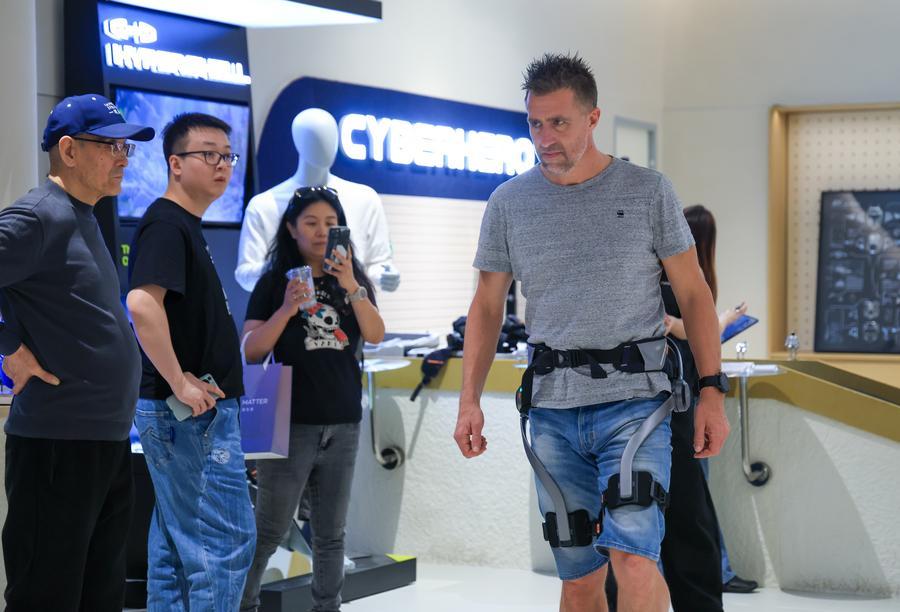
At this year's CES in Las Vegas, the geographic advantage was unmistakable. Of roughly 4,100 exhibitors, approximately 380 came from Shenzhen; more than 100 from Nanshan alone, with at least 65 clustered along the Liuxian corridor, also known as "Robot Valley."
The hardware firms in the district didn't bring just gadgets. They brought the entire supply chain: UBTECH's self-maintaining humanoid robots, RoboSense's sensors, and the agile workshops across Shenzhen that rapidly produce customized components.
Its model is not quite Silicon Valley, which long ago outsourced its manufacturing; nor is it Austin, Texas, whose tech boom relies on luring cost-sensitive refugees from San Francisco. Startups stay not because it's cheap, but because leaving means exiling themselves from the ecosystem. They benefit from the speed afforded by proximity.
LOGIC OF DENSITY
Nanshan, where China's first open industrial zone, Shekou, was founded, marks the start of the country's opening-up policy and serves as an early incubator for its high-tech manufacturing sector. Since then, this densely packed district has fostered more than 6,000 national high-tech enterprises, including 394 specialized and sophisticated "little giant" firms.
Facing severe land constraints, Nanshan even pioneered an "Industrial Upstairs" initiative, stacking factories vertically in multi-story buildings. This concentration creates a "same-day closed-loop" supply chain, in which all stages, from prototyping to assembly, occur within a single geographic hub on a single day.
Wang Cheng, product line manager at Orbbec, a leading 3D vision sensor maker based in the valley, recounted how his team once diagnosed and solved a complex optical issue on the spot for an overseas client in the glass-cleaning robotics industry, who had traveled all the way to Shenzhen seeking a solution.
A short morning drive brings Wang to the assembly maker's office. Teams gather around a single screen, work through engineering and algorithmic challenges, and schedule afternoon testing, all before lunch. This is his typical workday.
Many things are settled with a phone call or two, and within minutes, people along the chain sit around a table, working through the issue all in the same day. The team at drone-maker Potensic explained why they relocated to Liuxian Avenue.
Roughly 70 percent of manufacturing can be handled in Liuxian, and up to 90 percent of production can remain within Shenzhen, according to Huang Hui, PR manager at Mammotion, a robotic mower manufacturer.
The mountain-flanked valley's layout itself accelerates innovation: campuses like Tsinghua and Harbin Institute of Technology face directly onto industrial parks and corporate headquarters. Joint university-corporate labs enable seamless lab-to-industry translation, turning this compressed geography into a "petri dish" where future industries are cultivated at pace.
GOV'T AS ENABLER
Nanshan's local officials describe their role as providing an "invisible string" that ties the ecosystem together, rather than picking winners. Their approach is described in a maxim: no disturbance, but always responsive to requests.
The government provides startups with a bundled package that includes a workspace, early-stage funding, and expedited regulatory approvals -- all in one offering.
"This policy package is more precisely tailored to serve startups with technological breakthroughs, sustained R&D investment, and broad commercial prospects," said Liu Jingkang, founder of Insta360. This Nanshan-based hardware maker's panoramic camera became an instant U.S. hit, with customers lining up at dawn to grab the new release -- shattering the stereotype of Chinese manufacturing as merely "cheap and cutthroat."
Nanshan's government services also deploy AI assistants for instant inquiries. This year, more application scenarios and greater AI computing power will be made available to small and medium-sized businesses.
On a broader scale, the Chinese government is set to inject additional capital into the region to drive growth in its tech sector, as part of a blueprint to build an international technological innovation center here.
Last December, the national venture capital guidance fund was launched in China. Among the three regional funds under its guidance, the Guangdong-Hong Kong-Macao Greater Bay Area Fund was registered and established in Nanshan, with a target scale of 50.45 billion yuan. The fund follows early-stage, small-scale, long-term investments in hard technology.
As evening traffic thickens along the avenue, engineers inside Nanshan's industrial parks are still huddled over prototypes. In an era defined by technological upheaval, this sense of urgency reflects China's broader ambition. ■