
* Reinvigorated engagement between Europe and China is being driven by a mutual recognition of the vast potential for win-win cooperation.
* China has become a critical contributor to scientific innovation and advanced manufacturing, as well as a driving force for common prosperity worldwide.
LONDON, Feb. 1 (Xinhua) -- In a world rattled by geopolitical tensions, Europe is once again searching for steadier ground, and China is increasingly re-emerging as a crucial partner in the eyes of many European officials and businesses.
Since the end of 2025, senior-level exchanges have gathered pace, marked by British Prime Minister Keir Starmer's recent trip to China and French President Emmanuel Macron's state visit late last year, alongside a gradual restoration of dialogue mechanisms on trade, climate and governance.
Analysts say this reinvigorated engagement is being driven by a mutual recognition of the vast potential for win-win cooperation and a shared need for strategic stability amid global turbulence.
ENHANCING HIGH-LEVEL TIES
Starmer's visit to China, the first by a British prime minister in years, was widely observed as a test of whether London could set aside differences to pursue a more calibrated approach that balances engagement with safeguards.
Following the visit, the two sides had affirmed their commitment to a build a stable and forward-looking relationship, focusing on pursuing cooperation while conducting candid dialogue to enhance mutual understanding.
"I'm absolutely convinced that the more we engage, the more that mutual trust and respect can be built upon," Starmer said while touring Shanghai, a metropolis in eastern China where, according to him, a great future and great opportunities lie.
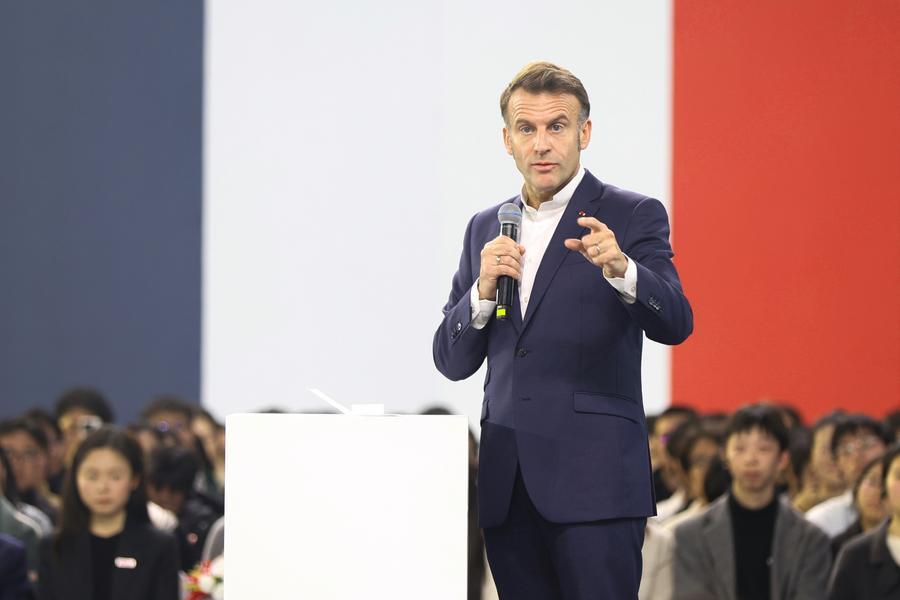
Across European political circles, similar thinking is gaining traction: viewing engagement as a practical tool for properly managing differences and reducing risks. Macron's December 2025 trip, which featured meetings with China's leadership and extensive public diplomacy, underlined France's strong intention to engage with China.
This momentum has continued into 2026. Finnish Prime Minister Petteri Orpo concluded his four-day visit to China on Wednesday, the first by a Finnish prime minister in 17 years, further highlighting the enhanced frequency of high-level China-Europe exchanges.
In an exclusive interview with Xinhua in Beijing, Orpo said cooperation potential between Finland and China in fields such as clean energy and green transition is steadily unfolding.
The two governments signed cooperation documents covering science and technology, housing and urban-rural development, customs, culture and tourism, economy and trade and energy.
"It's very good to continue our bright future in each cooperation," Orpo said.
Taoiseach of Ireland Micheal Martin, who wrapped up his visit to China earlier last month, echoed that Ireland is willing to deepen cooperation with China in trade, investment, science and technology, biomedicine, renewable energy, artificial intelligence, education and other fields.
DEEPENING COOPERATION
Business figures argue that restored top-level dialogue can help rebuild confidence throughout the economic system. Steven Lynch, director of international trade at the British Chambers of Commerce, told Xinhua that Starmer's visit to China should enable Britain to articulate a clearer, more coherent approach to China to keep economic engagement on track.
China has become a critical contributor to scientific innovation and advanced manufacturing, as well as a driving force for common prosperity worldwide, Pascal Soriot, CEO of British pharmaceutical giant AstraZeneca, told Xinhua on Friday, a day after the firm pledged to invest 15 billion U.S. dollars in China through 2030 to expand medicines manufacturing and R&D facilities.
In addition to the firm's strategic R&D centers in Beijing and Shanghai, the plan also includes expansion of its existing manufacturing facilities in Beijing and in east China's Wuxi, Taizhou and Qingdao, along with the establishment of two new plants focusing on cell therapies and radioconjugates -- the latter a new modality for cancer treatment.
Astrid Nordin, chair of Chinese International Relations, Lau China Institute of King's College London, stressed the "shared interests" between China and Britain, particularly in education, climate change, health and scientific research.
In northern England, Chinese automaker Chery Commercial Vehicle plans to set up its first European headquarters in Liverpool, according to local authorities. The hub is expected to support research, engineering and commercialization, while creating roles across software, R&D and operations, a move local leaders framed as a major vote of confidence in the region's advanced manufacturing and green innovation ambitions.
On the continent, industry leaders are also advocating pragmatic cooperation. Markus Kamieth, CEO of German chemical giant BASF, said that China is becoming an increasingly important innovation hub, particularly in green technologies, and that "sensible cooperation" has real value, including for political relations.
Paulo Rios de Oliveira, an executive board member of AICEP Portugal Global, a government trade and investment agency, said China remains a major and reliable partner, with new growth points emerging in energy transition, sustainable transport, advanced manufacturing, digital economy, life sciences, healthcare and the marine economy.
He added that China has become one of Portugal's most important economic partners, with trade expanding both in scale and quality, and Chinese investment contributing across sectors such as energy, finance, insurance, ICT, infrastructure and modern services.
Ioannis Kotoulas, adjunct lecturer in geopolitics, University of Athens, also said that Europe is attracted to China's high technologies, problem-solving efficiencies, and its emphasis on economic cooperation rather than geopolitical confrontation.
The 48 Group Chairman Jack Perry said that British businesses are looking to deepen cooperation with China in areas where the two economies are genuinely complementary, adding that the Britain-China relationship matters not just bilaterally, but globally. "It shows that cooperation is still possible between countries with different systems, histories and perspectives. That has a stabilizing effect on markets and on confidence."■