
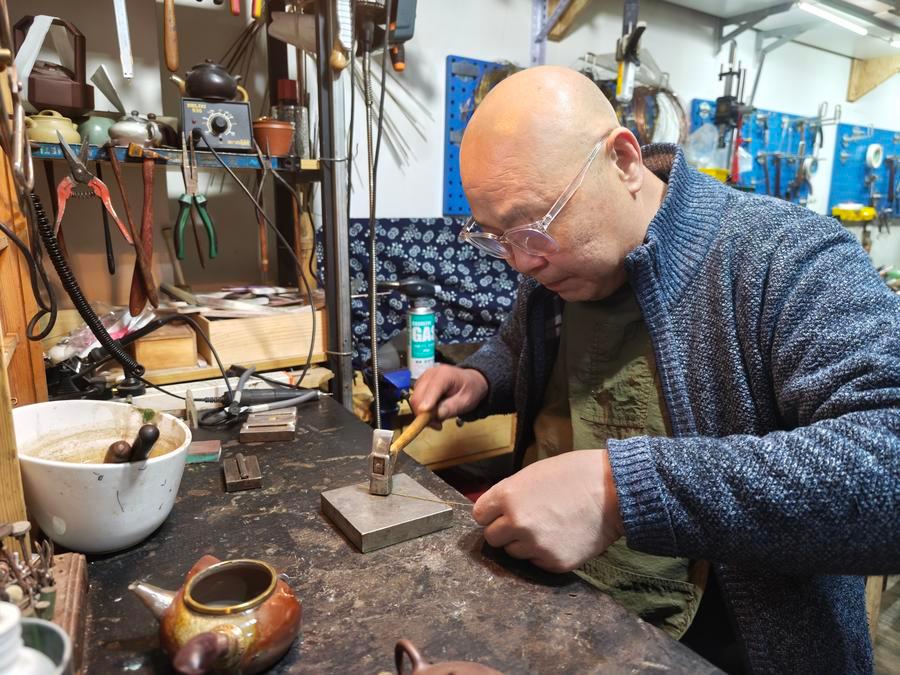
JINAN, Jan. 22 (Xinhua) -- In a small studio in east China's Shandong Province, the crisp, rhythmic ding-dang of a hammer strikes a persistent beat against the quiet hum in the street.
This is the sound of juci -- the ancient Chinese craft of mending broken ceramics with metal staples, which has been listed as a provincial-level intangible cultural heritage.
While the exact origins of juci are not recorded in historical documents, its depiction in the famous handscroll painting "Along the River During the Qingming Festival" shows that the craft was already well established and refined by the Song Dynasty (960-1279).
For 62-year-old Yang Tao, an inheritor of the intangible cultural heritage in the city of Zibo, the hammer's rhythm is the soundtrack of his life. His earliest memories are woven with the calls of his grandfather, a juci artisan, and the clatter of tools in the family's repair kit. "Grandpa's tools were my toys," Yang recalls. "I learned by mimicking his every move."
Once a practical skill for extending the life of ceramics, juci has faced a decline in an age of abundance and replaceable goods. To ensure juci's survival and pass down the skills, its practitioners like Yang have shifted from pure restoration to artistic innovation, securing its cultural legacy beyond mere utility.
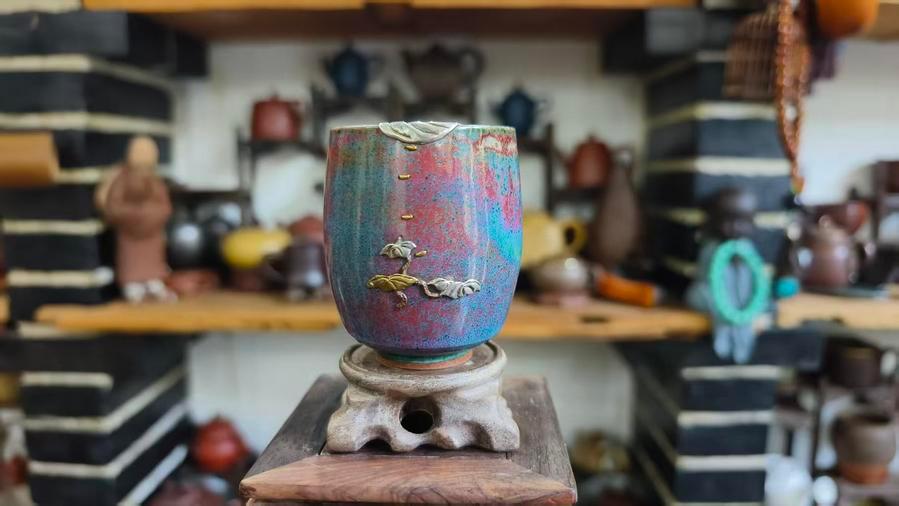
According to Yang, the craft begins with reassembling fragments like a delicate puzzle. Using a bow-driven diamond drill, a ceramic repairman bores minute holes along the crack, then carefully hammers in handmade metal staples to bind the pieces.
Yang spent eight years creating a staple with an inner diameter of just 1 mm to make the repair more delicate. His collection of over 500 hammers, many of which he forged himself, is a testament to his pursuit of perfection.
"The differences might be invisible to others, but I know each hammer gives a staple a distinct character," he explained.
The mastery earned him a prestigious role in restoring a Ming Dynasty (1368-1644) fish-pattern porcelain vat at the Capital Museum in 2018. As he examined the centuries-old staples on the ancient piece, which incorporated some now-extinct techniques, he felt a strong urgency to pass the craft on.
"Many practitioners are still working on the front lines, already approaching their sixties. We face a real risk of the craftsmanship disappearing," Yang said.
To preserve the craft, he teaches cultural heritage restoration courses in schools and runs hands-on training workshops for apprentices. He has had more than 200 apprentices across the country, with the youngest in his 20s. Some of them have established their own studios.
At Yang's studio, Wang Xiaomei, one of his apprentices, crafted a lotus-shaped copper base for a cracked teapot. "I want to bring the philosophy and aesthetics of the traditional craft into modern design," she said, while polishing the metal to a soft glow.
Yang has also created a social media account and begun using artificial intelligence to generate decorative designs, hoping that modern technology, combined with the help of his young apprentices, can help decorative juci find a place in the market.
"If we only remain at the level of repair, this old craft will eventually fade away. Only by transforming skill into art can it be truly passed down," Yang said. ■