by Xinhua writer Liu Bowei
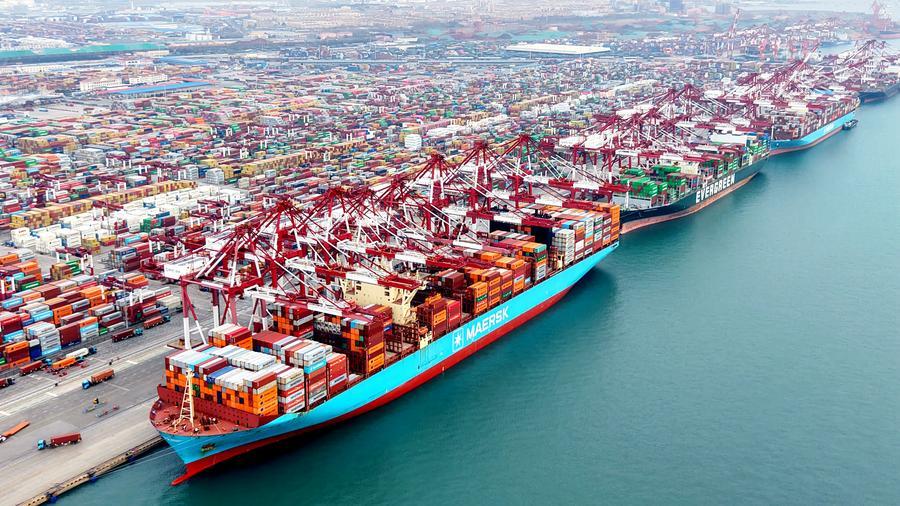
BEIJING, Dec. 29 (Xinhua) -- As 2025 draws to a close, the global economy has weathered a year of turbulence. Escalating U.S. tariffs and protectionist practices, on top of persistent geopolitical tensions and volatile financial markets, have laid bare structural vulnerabilities and dampened global trade and growth.
Initiatives to diversify trade, deepen regional partnerships, and enact targeted economic adjustments have nevertheless bolstered the global economy's capacity to withstand waves of shocks, revealing a resilience that persists even amid profound uncertainty.
Marked by resilience under immense strain, the global economy stands at a pivotal crossroads, as the world faces an urgent imperative to recalibrate for future growth.
TRADE PAIN DEEPENS
Since U.S. President Donald Trump returned to the White House, Washington rolled out a new round of unilateral tariff measures with increasing frequency, pushing the average U.S. import tax from 2.4 percent earlier in the year to nearly 18 percent -- the highest level since the 1930s.
However, high tariffs have neither strengthened U.S. industrial competitiveness nor addressed its structural problems. Instead, they have stirred ripple effects that reverberate well beyond U.S. borders.
At home, these domestic repercussions are evident in rising prices, higher business costs, diminished consumer welfare, and mounting inflation, all of which have weighed on economic growth.
According to a report released by the United Nations Conference on Trade and Development (UNCTAD) earlier this month, U.S. growth is expected to slow to 1.8 percent in 2025 and 1.5 percent in 2026, down from an average of 2.5 percent between 2015 and 2019.
In Europe, new U.S. tariffs on steel, aluminum and automobiles have squeezed supply-chain margins and undermined competitiveness, prompting firms to delay investment and rethink production plans, with the EU's growth projected by UNCTAD at a modest 1.3 percent in 2025.
In Asia, Japan has also felt the strain, with exports to the United States falling year on year for seven consecutive months since April, as U.S. auto tariffs continue to hamper shipments. A widening trade deficit and a weakening yen have further compounded pressures on the Japanese economy.
The tariff has created a lot of uncertainty, which impacts not only the imports the United States makes from different parts of the world, but also the growth in trade at the global level, said Luz Maria de la Mora, director of the Division on International Trade and Commodities of UNCTAD.
"That kind of uncertainty normally has an impact on investors, on trade partners, and also on the way in which supply chains are working," she said.
Echoing her remarks, Luis Antonio Paulino, director of the Confucius Institute at Sao Paulo State University in Brazil, said: "Trade uncertainty leads multinational companies to delay or cancel investment plans, reducing foreign direct investment flows. Unilateral tariffs also increase trade disputes and weaken the rules-based multilateral trading system."
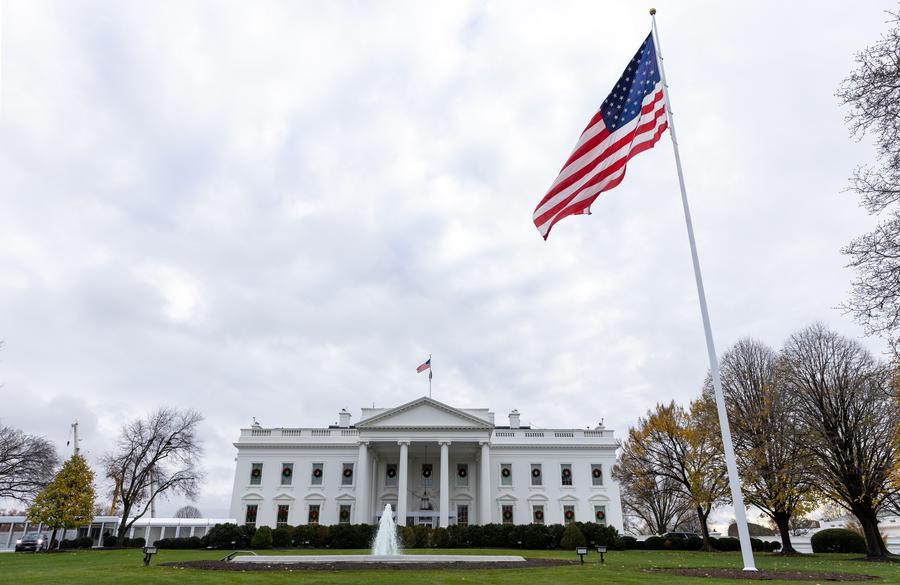
As the world's largest goods importer unilaterally raises tariffs, affected countries are often left with little choice but to respond in kind, risking a downward spiral in global trade.
"There, you see more and more countries adopting some protectionist measures. And by adopting that, it will mean a slow process for the economy in many countries. So, the tariff war initiated by the United States has severely undermined the modern and multilateral trading system," said Bernard Dewit, chairman of the Belgian-Chinese Chamber of Commerce.
RESILIENCE AMID UNCERTAINTY
Yet the year proved somewhat less grim than expected. Global trade continued to grow, unemployment remained low in most regions, and stock markets recorded another year of solid gains.
In October, the International Monetary Fund (IMF) revised up its 2025 global growth forecast to 3.2 percent, 0.2 percentage points higher than in July.
The revisions were partly due to importers front-loading goods in response to U.S. tariffs, the swift reorganization of supply chains, trade negotiations, and the overall efforts of countries to keep the global trading system open, the IMF noted in its report.
In a recent article, the World Bank observed that emerging markets and developing economies -- now accounting for nearly 40 percent of global trade -- have strengthened regional ties and signed new agreements, helping offset the drag from trade-restrictive measures.
"Economies today are much more diversified, so no country depends on just one or two markets," Andres Angulo, professor of international relations and Asia Pacific at the Academy of Christian Humanism University of Chile, told Xinhua.
"In Latin America, countries diversify through agreements and investments, targeting multiple markets rather than relying on a single one," he added.
Regional economic cooperation gained momentum in 2025, particularly among Global South nations. Indonesia's entry into BRICS, together with expanded trade and supply chain cooperation under the China-ASEAN FTA 3.0 framework and the deepening implementation of the African Continental Free Trade Area, stands out as a set of key highlights. These developments underscore a broader willingness among countries to seek stability through more coordinated economic engagement.
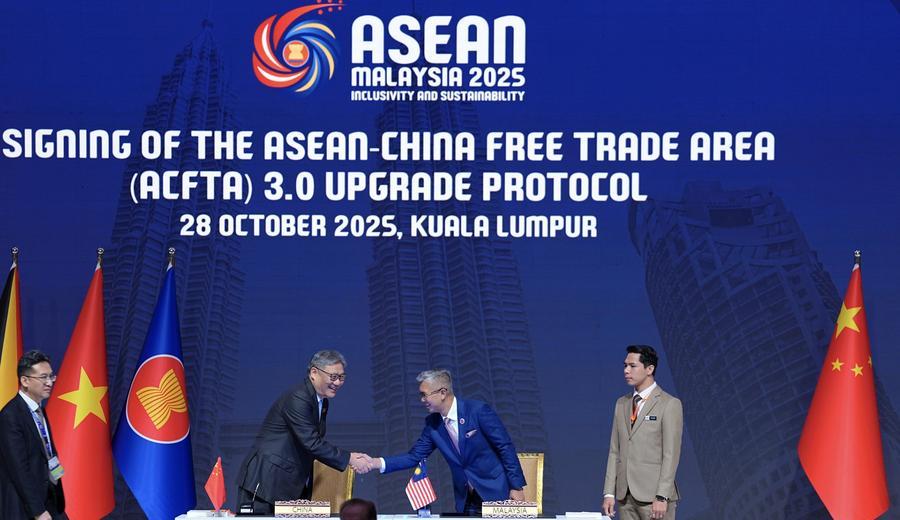
According to UNCTAD data, global trade is expected to grow around 7 percent in 2025, led by East Asia, Africa, and South-South trade. South-South trade alone expanded by roughly 8 percent.
"We're seeing that trade among South countries is double the growth rate of developed countries," said De la Mora, adding that China, an important Global South country and a major economy in the world, is one of the key engines of growth for global trade and the economy at large.
China is really driving many of the activities worldwide, said the expert, highlighting China's role as a stabilizing force and hub of shared global opportunities.
Applauding China's zero-tariff treatment for 100 percent tariff lines for 53 African countries with which it has diplomatic relations, De la Mora said, "Important dynamics are taking place in terms of how to make sure that trade continues to be an engine of growth."
TIME FOR RECALIBRATION
"What we are seeing is demonstrable resilience in the world," said IMF Managing Director Kristalina Georgieva. "But we are also saying it is a time of exceptional uncertainty and downside risks are still dominating the forecast. So watch it, don't get too comfortable."
As 2026 approaches, many experts expect global growth to broadly mirror 2025, albeit in an increasingly fragmented global economy. Inflationary pressures, elevated interest rates in advanced economies and persistent geopolitical tensions are set to weigh on expansion. Meanwhile, an increased trend towards new technologies and targeted stimulus measures across many economies is likely to support stability, with China remaining a key anchor.
"If the current trends persist, trade frictions are likely to remain elevated in 2026," Tobias Alando, chief executive officer of the Kenya Association of Manufacturers, told Xinhua, warning that global growth next year could fall below 2025 levels amid U.S. tariffs, rising debt, tighter financial conditions and policy uncertainty.
The view echoes the latest forecast by the Organization for Economic Co-operation and Development, which projects global GDP growth as slowing from 3.2 percent in 2025 to 2.9 percent in 2026.
Against this backdrop, some analysts describe 2026 as a "wait and see" year, not only because of unresolved geopolitical conflicts, but also because the global economy is at a crossroads over how it responds to mounting fragmentation.
Stephen Ndegwa, an international relations lecturer at United States International University-Africa, said that global growth prospects will largely depend on whether peace can prevail in major geopolitical flashpoints and that persistent tensions will continue to keep investors cautious.
As the global economy navigates this period of hesitation, experts pointed out that U.S. measures rooted in unilateralism are increasingly expected to reveal their limitations, prompting investors to reassess long-term strategies. And China, with its high-standard opening-up and commitment to safeguarding free trade and economic globalization, is providing economies worldwide with new growth and industrial upgrading opportunities, reinforcing the trend toward more predictable and cooperative strategies.
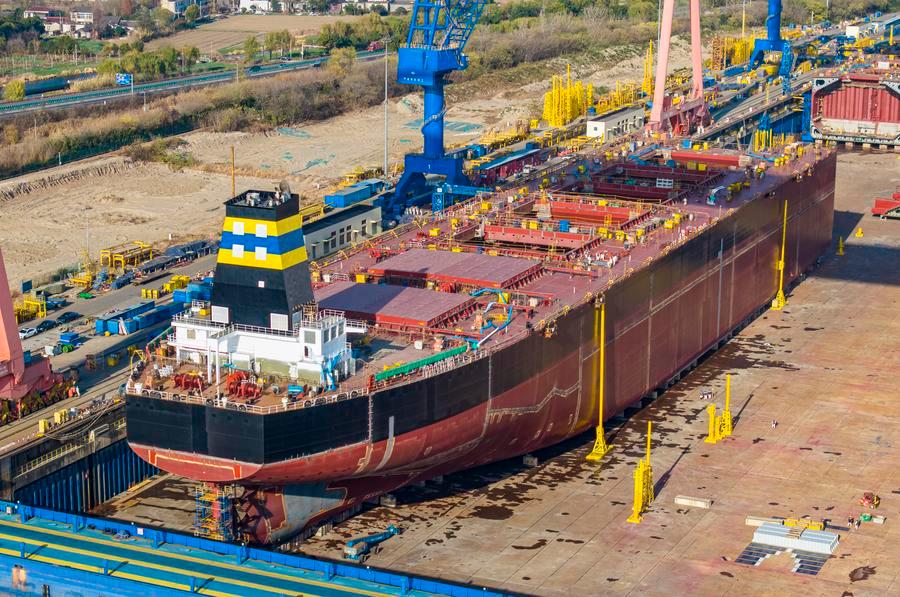
"After receiving the shock of U.S. tariffs, countries around the world have begun to recover, adjust their paths, and move past this shock," said Mostafa Ibrahim, vice-president of the Egyptian-Chinese Business Council. "These pressures will be more motivating for countries to find solutions away from the United States, especially for its allies and developing countries."■