BEIJING, Dec. 28 (Xinhua) -- 2025 has been an uncommon year for the global economy. While much of the world struggled to regain momentum, China pressed ahead, brushing aside doubts and absorbing global headwinds.
Backed by distinctive institutional strengths and inherent advantages, including a vast market, a comprehensive industrial base, and a wealth of manpower and talent, the country has emerged as an "oasis of certainty" amid a turbulent global landscape.
POWER IN INTERNAL PULSE
Recently, many international institutions, including the World Bank, the International Monetary Fund (IMF), the Asian Development Bank, and the OECD, revised their 2025 growth forecasts for China upward.
Kristalina Georgieva, managing director of the IMF, said that despite sizable shocks, China's economy has shown remarkable resilience.
With a 5.2-percent GDP growth in the first three quarters, China appears to be keeping the full-year target of around 5 percent in view.
This performance was hard-won. In 2025, the world's second-largest economy faced exceptional external pressures, with trade tensions weighing heavily on growth. At the same time, the imbalance between strong supply and insufficient domestic demand remains pronounced.
Unlike many manufacturing powerhouses that respond to cooling domestic needs with aggressive export expansion, China focused on "managing its own affairs," placing expanding the domestic demand at the top of the agenda to navigate the headwinds.
The country's market provides a solid foundation. With more than 1.4 billion people, nearly 190 million business entities and a growing middle-income population, China possesses a consumer market unmatched in depth or diversity.
Such a super-sized market offers companies ample room to grow even amid trade tensions, serving as a stabilizer for overall growth, said Zhang Zhanbin, a researcher with the Party School of the Communist Party of China Central Committee.
New consumption patterns are also generating fresh demand. The Su Super League, an amateur football competition, has drawn millions of viewers, turning local matches into a nationwide spectacle. Meanwhile, designer toys such as Labubu have gone viral at home and abroad, underscoring the consumer enthusiasm around emerging cultural products.
Zhang Tianbing, leader of Deloitte Asia Pacific's consumer products and retail sector, noted more spending on services in China as the consumption structure continues to evolve. Chinese consumers, Zhang said, are increasingly turning away from conspicuous consumption and purely low-cost purchases, favoring options that deliver emotional value, better cost efficiency and long-term sustainability.
Policymakers have reinforced the momentum with a slew of pro-consumption measures, including a 500-billion-yuan (about 71.07 billion U.S. dollars) relending facility aimed at boosting service consumption and elderly care, alongside a nationwide pro-consumption initiative funded by ultra-long special treasury bonds for consumer goods trade-in programs.
Official data showed that during the first 11 months, China's retail sales of consumer goods expanded 4 percent year on year. Service consumption grew at a faster pace, with service retail categories such as culture and sports, as well as telecommunication and information, both posting double-digit sales growth during the period.
"China's growth in the coming years will depend more on domestic demand," said Mara Warwick, World Bank Division Director for China, Mongolia and Korea.
SPARK AT INNOVATION FRONTIER
At the start of 2025, a familiar warning circulated among economists: China, they argued, was headed toward its own version of Japan's "lost decades." An increasingly unpredictable policy environment in a certain country, combined with the relocation of some supply chains, appeared to threaten the foundations of the country's manufacturing model.
By year's end, that narrative had been upended. China reinforced its position as the world's most consequential manufacturing hub, but more dynamic, and in some respects more indispensable, than before.
Analysts largely attribute that resilience to a long-running strategy centered on technological innovation. Over recent years, China has accelerated self-reliance in science and technology and positioned innovation as a new engine of growth.
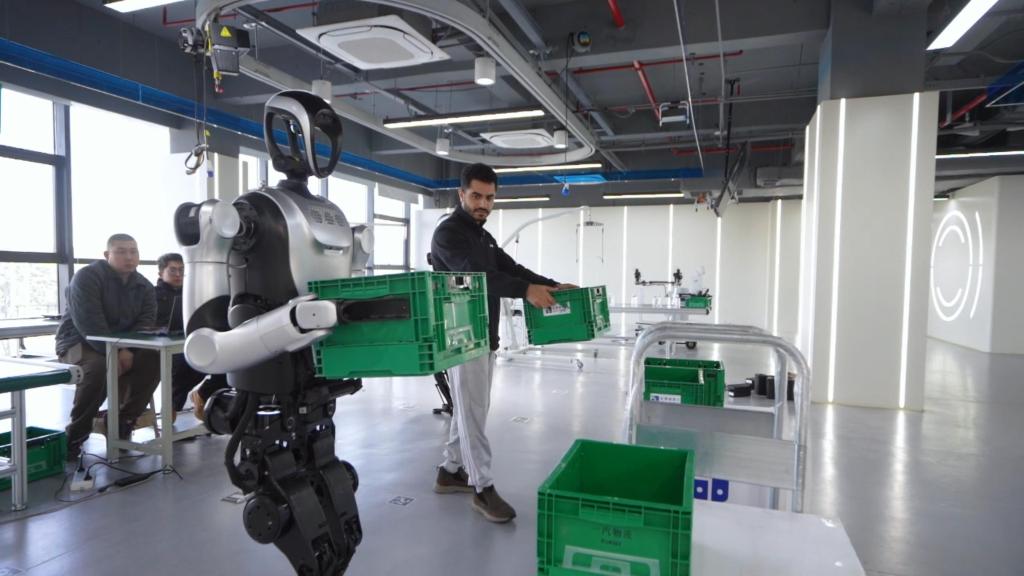
Breakthroughs in domestically developed high-performance chips and operating systems have reduced reliance on foreign suppliers, while traditional industries are being upgraded with digital technologies to boost productivity. Artificial intelligence has moved from laboratories into the industrial backbone, optimizing everything from port logistics to real-time customer service.
Now, China boasts over 500,000 high-tech enterprises, ranks among the top 10 of the Global Innovation Index for the first time, and holds 60 percent of global artificial intelligence patents. In frontier sectors such as artificial intelligence, big data, and electric vehicles, China has emerged as an undeniable global leader.
These advances rest on sustained investment. In 2024, China's research and development (R&D) expenditure took up 2.69 percent of its economic output, higher than that of the European Union. Guidelines for the AI Plus initiative were introduced to accelerate AI integration, while a national venture capital guidance fund channels capital into strategic and emerging industries.
Talent is another pillar. The country is home to nearly 20 million scientists and engineers, and each year, over 5 million students graduate from Chinese colleges in science, technology, engineering and mathematics (STEM), a figure that leads the world. It also introduced a new K visa to attract young foreign science and technology professionals, at a time when many other economies are tightening their immigration policies.
China's innovation wave has renewed foreign investors' appetites. According to the World Bank, roughly one-third of new foreign direct investment into China has gone to high-tech sectors. The KraneShares China Overseas Internet ETF, the largest Chinese Stocks ETF listed in the U.S. in terms of assets under management, has accumulated 2.3 billion dollars since the start of this year, and is expected to record the best annual performance since 2021.
For multinational corporations, a presence in China is no longer just about market access -- it's about harnessing Chinese innovation to strengthen global competitiveness. Porsche, the luxury sports carmaker owned by the Volkswagen Group, has established its first-ever R&D center outside Germany in Shanghai. Pharmaceutical giant AstraZeneca announced a 2.5 billion U.S. dollar R&D center in Beijing this year.
Xu Yang, president of Danfoss China, said China's advances in areas such as data centers, shipbuilding and building retrofits have created new engines of growth for the company's businesses. Describing China as the company's "second home market," he said Danfoss's long-term commitment and confidence in the country remain firm. ■