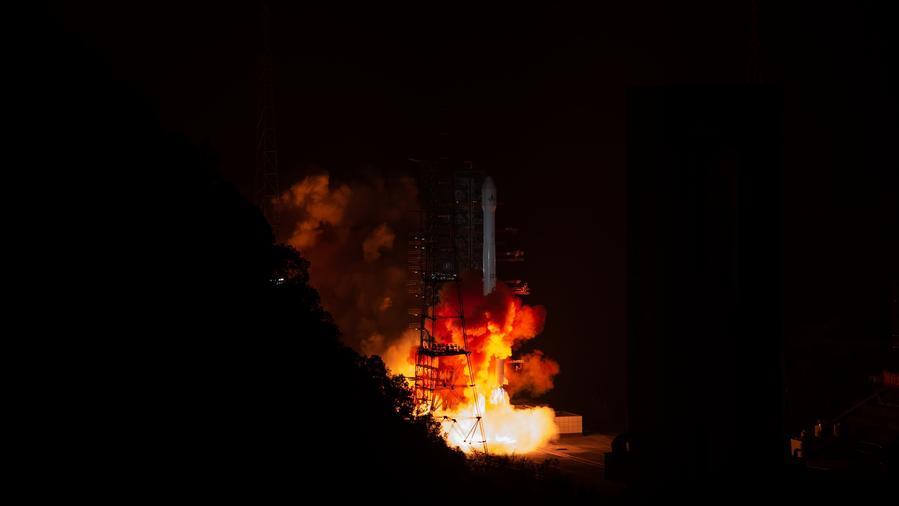
XICHANG, Dec. 27 (Xinhua) -- China on Saturday sent a new satellite into space from the Xichang Satellite Launch Center in the country's southwestern Sichuan Province.
The satellite, Fengyun-4 03, was launched by a Long March-3B rocket at 12:07 a.m. (Beijing Time) and has entered its planned orbit.
With this successful launch, China's Fengyun meteorological satellite family -- now consisting of more than 20 satellites -- has gained a new member that is considered the most capable in terms of comprehensive observation capabilities.
According to the Shanghai Academy of Spaceflight Technology (SAST), the Fengyun-4 03 satellite is equipped with four Earth-observation instruments and two solar-observation instruments. It features a range of advanced capabilities, representing a substantial upgrade in observational performance, detection parameters and data transmission efficiency.
Among its instruments, the advanced geostationary radiation imager can now complete a full-disk scan of Earth in five minutes -- three times faster than the previous 15-minute cycle -- and is sensitive enough to detect atmospheric temperature variations as small as one-fiftieth of a degree Celsius from thousands of kilometers away.
Another key payload, the geostationary interferometric infrared sounder, has enhanced its spatial resolution from 12 kilometers to 8 kilometers and can map temperature and humidity across China within one hour.
Its lightning imager captures 500 frames per second and can identify lightning events within a 30-gigabit-per-second data stream -- a processing feat comparable to screening 30 high-definition movies in one second to locate individual frames containing lightning signals.
According to the SAST, the Fengyun-4 series has progressively expanded China's meteorological observation capacities.
China launched the Fengyun-4 01 satellite in December 2016, followed by the Fengyun-4 02 in June 2021. With the new Fengyun-4 03 satellite -- which enables inter-satellite coordination, high-speed data transmission, and broadcast functions -- the three satellites will now form an integrated and coordinated observation network.
SAST said that this enhanced network will significantly improve China's capabilities in weather forecasting, meteorological disaster prevention, space-weather monitoring, and ecological-environment observation. ■