Now attention has turned to "the day after." But what comes next? Palestinians have little say in the discussions shaping their future. Hamas takes a hard line on disarmament; Israel speaks of a "yellow line" as the "new borderline" inside Gaza. Neither shows urgency to move beyond the truce.
GAZA, Dec. 27 (Xinhua) -- Over the past year, there were moments when it seemed the war in Gaza might finally be over. Ceasefires were announced, talks resumed, and hope flickered -- only to be snuffed out as the fighting flared again.
So when another truce was announced in October, it brought a weary relief, shadowed by deep doubt. Now, more than two months later, the ceasefire largely holds, but so do the questions that will determine whether it lasts: Will Hamas disarm? Will the Israeli forces withdraw?
Uncertainty has been the only constant. For journalists, this has made even basic reporting profoundly difficult. The Israeli military and Hamas routinely trade blame, leaving the reality on the ground hard to verify. Casualty figures released by Gaza-based health authorities are also contested.
For Gazans, the uncertainty has never been an abstraction. Tens of thousands were killed. Those who have survived live from hour to hour, not sure what the next day would bring.
The year opened with cautious hope. After months of negotiations, a ceasefire was announced in mid-January. The guns never fell fully silent, but many Gazans allowed themselves to believe a new beginning was coming.
In February, U.S. President Donald Trump said the United States would "take over" Gaza. He repeated the idea in May. The statement left about 2 million Gazans in limbo, unsure whether they would be forced from their homes yet again. Many rejected the proposal outright. "Gaza is our land," a woman in Gaza City told me. "We cannot leave it for strangers."
Then in March, large-scale Israeli airstrikes resumed. Why, Gazans asked, were they being subjected to this again? Many had returned home during the lull, only to be displaced once more. After earlier ceasefires had failed to stop the fighting, could another one really hold?
By late May, U.S.-backed aid distribution sites were set up that bypassed the UN system. They soon became what witnesses called "death traps." Attacks near those points killed and wounded thousands. The threat was no longer only from the sky: stepping out to collect a bag of flour could be fatal.
"I dreamed of returning home to my children with a full bag," a man in Rafah, southern Gaza, said after leaving an aid point, "but I see death there."
In August, famine was officially declared in Gaza. People told me they were too hungry to walk, dizzy from lack of food. Markets stood empty. Children crowded distribution points, scrambling for thin soup. In those moments, dignity dissolved. The war had shattered everything.
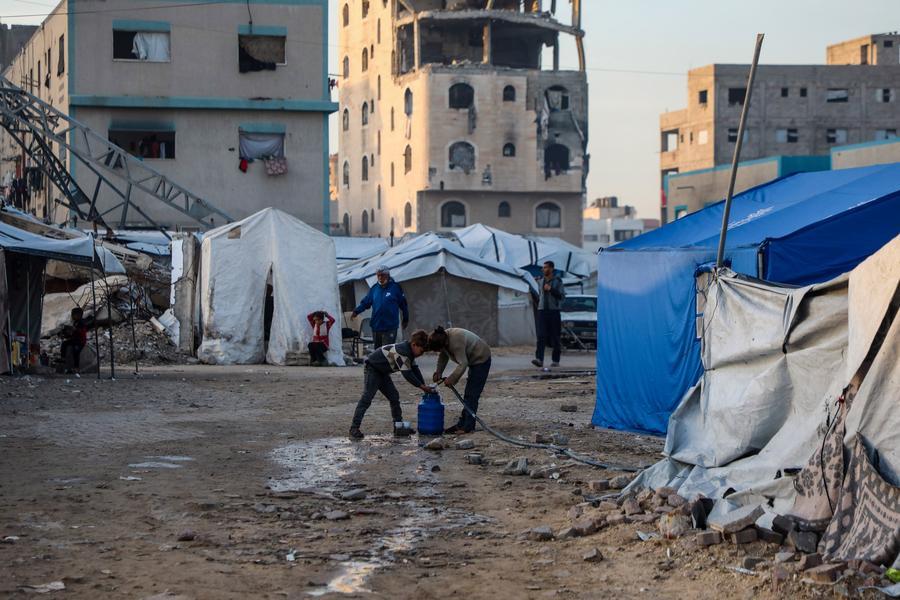
Now winter has come. The October ceasefire has held, but the rains have not waited for reconstruction. Downpours have collapsed tents and damaged buildings. Medics have reported infants dying of hypothermia. Has the war truly ended? And if so, where is normal life? Rebuilding Gaza will take decades. Until then, people remain crammed into tents and the shells of shattered homes.
Gazans are living through a war most of them did not start and cannot stop. Again and again, they watch their homeland become a bargaining chip in geopolitical games. Politicians debate who will control Gaza, while ordinary people are paying the price.
Amid all the unknowns, one thing is clear: the scars of war run deep. Two unbearable years have left too many painful memories that will not fade simply because the guns fall silent.
I remember a father who pulled his child's body from a crater left by an airstrike. Exhausted, he sank to his knees, pressed his face to the small cold chest, and wept in the mud.
I remember a girl, not yet 10, who lost her entire family in an airstrike. She may not fully understand death, but she knows her mother will never again pack her school lunch.
I remember a rescuer who heard cries from beneath the ruins. Weak from hunger and without tools, he dug until his strength gave out. The cries slowly faded.
Such tragedies repeated for more than 700 days. I have tried to comfort colleagues here, only to find the words turn hollow. When Gazans speak of lost family, of surviving but not living, of days too hungry to walk, I realize no consolation reaches that depth.
Now attention has turned to "the day after." But what comes next? Palestinians have little say in the discussions shaping their future. Hamas takes a hard line on disarmament; Israel speaks of a "yellow line" as the "new borderline" inside Gaza. Neither shows urgency to move beyond the truce.
Gaza's wound remains open. In this war, more than 70,000 were killed. A generation has lost its childhood. Neighborhoods were leveled, families erased. With questions unanswered and grief still heavy, Gazans walk forward, into a future they cannot see -- and cannot shape.■