* China's high-speed rail network has further expanded with several new lines opening.
* The network has facilitated public travel and injected new momentum into high-quality development.
* It not only expands the travel radius and mobility but also helps facilitate economic development.
YINCHUAN, Dec. 23 (Xinhua) -- As the year draws to a close, China's high-speed rail network has further expanded with several new lines opening, which have facilitated public travel and injected new momentum into high-quality development along the routes.
At around 10 a.m. Tuesday, the D4667 bullet train departed from Inner Mongolia's Baotou City to Yinchuan, the capital of Ningxia Hui Autonomous Region in northwest China. This journey along the new line significantly reduces travel time between the two cities, cutting it from over six hours to just about 2.5 hours.
Onboard the train that runs as fast as 250 km per hour, passengers raised their phones to capture the historic moment. "Enjoying Baotou steamed buns in the morning and admiring Ningxia's vast desert landscape at noon has become a reality," said Liu Yu, a Baotou resident who secured a ticket for the inaugural trip.
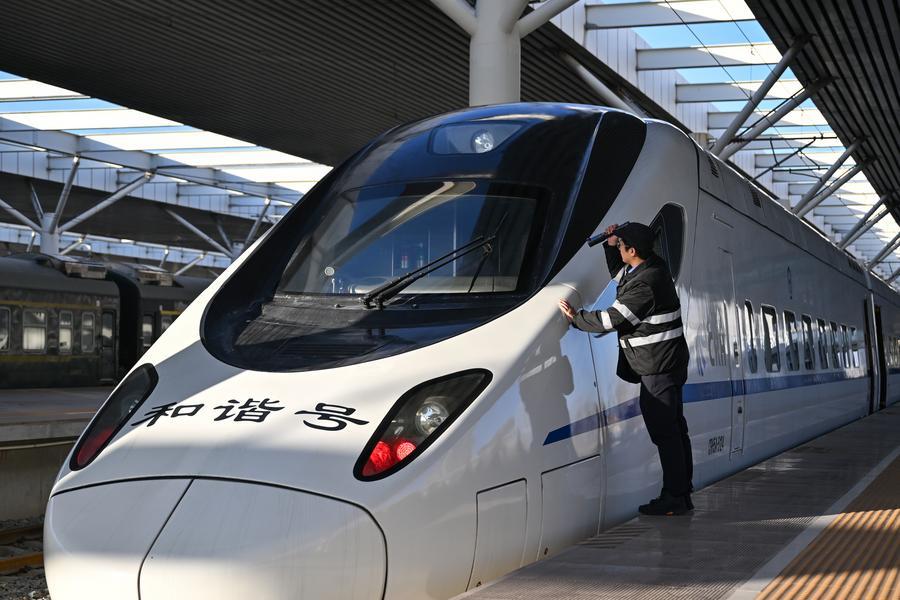
With an investment of 54.63 billion yuan (7.75 billion U.S. dollars), the 519-km line is a major section of the high-speed railway linking Beijing and Lanzhou, capital of Gansu Province, filling the last missing link in northwest China's high-speed rail network.
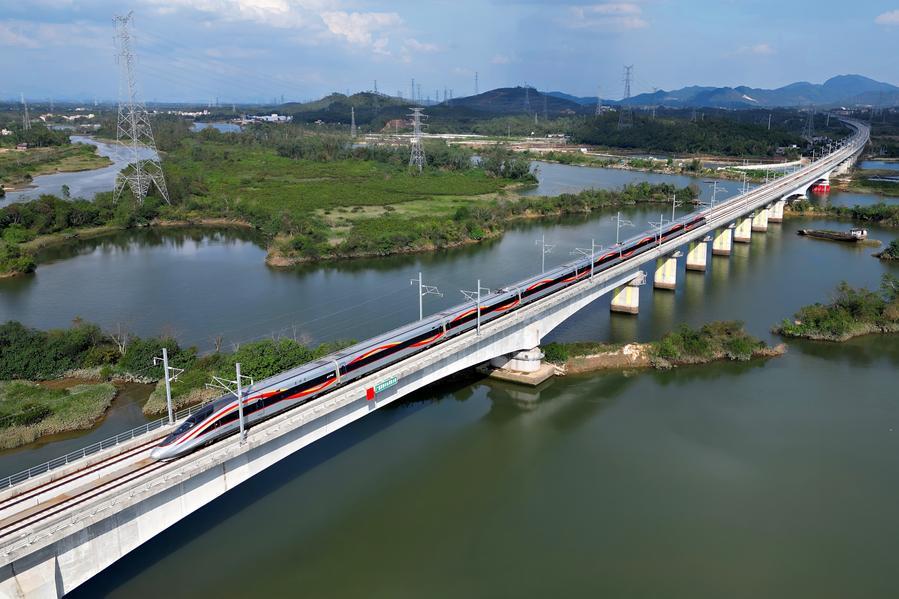
A day earlier, two high-speed rail lines in Guangdong Province began operations, significantly compressing the travel time within the Guangdong-Hong Kong-Macao Greater Bay Area. On Dec. 5, the opening of a new line in south China's border region of Guangxi added a new transport route between China and ASEAN countries.
The Xi'an-Yan'an line in Shaanxi Province and the Hangzhou-Quzhou line in Zhejiang Province are also set to open soon, enhancing connectivity in the revolutionary heartland in northern Shaanxi as well as in the Yangtze River Delta region.
With the opening of these high-speed rail lines by year-end, China's high-speed rail mileage is expected to exceed 50,000 km.
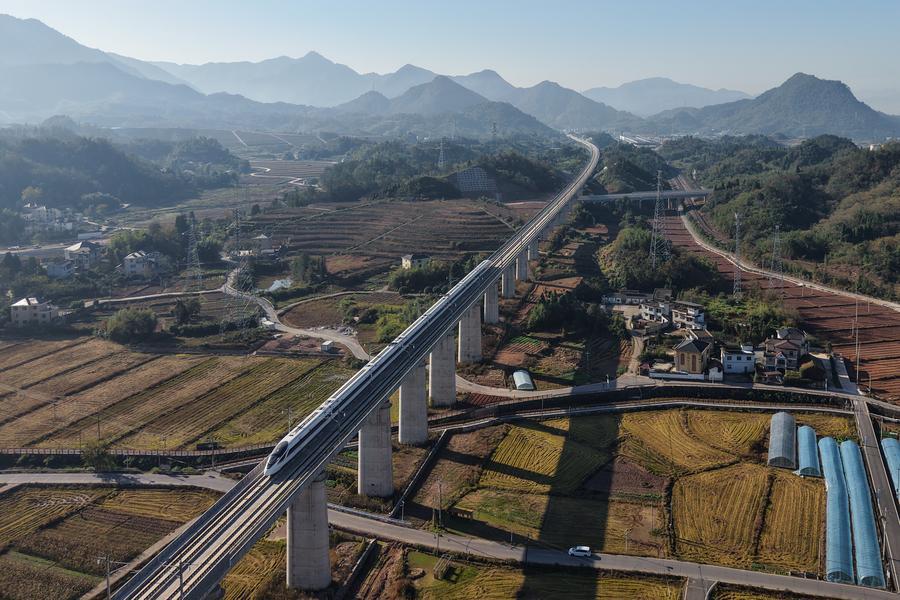
Since launching its high-speed rail service in 2008, China has built the world's largest high-speed railway network, accounting for over 70 percent of the world's total. Up to 10,000 bullet trains carry as many as 16 million passengers every day, with bullet trains having transported over 22.9 billion passengers by the end of 2024.
According to "China High-Speed Rail," a book compiled by the China State Railway Group Co., Ltd., the average railway travel time between the 31 provincial-level capitals in the Chinese mainland decreased by nearly 50 percent in 2024 compared to 2012. "Touring China by high-speed rail" has become a trendy travel option for passengers from both home and abroad.

Kanyanat In-Aim, a Thai student at Ningxia University, toured Xi'an via high-speed rail during the summer break.
The 20-year-old said shorter travel time and reasonable ticket fare make high-speed trains the first choice for students like her.
"It's more affordable than flying, with frequent schedules, greater flexibility and minimal delays," she said, adding that she has planned a winter trip to Baotou with friends on the new high-speed rail to enjoy local food and Mongolian culture.
The sprawling high-speed rail network not only expands the travel radius and mobility but also helps facilitate economic development.
Cities along the Baotou-Yinchuan line have formed a tourism alliance to attract tourists, with destinations like Zhongwei promoting desert stargazing resources. Local specialties, ranging from wine and goji berries to melon and lamb, are reaching national markets faster via high-speed railway transportation.
"We have long anticipated this and are fully prepared," said Ma Shandan, a tourism official from Zhongwei, known for its desert resort of Shapotou on the bank of the Yellow River. "The growing number of tourists will boost our vision of becoming an international tourism destination."
According to national plans, by 2035, China's high-speed rail network will reach 70,000 km, comprising eight main vertical lines linking the north and south and eight horizontal lines connecting the east and west. Once completed, the network will cover major cities, city clusters, and key economic zones nationwide. (Video reporters: Lyu Qiuping, Peng Yuan, Lu Ying, Liang Aiping, Lin Juan, Fu Ruixia, Tian Jianchuan, Wang Ruiping, Mao Xin and Liang Shun; video editors: Zhang Yichi and Mu Xuyao) ■