To manipulate public education and popular opinion, Japan's right wing has long promoted historical revisionism to "whitewash" wartime crimes.
BEIJING, Dec. 23 (Xinhua) -- The fact that Japan has never thoroughly purged militaristic ideology in the post-war period has led to the emergence of figures like Japanese Prime Minister Sanae Takaichi. Over the decades, Japan's right-wing forces have been plotting to restore their agendas.
After Japan's defeat and surrender in World War II, the nation -- having been the primary instigator of aggression -- should have undergone a thorough reckoning. The Potsdam Declaration clearly stipulated that "there must be eliminated for all time the authority and influence of those who have deceived and misled the people of Japan into embarking on world conquest."
However, with the start of the Cold War, Washington's Japan policy shifted fundamentally -- from weakening and demilitarizing Japan to cultivating and rearming it. As a result, the reckoning of Japanese militarism was left unfinished. A policy designed to expel militarists from the political, economic and public spheres, was also suspended, allowing many wartime figures to return to power.
The most emblematic case is Nobusuke Kishi. A militarist remnant who served as Minister of Commerce and Industry in Hideki Tojo's cabinet and was detained as a suspected Class-A war criminal, Kishi unexpectedly returned to politics and became Japan's prime minister in 1957. His rise marked the "revival" of militarist forces in post-war Japan. Atsushi Koketsu, emeritus professor at Yamaguchi University, observed that Japan's post-war political system was, in part, established by those who had once waged aggressive war, adding that their influence continues to this day.
As a result, Japan's right-wing forces were emboldened to grow and fester. For decades, the right-wing forces have worked to revive militarism, deny Japan's history of aggression, and break free from the constraints of the post-war international order.
Their attempts have been visible in actions such as visiting the Yasukuni Shrine. During the war, Yasukuni served as a tool of militarist indoctrination, glorifying "loyalty to the emperor." After 14 Class-A war criminals, including Hideki Tojo, were secretly enshrined there in 1978, the shrine became a symbol of glorification of Japan's war of aggression. Since then, Japanese politicians have continuously visited the shrine. Takaichi herself publicly called it "a sanctuary for peace," and has visited it almost every year in recent years.
To manipulate public education and popular opinion, Japan's right wing has long promoted historical revisionism to "whitewash" wartime crimes. They claim Japan waged war for "self-preservation and self-defense." They also attempt to smear acknowledgments of war crimes as a "masochistic view of history." In 1997, right-wing scholars founded the Japanese Society for History Textbook Reform, which has worked with right-wing politicians to push for textbook revisions. Terms such as "invasion" of China were softened to "advance" or "entry," while atrocities including the Nanjing Massacre and the forced recruitment of "comfort women" were labeled "questionable."
These right-wingers also seek every opportunity to "unshackle" Japan's military. The cornerstone of Japan's pacifist constitution is Article 9, which renounces the nation's right to engage in war or to resort to military force to resolve international conflicts. For decades, this article has been a fundamental constraint on Japan's military endeavors.
However, right-wing groups have worked tirelessly to undermine this very clause. Following the end of the Gulf War, Japan dispatched minesweepers to the Gulf region, marking the first overseas deployment of the Self-Defense Forces (SDF). During the war in Afghanistan, Japan sent naval vessels to provide fuel supplies for U.S. forces, representing the first wartime overseas dispatch of the SDF. In the Iraq War, SDF personnel were deployed to Iraqi territory, the first time they were sent to a foreign land in the midst of an active conflict.
The operational scope of Japan's military forces has continued to expand, steadily hollowing out the principles of its pacifist constitution.
This trend accelerated markedly during Shinzo Abe's administration. In 2015, the Japanese government forced through a new security law allowing Japan to exercise collective self-defense when countries "closely related to Japan" come under attack. This created a legal opening for Japan's shift from defense to offense.
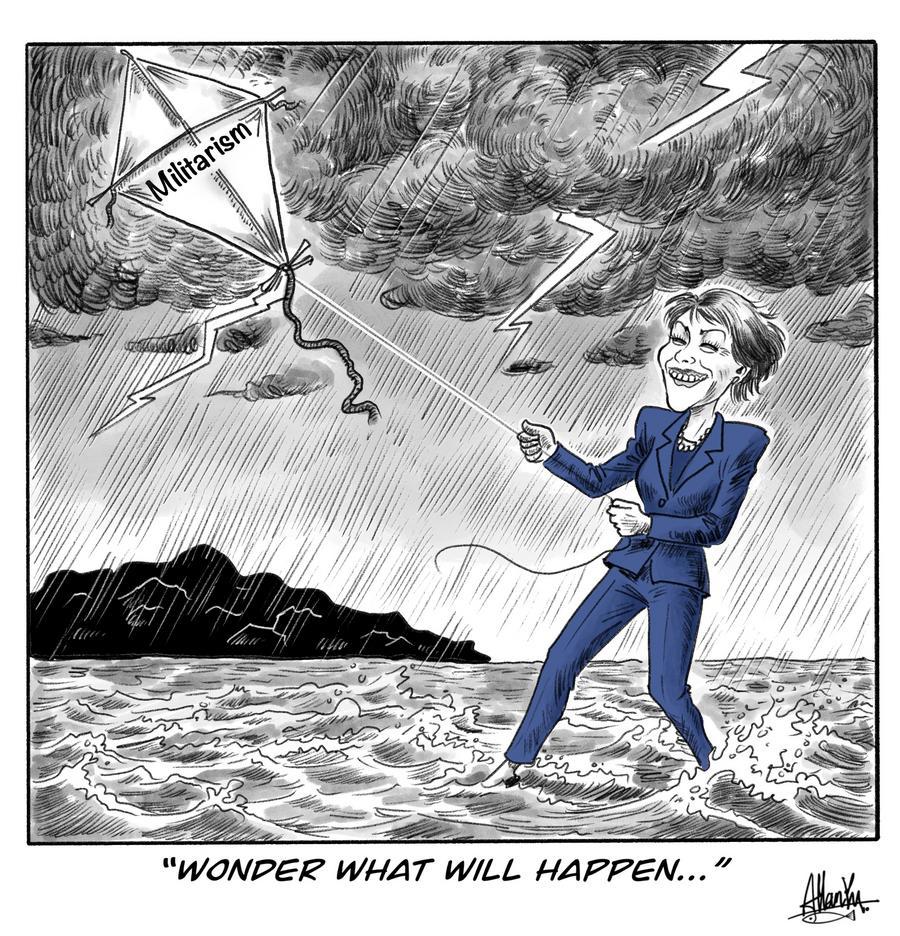
Now, Takaichi, a self-claimed political heir of Abe, attempts to take this already-dangerous reinterpretation and wrench it into even riskier territory for Japan and the region. Unless Japan confronts this unresolved legacy with honesty and restraint, the specter of militarism will continue to seep into its politics with consequences that extend far beyond its shores.
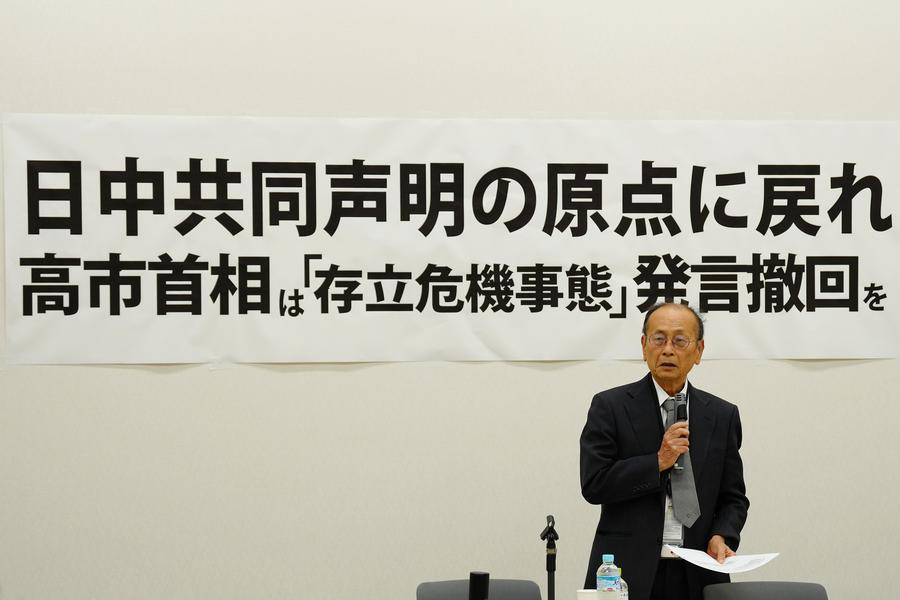
Takaichi's political ascent has been nurtured in the poisonous soil of historical revisionism. From questioning the Murayama Statement, which is regarded as the pinnacle of Japan's apology for its wrongdoing before and during World War II, to denying the Nanjing Massacre and glorifying militarist symbols, she has aligned herself with factions that refuse to reckon with Japan's past aggression. Even more alarmingly, Japanese media have revealed that Takaichi was once photographed with a leader of a neo-Nazi group in Japan.
For decades, Japan's right-wing politicians like Takaichi have remained stuck in a century-old worldview, unable -- or unwilling -- to move beyond the mindset that once fueled Japan's aggression. Their perceptions of China are defined not by facts or contemporary developments, but by nostalgia for imperialist ambitions, denial of wartime atrocities, and disregard for the solemn commitments Japan made when normalizing relations with China.
The Takaichi administration also appears eager to divert attention from domestic challenges, including minority rule, shrinking support for Takaichi's Liberal Democratic Party and dissatisfaction with governance, by staging a confrontational foreign policy performance.
Driven by multiple factors, Takaichi has accelerated her dangerous agenda. She has not only made reckless remarks concerning Taiwan, but also pushed for a drastic increase in defense spending, sought to revise key security documents, attempted to further relax restrictions on arms exports, hinted at developing nuclear-powered submarines, and even broached revising Japan's three non-nuclear principles.
In the face of clear historical and legal facts, Takaichi has neither acknowledged her errors nor withdrawn her fallacies, but intensified them instead. This fully demonstrates that her remarks on Taiwan were by no means a momentary slip, but a deliberate exposure of her political intentions. Some insightful voices in Japan have noted that Takaichi is laboring under at least two fatal misjudgments.
First, she has misjudged the international landscape. An editorial in the Asahi Shimbun sharply pointed out that at a time when the United States is seeking to stabilize its relations with China, Takaichi's remarks "lack a broad perspective," shaking the foundation of Japanese diplomacy. Other commentators noted that Takaichi was trying to tie the United States to her risky agenda and make Washington "foot the bill," which is nothing more than a dangerous political gamble.
Second, she has misjudged China's resolve. The Taiwan question is at the core of China's core interests and the red line that must not be crossed. By challenging China's core interests, she is certain to face a firm and resolute response from the Chinese side.■