BEIJING, Dec. 12 (Xinhua) -- As temperatures plunge across much of north China, a renewed burst of winter enthusiasm is sweeping in, turning the season's chill into unmistakable economic heat.
For Pan Shian, a primary school student in Jilin City in northeast China's Jilin Province, this winter is destined to be unforgettable as the newly introduced "snow break" gave him extra time to practice skiing more than ever. Under the guidance of his coach and with encouragement from friends, he has gradually found his balance on the snow.
Several regions, including Jilin and the Xinjiang Uygur Autonomous Region, rolled out their first official snow breaks this year, giving students days off to encourage them to participate in winter sports. Experts believe the initiative will not only improve children's physical fitness, but also inject new momentum into the country's rapidly expanding ice-and-snow economy.
The move sparked immediate enthusiasm. "Over the snow break, the number of visitors has nearly matched the levels seen during the Spring Festival peak," said Zhuang Hong, marketing manager of a resort in Xinjiang. All slots for the free public ski lessons offered by the resort to primary and middle school students were booked out well in advance.
China has in recent years positioned its ice-and-snow economy as a new engine of high-quality growth, especially since the 2022 Beijing Winter Olympics stirred national enthusiasm for winter sports. The government has set a target for the ice-and-snow economy to reach 1.5 trillion yuan (about 212.21 billion U.S. dollars) by 2030.
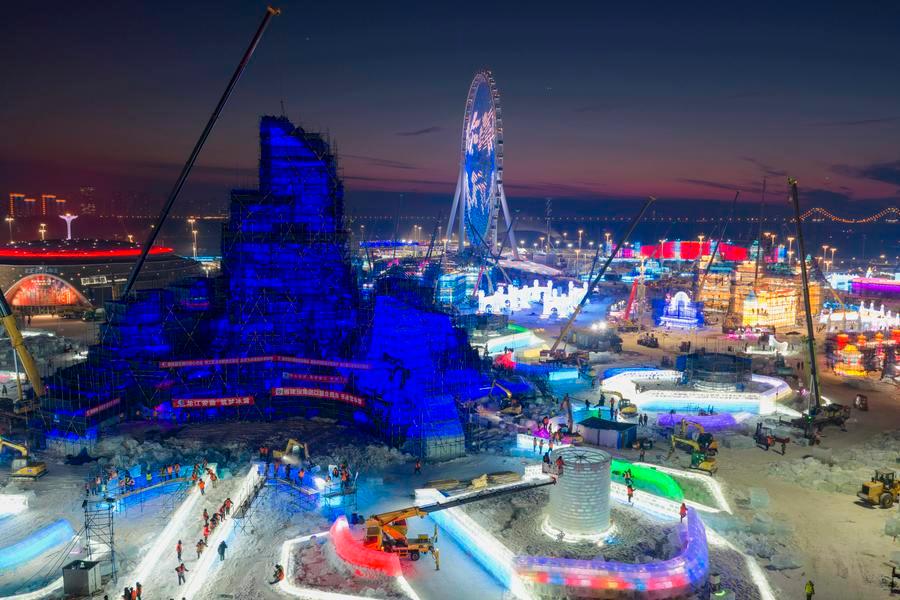
Across north China, the country's snow belt, cities are racing to broaden their winter offerings. In Harbin, capital of the northernmost province of Heilongjiang, preparations are underway for the opening of the Harbin Ice-Snow World, a 1.2-million-square-meter ice-and-snow wonderland featuring new attractions and upgraded services. During the last ice-and-snow season, the world's largest ice-and-snow theme park drew more than 3.56 million visitors.
Heilongjiang is also testing new approaches to sustain the momentum. The province recently hosted the inaugural Ice-and-Snow Sports Super League, following the lead of other "sports-plus" leagues launched in Guizhou and Jiangsu. The league features more than 100 events, ranging from professional skiing and skating competitions to fun activities such as snow football challenges, covering nearly every sport that can be played on ice or snow.
The Super League will utilize distinctive tourism resources across the province to launch city culture festivals, travel-photography contests and other activities around major competition venues, thus creating an immersive ice-and-snow tourism experience combining athletic excitement, leisure travel and specialty consumption, according to Wang Xianyu, director of Heilongjiang Provincial Sports Bureau.
Meanwhile, snow is no longer a prerequisite for south China's growing army of ski lovers. In regions where snowfall is rare, indoor ice and snow facilities are springing up, bringing winter sports far beyond their traditional northern strongholds.
One of the newest indoor resorts, launched in September in the subtropical tech hub Shenzhen, has become a bustling winter escape. With an investment of 29.6 billion yuan, the facility now welcomes over 5,000 visitors a day.
The appeal drew in skiers from nearby regions. "It takes less than an hour to get here from Hong Kong West Kowloon by high-speed rail," said a skiing enthusiast from Hong Kong.
Zou Xinxian, a professor at Beijing Sport University, said the expansion of winter sports into south China helps address the north-south gap in ice-and-snow activities caused by natural conditions, and also boosts the overall market, driving growth across the entire winter-tourism value chain.
China's growing passion for ice-and-snow sports has not only boosted tourism but also spurred development across related industries. Its comprehensive product chain now delivers ice-and-snow equipment covering everything from individual gear to venue infrastructure, and from professional competition facilities to mass participation products.
According to an industrial research report, the size of China's ice-and-snow industry is projected to reach one trillion yuan this year. During the 2024-2025 ski season, consumer spending on winter sports and related activities exceeded 187.5 billion yuan, representing year-on-year growth of more than 25 percent.
Industry insiders anticipate that, driven by business upgrades, industrial integration and policy incentives, China's ice-and-snow economy will continue to release its vitality and emerge as a key engine for boosting consumption and promoting high-quality regional development. ■