BEIJING, Feb. 4 (Xinhua) -- Since the introduction of Xi Jinping Thought on Culture in October 2023, "culture" has become a buzzword throughout China.
In January, a key policy meeting on public communication hailed Xi's cultural thought, stating that it "provides solid ideological guarantees, powerful inspiration, and favorable cultural conditions to make China a stronger country and rejuvenate the Chinese nation on all fronts."
Under Xi's leadership, the Communist Party of China (CPC) is drawing on culture to enhance its governance and drive China's modernization.
How does Xi use the integration of Marxism and fine traditional culture to pursue the Chinese dream of national rejuvenation?
In 2012, Xi incorporated the concept of "cultural confidence" into the report to the 18th CPC National Congress. Later, as the general secretary of the CPC Central Committee, Xi integrated this concept into the "Four Confidences" of socialism with Chinese characteristics, describing cultural confidence as a "more fundamental, deeper, and more enduring force."
"Without full confidence in our culture, without a rich and prosperous culture, the Chinese nation will not be able to rejuvenate itself," he said.
While the world is undergoing profound changes unseen in a century, President Xi has led China into a new era.
Theorists believe that the severe challenges the country faces in the 21st century demand a cultural renaissance to rebuild national identity in the post-Cold War world, where various civilizations and value systems compete and coexist. They even say that the rise and fall of major countries over the past 500 years is the result of the force of cultures.
Xi has cultivated confidence in the Chinese culture in service of the nation's rejuvenation, and established an impenetrable barrier against negative elements in Western culture, according to observers.
On July 1, 2021, when the Party celebrated its centenary, Xi proposed "two integrations," emphasizing the need to "integrate the basic tenets of Marxism with China's specific realities and fine traditional culture." The "second integration" -- one with fine traditional culture -- represents a profound "chemical reaction" and the emancipation of the mind, Xi said.
In June 2023, at a key meeting on cultural inheritance and development in Beijing, Xi summarized five distinctive features of Chinese civilization, emphasizing its outstanding continuity, innovation, unity, inclusiveness, and peaceful nature.
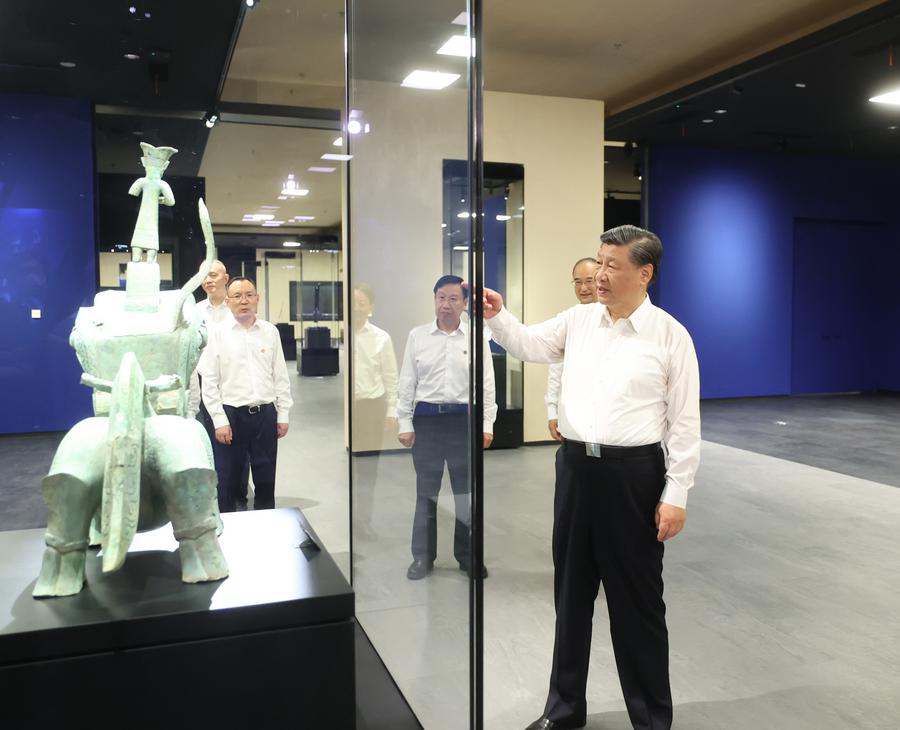
Over a month after the meeting, Xi visited the Sanxingdui archaeological site in Sichuan Province. During his visit, he took his time to examine details of the artifacts dating back thousands of years.
"Where do they come from?" he asked.
"They originated from the cradle of the Yangtze River and Yellow River civilizations, and were born out of the innovative creations of the ancient local people," the docent replied.
At the end of 2023, when Xi delivered his New Year message from his office in central Beijing, a photograph of him observing the Sanxingdui artifacts with great attention was displayed on his bookshelf.
Xi Jinping Thought on Culture, formally put forward in October 2023, encompasses several key aspects, including strengthening the Party's leadership over public communication and culture and promoting the creative transformation and innovative development of China's fine traditional culture.
Theorists state that the establishment of the thought shows that the Party's historical and cultural confidence have reached new heights.
"If there were no 5,000 years of Chinese civilization, where would the 'Chinese characteristics' come from? And if it were not for these Chinese characteristics, how could we have today's successful path of socialism with Chinese characteristics?" Xi once said.
Theorists say that Xi pioneers a new way of governing the country by leveraging culture.
Xi firmly believes in Marxist historical materialism, which views the masses as the creators of history. He elevates the ancient belief of "Min Wei Bang Ben" -- meaning "the people are the foundation of the country; with a solid foundation, the country is at peace" -- to the Party principle of "putting people first."
After leading China to eliminate absolute poverty, Xi strives for the next goal: common prosperity.
"Common prosperity is a fundamental goal of Marxism and has also been a basic pursuit of the Chinese people since ancient times," Xi told Party officials, quoting ancient philosophers. Confucius said, "The trouble lies not in scarcity but in uneven distribution; not in poverty but insecurity," and Mencius called on people to "care for the elderly and the children of others as they care for their own."
"Our goal is both inspiring and simple. Ultimately, it is about delivering a better life for the people," Xi said.
He blends the Party's governing philosophy of "the country belongs to the people, and the people are the foundation of the country" with the traditional idea that "the rise or fall of a political power depends on whether it accommodates the people's will."
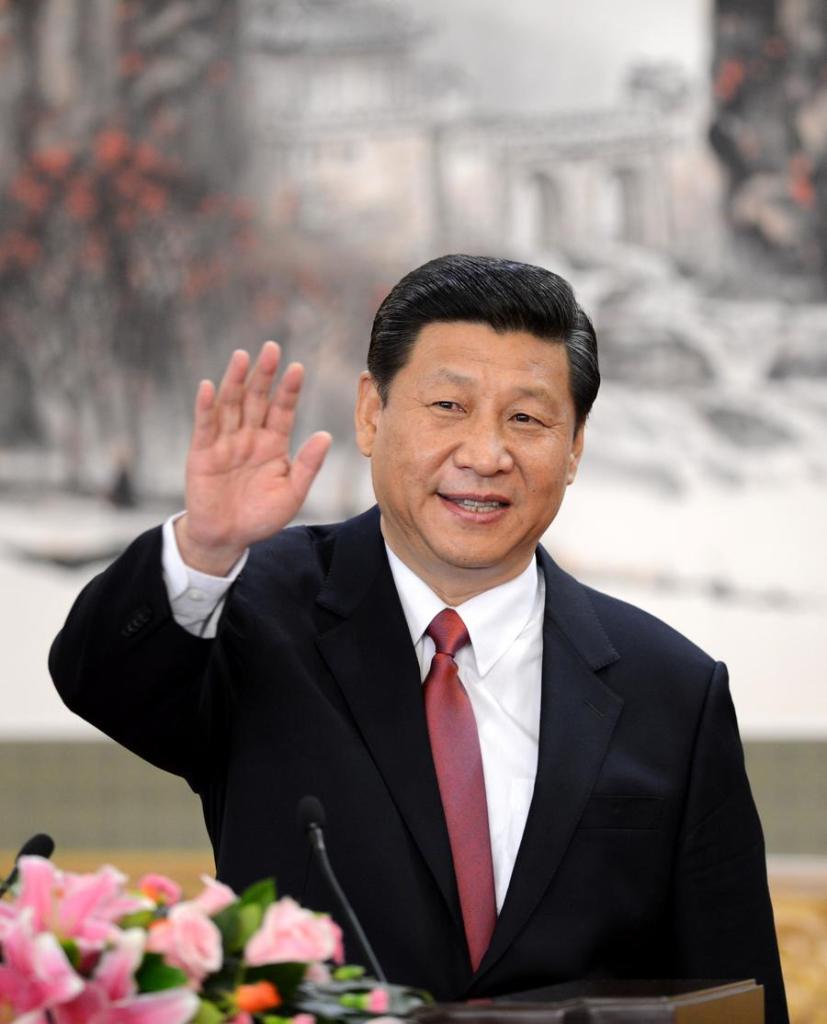
On his first day in office as the Party's top official, Xi cited a Chinese proverb to call for "ironclad self-discipline" and launched the most extensive anti-corruption campaign in CPC history. Xi often shares stories about ancient figures known for their integrity with Party officials, demanding that they practice self-discipline. He uses a Chinese proverb to warn the entire Party, "Many worms will disintegrate wood, and a big enough crack will lead to the collapse of a wall."
In March 2018, Xi became the first Chinese president to take the oath of office in front of the Constitution. He mentioned the ancient saying, "When those who uphold the law are strong, the state is strong; when they are weak, the state is weak," emphasizing the need to advance reforms under the rule of law and enhance the rule of law in the process of reform.
"The issue of the rule of law versus the rule of man is a fundamental question in the history of politics and a significant problem that all countries must face and solve in the process of achieving modernization," he declared.
Xi has constructed and perfected the "spiritual lineage of the CPC," highlighting the tremendous mental strength the Party has demonstrated in key moments or chapters of its history. He is a staunch opponent of "historical nihilism." When some people online defamed revolutionary martyrs like Qiu Shaoyun, hundreds of thousands of Communist Youth League of China members posted rebuttals. Xi commended their response, "Righteousness has overwhelmed misconduct, well done!"
Xi introduced the concept of "profound changes unseen in a century," incorporating insights from a Marxist view of history and the ancient Chinese philosophy of "changes." In his report to the 20th CPC National Congress, he included "discarding the outdated in favor of the new" from the "Book of Changes," driving reforms in key areas.
Xi, a proven change-maker, draws upon his transformative experiences in Liangjiahe, where he defied skeptics and proceeded with the construction of the first methane-generating pit in the entire Shaanxi Province.
Now, he advocates for embracing the enterprising and innovative spirit of the Chinese nation to propel China into an era of innovation.
In a discussion with academicians, he mentioned how, during the 18th century, under the direction of the Qing government, Western missionaries spent 10 years creating the unprecedentedly advanced "The Map of Imperial China." This map was kept secret within the imperial court while the missionaries took the data back to the West, organized and published it, resulting in the West having a better understanding of China's geography.
Xi uses this example to emphasize that scientific and technological development must be integrated with social progress. He stresses the need to deepen reforms in the management of science and technology, allowing all sources of innovation to flow freely.
Infusing both the principles of Marxist development theory and traditional Chinese dialectics, Xi has introduced a new philosophy advocating innovative, coordinated, green, and open development accessible to all. He urges an approach of "consolidating stability through progress and establishing the new before abolishing the old," employing Chinese philosophical perspectives to guide the nation's economic endeavors.
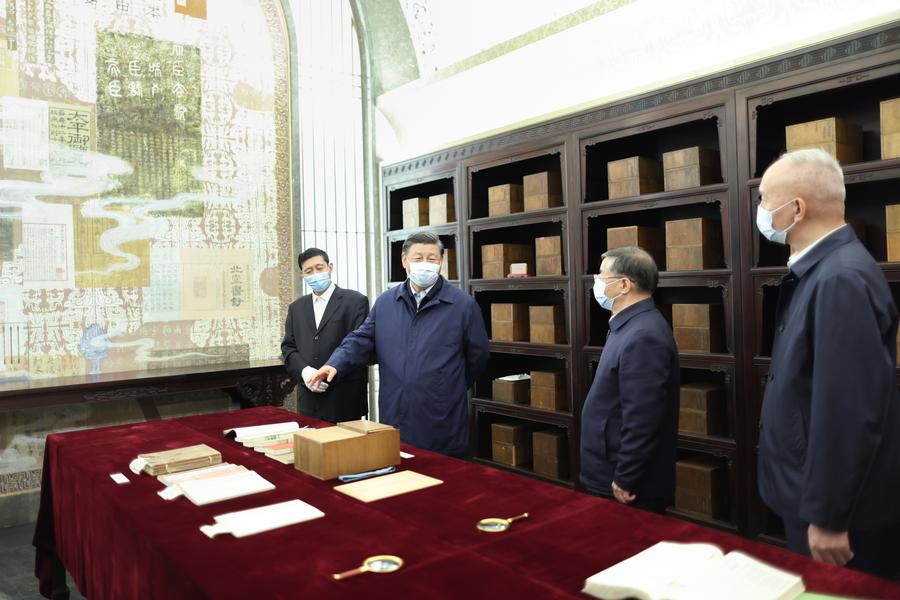
As an ardent fan of literature and art, he has vigorously promoted the flourishing of Chinese culture. In 2014, 72 years after the first such event, Xi chaired the second seminar on literature and art in CPC history, proposing concepts like "using literature to convey morality" and "cultivating people through culture." Attendees recalled that Xi spoke "like talking among friends and family," and he shook hands with everyone after the three-hour-long seminar.
He is enthusiastic about folk culture and arts, such as myths, epics, storytelling, and local operas. He encourages contemporary young novelists, poets, and painters to innovate, and extends support to the domestic science fiction film industry. This reflects his deep commitment to nurturing and promoting diverse aspects of Chinese cultural heritage and contemporary artistic expressions.
He emphasized the treasures passed down in Chinese culture -- the indivisibility of the territory, the order of the state, the unity of the nation, and the continuity of civilization -- asserting, "Our country must be reunified, and will surely be reunified."
Xi has adopted the traditional philosophy of "Tian Ren He Yi," or "unity of nature and man," to initiate an unprecedented campaign for ecological restoration and protection. This included a 10-year fishing ban on the Yangtze River to protect aquatic life. He likened the protection of the Yangtze River to traditional Chinese medicine treatment, stressing efforts to treat existing illnesses and prevent future ones. Under his leadership, China has witnessed historic changes in its environment, resulting in bluer skies, greener mountains, and clearer waters.
Xi tapped the ancient philosophy of favoring peace and harmonious coexistence in formulating foreign policy, proposing the concept of building a community with a shared future for humanity. He once told foreign leaders that China does not intend to only develop its backyard but rather a garden shared by all countries. ■