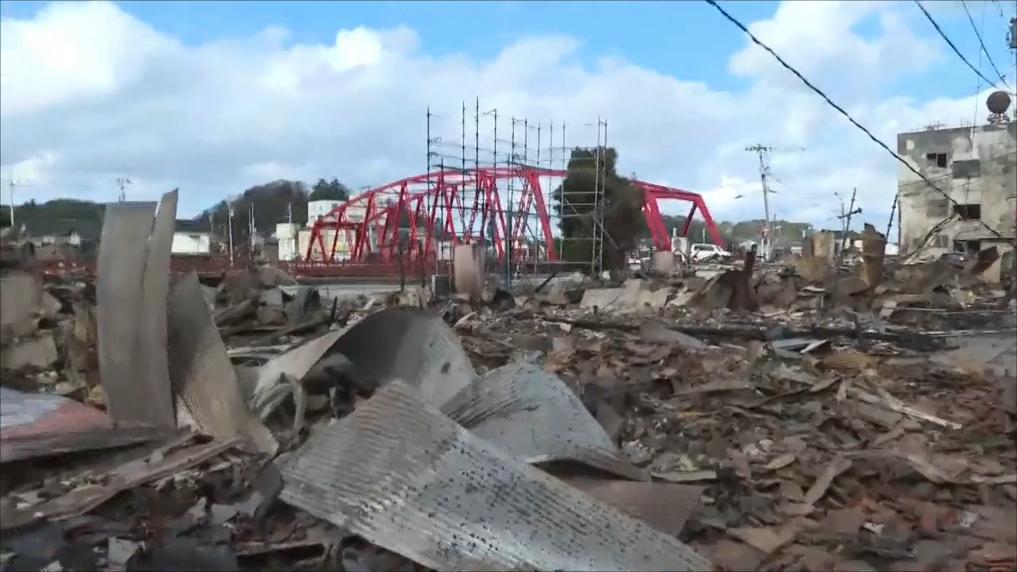
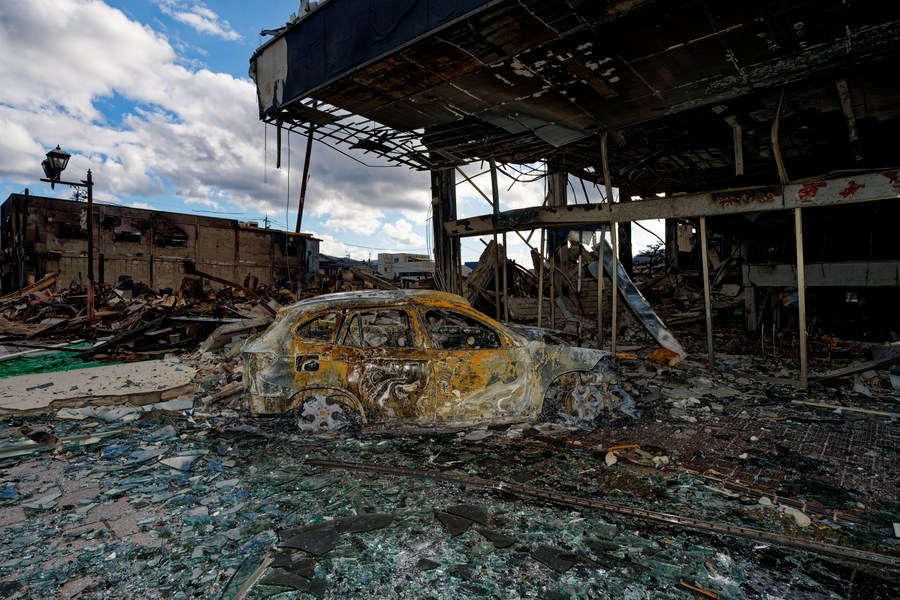
This photo taken on Jan. 4, 2024 shows rubble of a renowned morning market in Wajima city of the central Japanese prefecture of Ishikawa. The morning market was gutted by a large blaze, engulfing over 200 structures in the central Wajima area. (Xinhua/Zhang Xiaoyu)
Battling through torn-apart roads and scattered debris, it took over nine hours for Xinhua reporters to drive about 100 kilometers into Wajima city on Wednesday, only 30 km away from the epicenter of Monday's earthquakes in Japan.
WAJIMA, Japan, Jan. 5 (Xinhua) -- As rain fell sluggishly down, the architectural integrity of each block crumbled with collapsed houses dotting the landscape in the Japanese city of Wajima, only 30 km away from the epicenter when a series of strong earthquakes on Monday rocked the Noto region of Ishikawa Prefecture.
Battling through torn-apart roads and bridges strewn with scattered debris and glass remnants, it took over nine hours for Xinhua reporters to drive their way into Wajima city on Wednesday from Takayama, which is about 100 kilometers away.
A series of strong earthquakes, with a major one of 7.6 magnitude, on Monday struck at a shallow depth in the Noto region of Ishikawa. The Japan Meteorological Agency has officially named it the 2024 Noto Peninsula Earthquake.
Centered around 30 km east-northeast of Wajima, the devastating quake registered a maximum intensity of 7, which would make it impossible for people to stand.
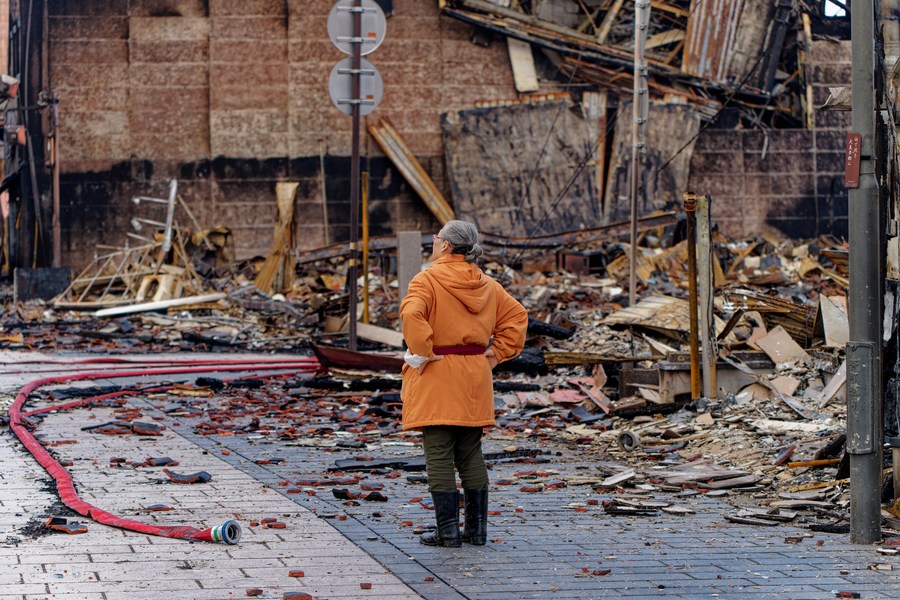
A citizen looks at the rubble of a renowned morning market in Wajima city of the central Japanese prefecture of Ishikawa, Jan. 4, 2024. The morning market was gutted by a large blaze, engulfing over 200 structures in the central Wajima area. (Xinhua/Zhang Xiaoyu)
As of Thursday afternoon, prefectural government data showed that the Noto Peninsula Earthquake has claimed 82 lives in Ishikawa, with 48 fatalities recorded in the hardest-hit Wajima city, best known for its fisheries, lacquerware and markets.
The earthquake also triggered a severe fire at the renowned Wajima Asaichi morning market, a century-old shopping district, destroying over 200 buildings.
Less than one km from where the fire broke out, two stone pillars stood tilting awkwardly in the middle of the road. They were, astonishingly, sections of sewer pipes lifted about a meter high from below the ground.
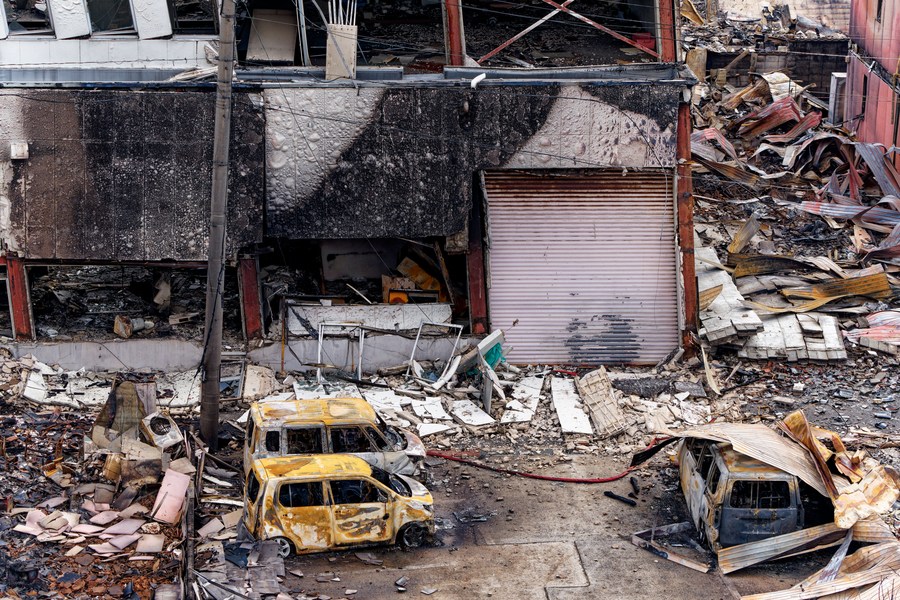
This photo taken on Jan. 4, 2024 shows rubble of a renowned morning market in Wajima city of the central Japanese prefecture of Ishikawa. The morning market was gutted by a large blaze, engulfing over 200 structures in the central Wajima area.. (Xinhua/Zhang Xiaoyu)
Adjacent to them, two houses presented a surreal sight, one reduced to just its roof after collapsing, with the other elevated, resting on top of two cars in the front yard.
In the pattering rain, the devastated city was falling short of water and food, and residents were lining up holding umbrellas along the roadside. A girl in her 20s in the queue told Xinhua that this was the only open supermarket in Wajima after the temblors and that she had traveled for over half an hour with her family upon hearing the news of the supermarket's reopening on social media.
Having queued for more than three hours already, she remained uncertain about when she would reach the front, and even then, the availability of food was unknown.
Recalling the scene when the earthquake struck, the girl was still in a state of shock: "Our family lives on the beach in Wajima City. When the earthquake occurred, the underground water pipe may have burst and the entire entrance was flooded. Just when my family and I were at a loss for what to do, we learned there was a tsunami warning, so we immediately ran for the hills. I only realized halfway through that I hadn't even put on my shoes."
"I was staying on the fifth floor of the hotel when the earthquake happened. The windows of my entire room flew out." A white-haired old man in the queue told Xinhua that he was a tourist from Aichi Prefecture and nearly 30 people of their tourist group were trapped in the city after the earthquake, staying at a nearby shelter.
"I haven't had a meal since the earthquake except for some snacks and a bottle of drinking water given by the shelter. When I saw everyone queuing up here, I followed suit. I didn't expect to wait in line for more than three hours. I feel like I can't hold on any longer," he said.
Reporters went to the front of the queue to find out what was going on, and saw clear purchase restrictions posted on the wall: each household could purchase up to one case of water, one case of instant noodles and two boxes of instant rice.
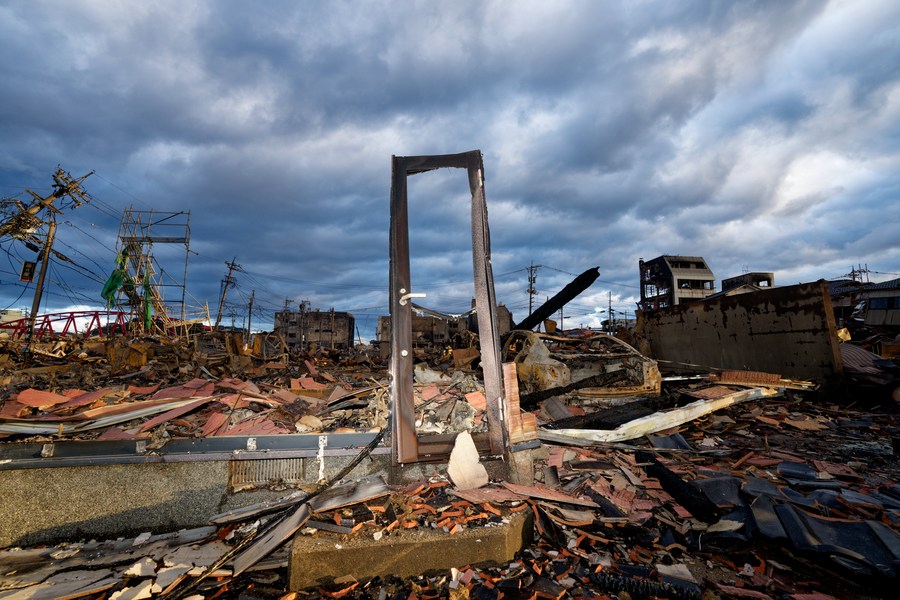
This photo taken on Jan. 4, 2024 shows rubble of a renowned morning market in Wajima city of the central Japanese prefecture of Ishikawa. The morning market was gutted by a large blaze, engulfing over 200 structures in the central Wajima area. (Xinhua/Zhang Xiaoyu)
After the earthquake, almost all traffic to Wajima City was blocked, and relief supplies were unable to enter the disaster-stricken area in large quantities. The shortage of water and food is currently the biggest difficulty here, according to media reports.
A group of firefighters were still carrying out the rescue as the rain got heavier and the sky turned completely dark.
"A four-storey building collapsed on the residential house next to it. We have found a woman under the rubble." Firefighters had no time to talk too much, but a Japanese journalist told Xinhua that the rescue team began their operation here on Wednesday morning, but the woman had not yet been rescued.■