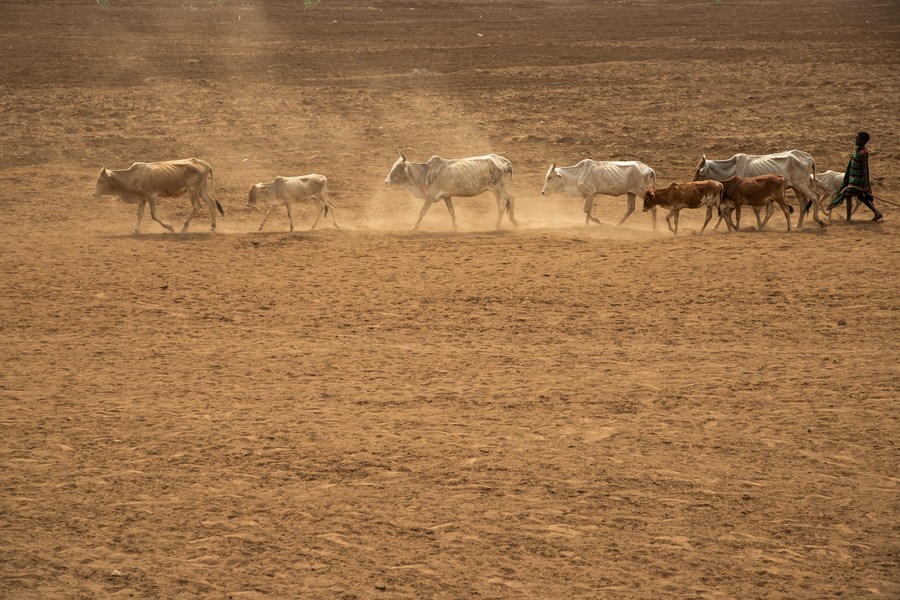
A herder moves with cattle in the drought-stricken Somali Region of Ethiopia, June 11, 2023. The adverse effect of climate change has further worsened the existing "widespread food insecurity" in the East Africa region. (Xinhua/Michael Tewelde)
Climate shocks are triggering worsening security environments. Action must be taken to avert ever-worsening effects.
UNITED NATIONS, June 14 (Xinhua) -- The UN Security Council on Tuesday highlighted the growing security risks climate shocks pose in vulnerable locations. Speakers strongly urged decisive action to address the intricate connections between climate change and conflict.
With an estimated 3.5 billion people living in climate hotspots, related peace and security risks are only set to heighten, UN Under-Secretary-General for Peace Operations Jean-Pierre Lacroix told the council, warning that action must be taken to avert ever-worsening effects.
Climate shocks are triggering worsening security environments, from Afghanistan to Mali, and UN peacekeeping missions are taking steps to adapt, from reducing their carbon footprint to addressing myriad related consequences.
"Given the growing linkages of climate change, peace, and security, as well as the broader changes to the conflict dynamics in the areas in which we work, we must continue to adapt," he said.
Providing an overview of current efforts, Lacroix said that within the past several years, most UN peace operations have faced greater dangers and political challenges.
Of the 16 countries that are the most climate vulnerable, nine host a UN field mission, he said, emphasizing that most UN peace operations are deployed in contexts that are both highly climate exposed and characterized by high levels of gender inequality.
"Our missions witness first-hand the dual vulnerabilities posed by climate change and insecurity," he said, offering several examples.
As such, priority areas for action in UN field missions include investing in capacities to anticipate and address climate and security linkages, reinforcing the mutual benefits of climate action and making environments safer, and ensuring the missions do not become part of the problem, he said.
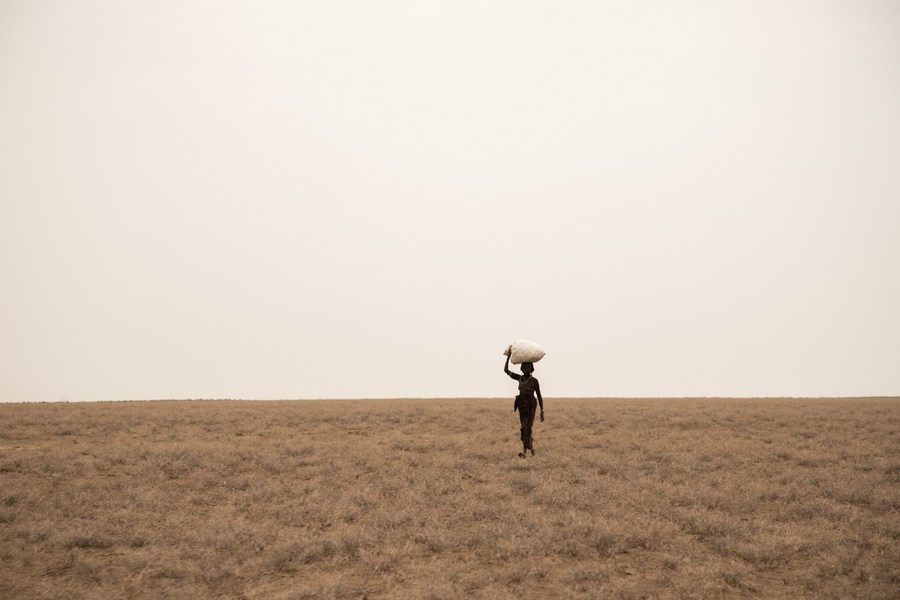
A woman carrying a load is seen in the Somali Region of Ethiopia, June 11, 2023. (Xinhua/Michael Tewelde)
At the council's second formal meeting of 2023, more than 70 speakers, including former Colombian President and Nobel Prize laureate Juan Manuel Santos, exchanged views on connections between climate change and worsening security.
He said that peace can only be maintained if the very forests, soils and rivers that communities depend on are protected and managed sustainably.
"We need bold policy action," he said. "We must redouble our efforts not only in mitigation and adaptation but in nature-positive solutions, including conserving high-integrity forests, peatlands, coral reefs, and other ecosystems that provide humanity with clean air, clean water."
Salma Kadry, a climate, peace and security expert at the Consortium on International Agricultural Research, warned that failing to address the scale of the climate crisis would expose her generation and future ones to an array of escalating dangers and insecurities.
She encouraged the global community to reassess the effectiveness of its peace and security measures in promoting innovation and building resilience, especially among women and young people. Additionally, she called upon the Council to broaden the range of research that informs its decision-making processes.
In the ensuing all-day debate, speakers tackled the issue of the climate crisis-security nexus, with many urging the council to expand the measures already underway to curb the impact climate-related changes have on both peacekeeping operations and the regions in which they are located.
Hermann Immongault, minister for foreign affairs of Gabon, said that 17 out of 20 countries most affected by climate change are in Africa. Access to water, along with drought, desertification and recurrent flooding constraints, is causing the economic and social fabric of the Horn of Africa and the Sahel region to fray.
He called for incorporating the climate-security nexus in geopolitical strategies; boosting cooperation between subregional and regional organizations and the United Nations; and sharing best practices at the national, regional and international levels.
"This is the question of survival of the affected populations and the issue that determines peace and security for people throughout the world," he added.■