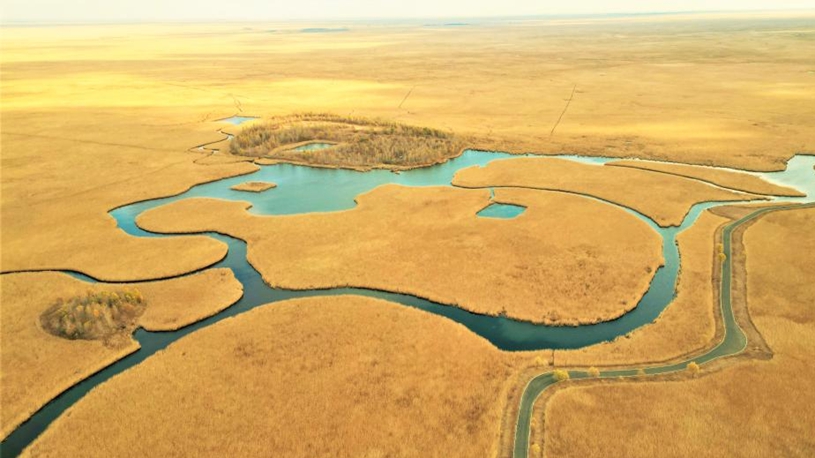
URUMQI, Oct. 31 (Xinhua) -- A vast expanse of yellow sand is dotted with round pastures in the southern part of the Taklimakan, China's largest desert, in northwest China's Xinjiang Uygur Autonomous Region.
In recent years, Hotan County, located at the southern fringe of the desert, has actively promoted the development of smart agriculture.
Forage planting has become possible regardless of the high evaporation rate and low water retention capacity in the desert. Water-saving irrigation equipment has been applied to accurately control the amount and time of water spraying.
Through forage planting, the county has seen an improvement in the ecological environment, the development of animal farming, and an increase in farmers' income.
"Forage planting in the desert is of great meaning. It can not only defend against the wind and the sand, but also help local farmers earn more money," said Yu Wenhua, manager of forage planting base of an agricultural technology company.
By the end of 2021, the local forage planting area had exceeded 100,000 mu (about 6,667 hectares), and the number of cattle and sheep had reached 737,100.
Produced by Xinhua Global Service