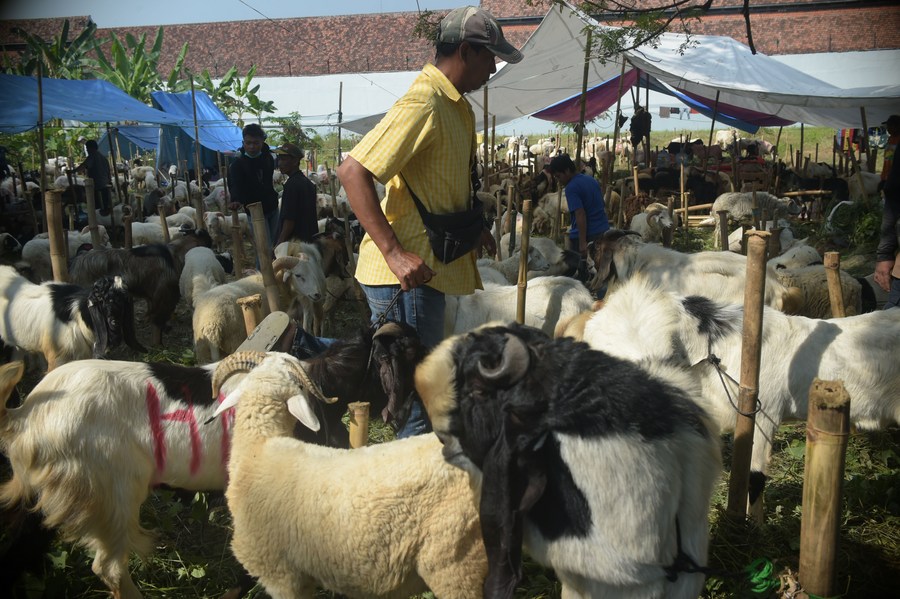
 A temporary livestock market ahead of the Islamic holiday of Eid al-Adha in Tangerang, Indonesia, July 8, 2022. (Xinhua/Zulkarnain)
Indonesia is currently coping with a re-emergence of the foot-and-mouth disease (FMD) affecting cloven-hoofed animals ahead of Eid Al-Adha celebrations.
by Nurul Fitri Ramadhani
JAKARTA, July 9 (Xinhua) -- Eid Al-Adha celebration is supposed to be the most-awaited and "profitable" moment for Supardi, a 56-year-old goat breeder from Gresik, Indonesia's East Java province -- but things are different this year.
Around 36 out of the total 61 goats he has have been infected by the foot-and-mouth disease (FMD), forcing him to kill and bury them.
"Every year before, I could sell more than 40 goats ahead of Eid Al-Adha. But now, only 10 goats have been sold," Supardi told Xinhua on Friday.
Eid Al-Adha, which falls on July 9-10, is an Islamic ritual where Muslims buy and sacrifice sheep, goats, or cows. One-third of the meat is eaten by the family, while the rest is distributed to the poor people.
Indonesia, the world's largest populous Muslim country, is currently coping with a re-emergence of the FMD which spreads among cloven-hoofed animals such as cattle, sheep, pigs, goats and cows.
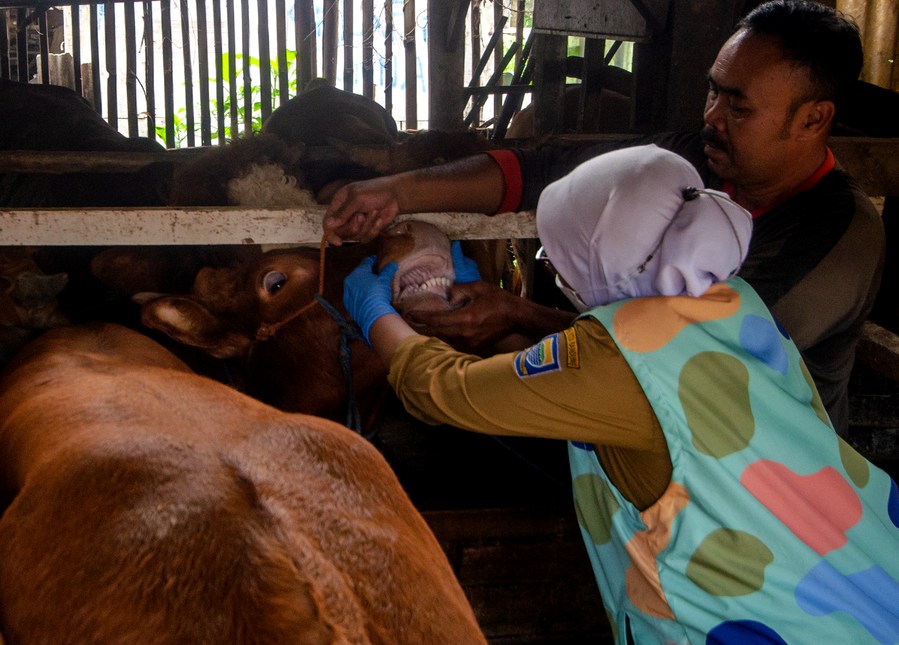
An animal care worker checks the mouth health of a cow in tackling a re-emergence of foot-and-mouth disease (FMD) among livestock animals in Bandung, West Java, Indonesia, July 4, 2022.(Photo by Septianjar/Xinhua)
As of Wednesday, more than 289,430 animals were reportedly infected and at least 1,722 animals died from the disease, according to official data from the National FMD Task Force.
Nadia, a 29-year-old employee from Jakarta, said she initially planned to buy a goat but canceled the plan due to the disease.
"I always buy either goat or sheep every Eid Al-Adha, but I will not do that this year. I am afraid of the disease because until now we do not know exactly what the impacts of it are to us as humans," she told Xinhua.
The Indonesian government has warned all cattle breeders and sellers to ensure that the animals they sell are free from the disease, ordering all slaughterhouses to kill and bury all animals that are showing symptoms or proven to be infected by the virus.
"We do not want to ruin this year's Eid Al-Adha festivities. All animals that will be sacrificed must be tested and proven negative from any diseases," Coordinator of the National FMD Task Force Wiku Adisasmito said Friday in a virtual press briefing.
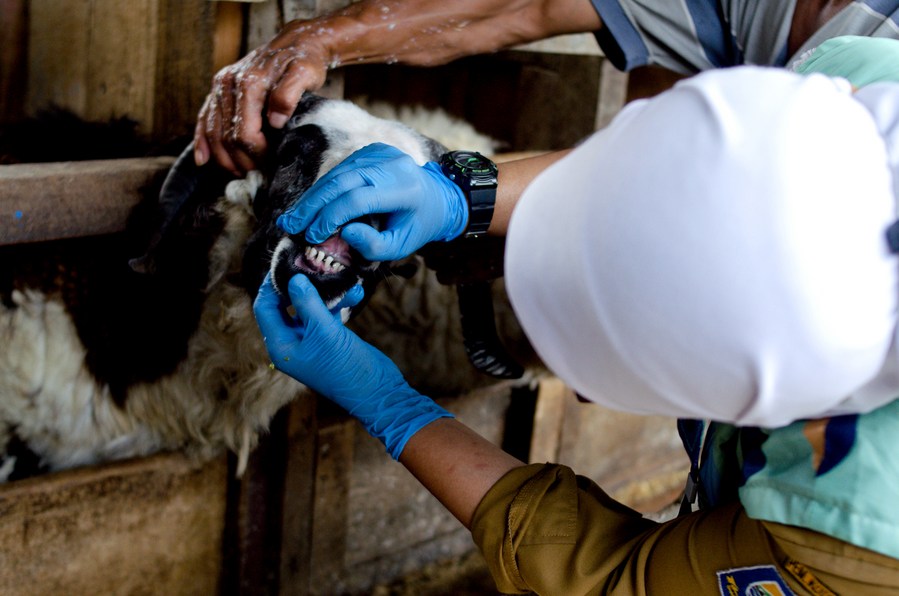
An animal care worker checks the mouth health of a goat in tackling a re-emergence of the foot-and-mouth disease (FMD) among livestock animals in Bandung, West Java, Indonesia, July 4, 2022. (Photo by Septianjar/Xinhua)
"As another anticipation, we urge the public to avoid consuming certain parts of the animals, such as legs, heads, offal and intestines, to prevent any unwanted infections," he added.
FMD, one of the world's worst animal plagues, spreads by direct contact among animals, and animal products, mechanical transfer via fomites and the airborne route.
The disease is characterized by blisters or sores around the mouth, muzzle, feet and teats, a tendency to lie down, as well as lethargy or depression.
Prior to the current outbreak, Indonesia had been declared free of FMD since 1986, a status recognized internationally by the World Organization for Animal Health (OIE) in 1990.
But the outbreak has re-emerged since May when Muslims across the country celebrated the Eid-al Fitr holiday and traveled back home.
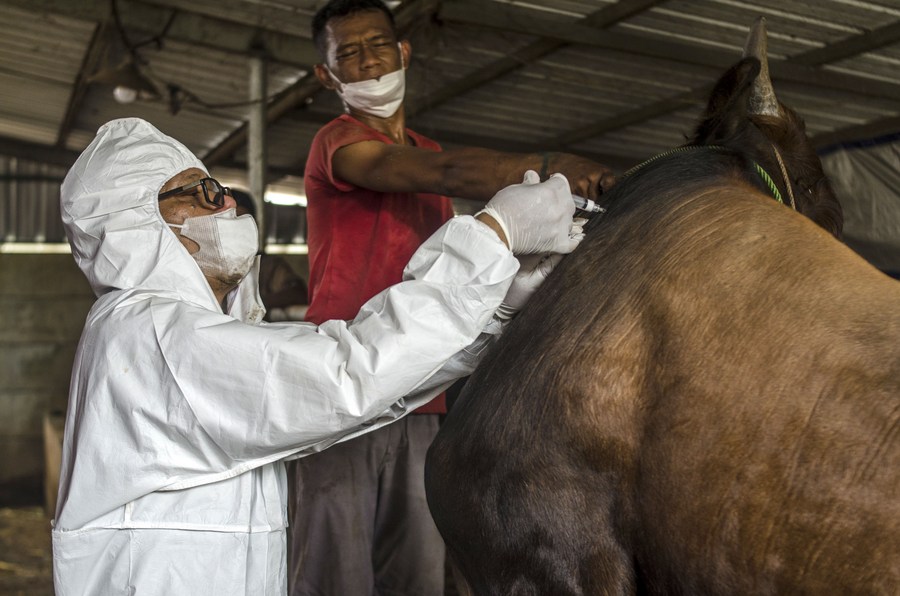
An animal care worker wearing protective suits gives a vaccine dose to a cow during nationwide livestock vaccination program against the foot-and-mouth disease (FMD) in Bandung, West Java, Indonesia, June 27, 2022.(Photo by Septianjar/Xinhua)
A lot of livestock breeders have been impacted by the outbreak, causing a decrease in livestock prices and a slump in exports of livestock and derivative products.
Coordinating Minister for Economic Affairs Airlangga Hartarto said the authorities had prepared around 3 million doses of FMD vaccines, mostly imported from France. To date, at least 91,716 livestock in the country have been vaccinated.
The Agriculture Ministry has also distributed medicines, antibiotics, vitamins, immune boosters as well as disinfecting agents to the farmers and breeders.
Supardi is one of the breeders whose goats have been vaccinated. But even though he has already announced that his goats have been free of FMD using a banner, he still lost many customers.
"I put extra efforts to take care of the rest of my goats, but that does not significantly fix anything. Buyers are still worried about the infections. I lost a lot this year," Supardi said. ■