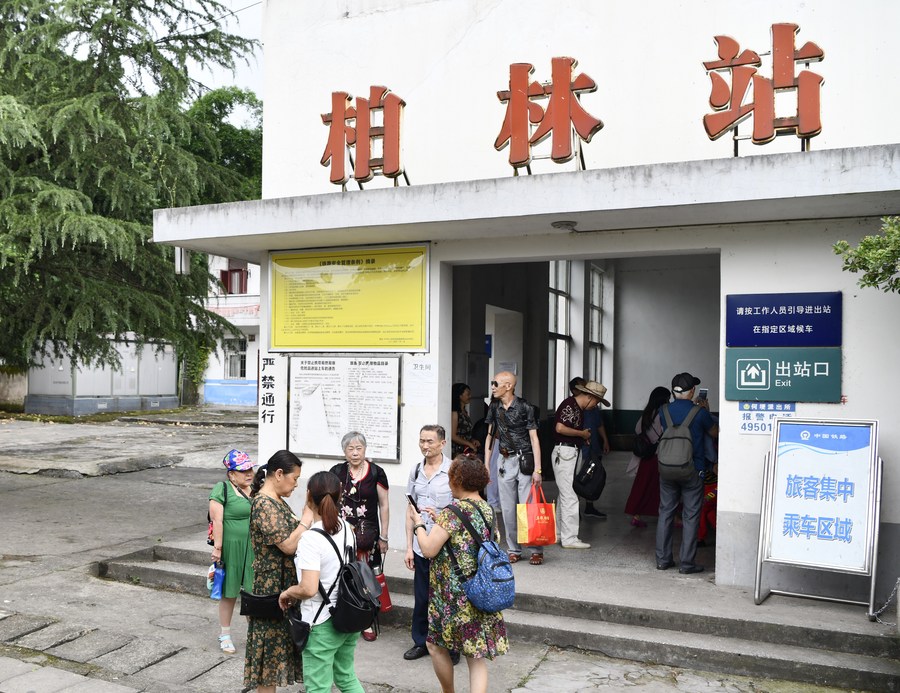
File photo taken on June 14, 2019 shows passengers at Bolin Railway Station along the Chengdu-Chongqing Railway. (Xinhua/Liu Chan)
CHONGQING, Feb. 15 (Xinhua) -- Martin Hinkens, who comes from Germany and now owns five German sausage eateries in China, began his adventure in a foreign land by mere coincidence.
He was told by a guest at his restaurant that there is a place in southwest China's Chongqing Municipality that shares the same Chinese name with Germany's capital, Berlin.
After searching a map for "Bolin," the Chinese name for Berlin, Hinkens was surprised that Bolin does not just refer to one single place, but a train station, a bus stop, a village and also a town in Chongqing.
The Bolin train station was built in 1952, alongside the construction of China's first railway linking Chongqing and Chengdu, capital of the neighboring Sichuan Province. Even today, a slow train continues to pass the small station along its route.
Since he often takes high-speed trains to travel between the two cities, where his restaurants are operated, Hinkens decided to take a look at the old station himself.
"I am home!" he posted on his WeChat feed, alongside a picture of himself standing under the sign for the train station.
As more and more people commented on the post, the German soon realized that the train station had become an internet-famous site in Chongqing. Many now post pictures of the station and joke that they have taken a train to Berlin.
Taking the slow train along the route is also becoming increasingly popular among all age groups. For young people, the journey lends a retro style to their photographs. And the elderly enjoy buying fresh, cheap vegetables in nearby villages or aboard the train, as many locals carry farm produce to sell on the journey.
Hinkens said he was amazed to find the slow train now serves as a moving market for those living in the region. And, as the old route was built along the Yangtze River, he says it is refreshing to appreciate the views along the way.
"Nowadays, trains are too fast to leave time for people to enjoy the view. I am glad that I can have this opportunity to have this nearly forgotten experience," Hinkens said.
The 140-km train journey from Bolin to Chongqing usually takes four hours. When Hinkens wants to speed up the trip to Chengdu about 300 km away, he opts for an intelligent Fuxing bullet train.
Launched last year, the inter-city bullet train can run 350 kilometers per hour.
The new trains are also filled with intelligent and user-friendly designs. Every seat has a charger and USB plug, and the screens above the seats show if they are available or not with red or green lights, Hinkens said. "Also, if you are hungry, you can directly scan the QR code on the armrest and order the food online."
Despite their difference in speed, Hinkens said that he found the two train types have something in common.
No matter how slow or fast these trains are, the trains always put people's needs first, he said. For example, the bullet trains have a designed wheelchair space and emergency call buttons in the special toilets for those with disabilities. There are also braille instructions for those who are visually impaired so that they can read which carriage they are in, he said. ■