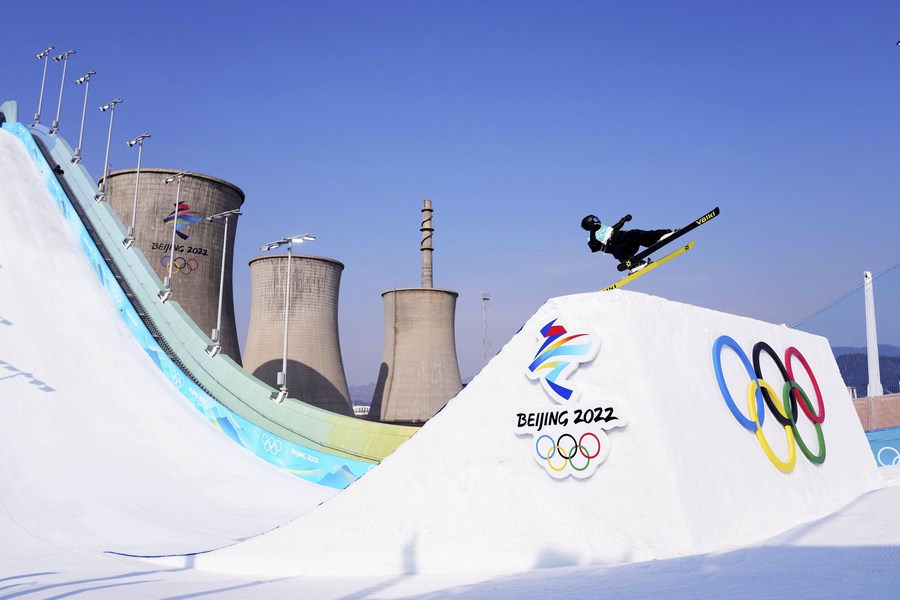
Birk Ruud of Norway competes during the freestyle skiing men's freeski big air final at Big Air Shougang in Beijing, capital of China, Feb. 9, 2022. (Xinhua/Xiong Qi)
BEIJING, Feb. 10 (Xinhua) -- Against the striking backdrop of enormous cooling towers, Olympic skiers launch themselves in the air with awe-inspiring twists and flips.
The stunning scene has been catapulted into the spotlight as many viewers and athletes were impressed by the large ski ramp built on the site of the repurposed Shougang Group's steel mill, over 20 km away from the iconic Tian'anmen Square in downtown Beijing.
The Shougang Big Air is the world's first permanent big air venue for long-term usage. It is set to host freestyle skiing and snowboard big air events, which will offer four gold medals altogether at the Winter Olympics. China's prodigy Gu Ailing claimed historic gold here on Tuesday.
"The venue is amazing. The big air jump rides so well and it is such a cool place to have the jump in. I really love it," said British freestyle skier Kirsty Muir.
Like the breathtaking skiing feats, the story behind how the steel mill was transformed into a cultural and sports complex without erasing its industrial heritage is also intriguing.
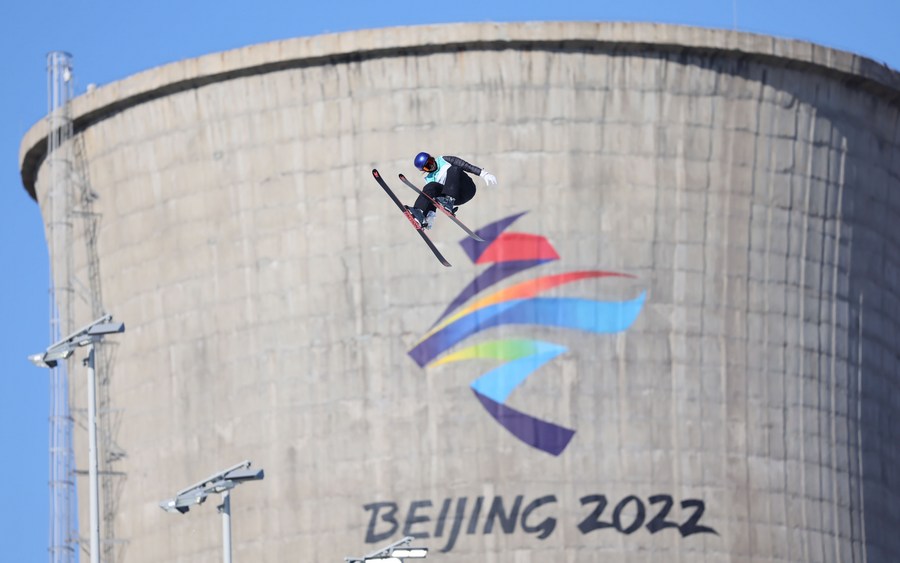
Gu Ailing of China competes during women's freeski big air final at Big Air Shougang in Beijing, capital of China, Feb. 8, 2022. (Xinhua/Lan Hongguang)
Founded in 1919, Shougang, a leading heavyweight steelmaker in China, once hit a record of 10 million tonnes of annual output, with more than 200,000 workers at the peak. It contributed to around 10 percent of Beijing's GDP before 2008 when the capital city hosted the Summer Olympics.
As part of the city's economic restructuring and pollution control initiatives, Shougang started relocating its production base to neighboring Hebei Province in 2005, where the steel conglomerate has built high-end and eco-friendly iron and steel production lines.
The steel-making operations in Beijing were halted in 2010, which left a large stretch of industrial heritage on the original sprawling campus. Rusty, aging smokestacks, blast furnaces and factories remain but without smoke coming out of them.
With China's successful bid to host the 2022 Winter Olympics, the industrial heart of the Chinese capital has taken on a new look as the headquarters of the Beijing 2022 organizing committee and training centers for ice and snow sports.
The Shougang Park has been hailed as a "new landmark for Beijing's urban revitalization."
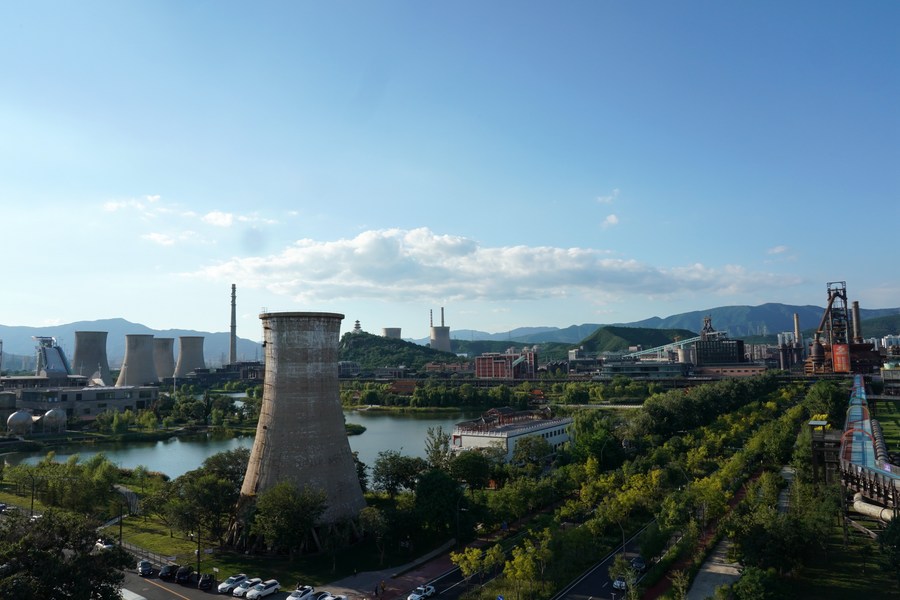
Photo taken on Sept. 6, 2021 shows a view of Shougang Park during the China International Fair for Trade in Services (CIFTIS) in Beijng, capital of China. (Xinhua/Zhang Chenlin)
For post-Games use, architects plan to transform the cooling towers hovering over the big air jump into venues for press conference or wedding. The remains of the former repair workshop, coking plant, and shaft furnace are being renovated into a street mall, sci-fi theme park, X-sports arena and high-tech incubator.
Not only the buildings have undergone a transformation, but so have the closed plant's approximately 50,000 steelworkers, who have turned themselves into ice makers, tourist guides, security guards, or property managers.
"The change is really incredible. My job has been changed from one related to 'fire' to one related to 'ice,'" said 42-year-old Liu Boqiang, a steel rolling worker-turned ice maker.
In the summer of 2017, Liu spent several months learning ice-surfacing. Coming into a completely new field, he had to learn from scratch. Every day he is busy on the ice rink, wearing knee pads and cotton clothes.
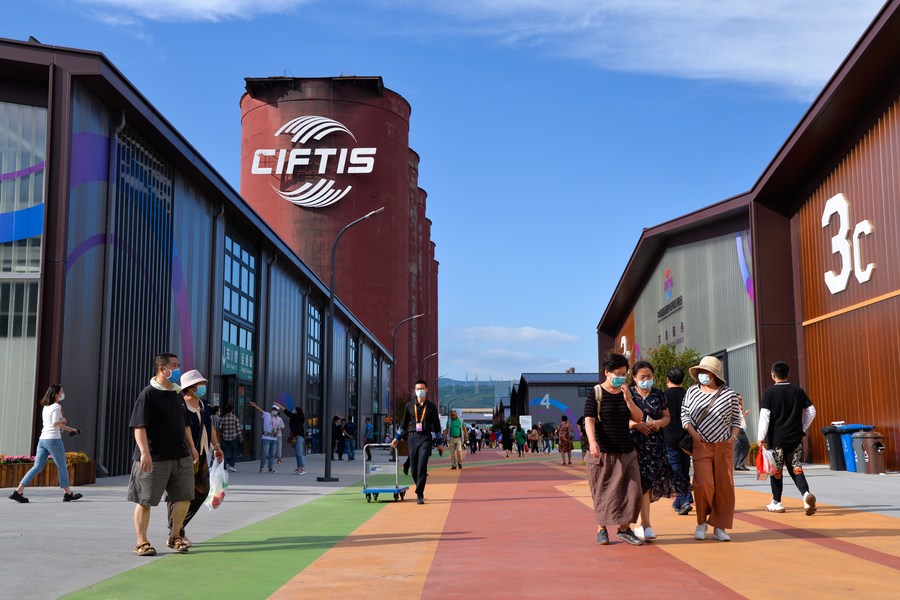
People visit the 2021 China International Fair for Trade in Services (CIFTIS) at Shougang Park in Beijing, capital of China, Sept. 6, 2021. (Xinhua/Xu Qin)
"Making ice is actually much more complicated than what it appears," said Liu, who now helps maintain the frozen surface at the National Aquatics Center for Winter Olympic curling contests.
From being a spectator in the 2008 Summer Olympics to joining the efforts for the 2022 Games, he described this experience as "beyond his imagination."
Wang Zhen, a worker of Shougang's Hebei plant, returned to the Shougang Park to watch the Games on site. "The steel used in the jumping platform was manufactured by Shougang," he said. "When I stood there, I was filled with excitement and pride as I had once worked in this place and witnessed its rebirth." ■