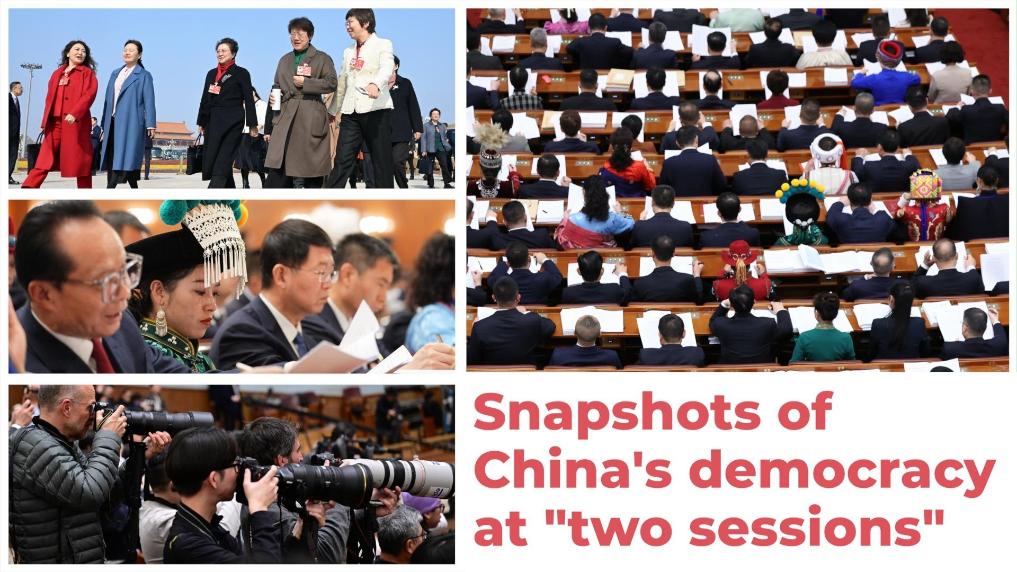
BEIJING, March 9 (Xinhua) -- With China's annual legislative and political consultative sessions, known as the "two sessions," underway in Beijing, foreign envoys and international journalists are closely watching the event for signals on the world's second-largest economy's development trajectory and its global implications.
They describe the gathering, during which the draft outline of the country's 15th Five-Year Plan (2026-2030) is being examined, as a crucial window into China's policy direction and a source of stability in an uncertain world.
"China is one of the biggest countries in the world. Everybody wants to know what is happening here and what policies will be adopted," said Daouda Bitie, Burkina Faso's ambassador to China. "That's why the 'two sessions' attract everyone."
For many, that means witnessing China's governance model up close. "My primary goal is to explain China's political system in more detail, because many audiences in the West don't really understand how it works," said Mojca Pisek, a journalist from Slovenia.
Bruno Falci, a Brazilian journalist with Latin American television channel teleSUR covering his first "two sessions," noted the diversity of participants at the annual gathering, where people from various ethnic groups and sectors including education, healthcare and technology have their voices heard. He also described China as a model for Latin America in poverty eradication.
James Kimonyo, Rwanda's ambassador to China, who has been invited to observe the annual "two sessions" for the seventh time, said the gathering offers insights into China's policy priorities and strategic direction. He noted that discussions on high-quality development, technological innovation, green transformation and opening up carry implications for Rwanda and the wider world.
With China set to embark on its new five-year plan, foreign observers are eager to understand the blueprint -- from health and technology to trade and global cooperation.
Martin Taylor, the World Health Organization representative to China, welcomed the plan's emphasis on improving the healthcare of the people.
"I'm very happy to see a big focus on improving health and healthcare in the 15th Five-Year Plan, so that people can live healthy and productive lives," he said.
"We are looking into how technology and innovation can further advance China's development agenda as well as the global development agenda," said James George, the United Nations Development Programme's Resident Representative ad interim for China. "Innovation, artificial intelligence and the digital economy will be key."
Bangladeshi Ambassador to China Md. Nazmul Islam said he was most focused on China's modernization and opening-up efforts, noting both countries' commitment to closer cooperation, particularly in areas such as modernization and connectivity under the Belt and Road Initiative.
"We need a world where we share prosperity," said Shahbaz Khan, director of the UNESCO Regional Office for East Asia. "I am very much looking forward to the next chapter of progress under China's 15th Five-Year Plan, and to seeing how the world benefits from it."
In a world grappling with volatility, many are looking to China for certainty. "In these turbulent times, I want to see how China can contribute to global stability," said Eric Napoli, a journalist with Brazil's A Tarde.
Maldivian Ambassador to China Fazeel Najeeb noted that in an uncertain world, China's role and its global initiatives are very important. "China is showing very steady hands. That is very encouraging for developing countries," he said.
"China is not only an example for socialist countries but also a hope for the world," said Alberto Blanco Silva, Cuba's ambassador to China, speaking in Chinese. "Hope, confidence, stability and unity -- that is the future we all want to see." ■