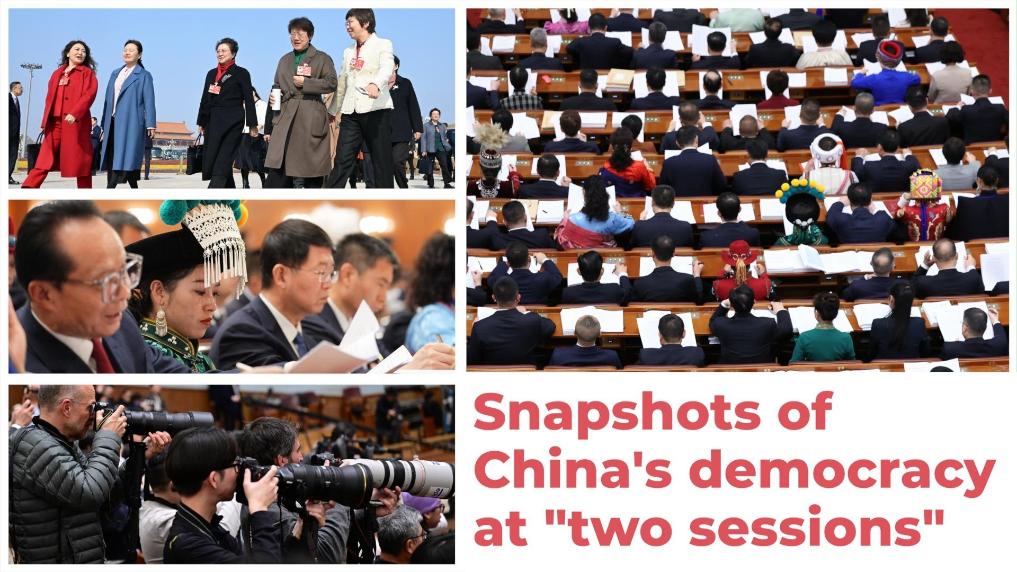

BEIJING, March 9 (Xinhua) -- China's annual "two sessions" have drawn elevated global attention this year, as lawmakers prepare not only to set the agenda for the coming year but also to approve a plan that could shape the country's trajectory through the end of the decade.
The meetings of China's top legislature and top political advisory body convene against a backdrop of deepening global turbulence. As geopolitical rivalries increasingly flout established rules and conflicts escalate in the Middle East, the international order faces unprecedented strain.
Policy choices of China -- the world's second-largest economy and home to 1.4 billion people -- reverberate far beyond its borders. The direction set at this year's "two sessions" will therefore be closely watched, particularly as many look to China for signals of stability in an increasingly uncertain world.
Currently under legislative review, the draft 15th Five-Year Plan maps out how China will advance over the next five years toward the goal of basically achieving modernization by 2035. A distinctive feature of this modernization is its emphasis on peaceful development.
In the next five years, China is expected to work with neighbors to advance integrated development and maintain overall stability in its relations with major nations, according to the draft plan.
At a press conference on China's foreign policy held on the sidelines of the legislative session, Foreign Minister Wang Yi reaffirmed that China will not pursue hegemony as its strength grows, nor does it subscribe to the logic that the world can be run by major countries.
Analysts say that China's preference for peace stems in part from a deep-seated cultural and historical instinct.
For much of its millennia-long history, China ranked among the world's leading nations. Its influence tended to travel through commerce, ideas and cultural exchanges, rather than through conquest or colonization.
The ancient Silk Road carried caravans across continents, while admiral Zheng He's maritime voyages in the 15th century reached as far as Africa, leaving behind silk, tea and porcelain -- not forts, colonies or cannon fire.
This restraint was a deliberate choice, integral to classical Chinese statecraft. "The Art of War" elevates victory without battle as the highest strategic ideal, and ancient thinkers warned that powers addicted to conflict would ultimately exhaust themselves.
Modern history reinforced the national psyche more brutally. After the Opium War of 1840, China endured invasions, bullying and humiliation at the hands of Western powers. Japan's invasion, beginning in the early 1930s and continuing through World War II, left deep and lasting scars on the country.
These experiences hardened an aversion to war and fostered a conviction that recovery and rejuvenation must come through internal effort rather than external expansion.
The decades since the founding of the People's Republic of China in 1949 have validated this path. The country has not initiated a war or seized an inch of foreign territory, yet it has grown into the world's second-largest economy and maintained that position for more than a decade.
This stance reflects not only the cultural continuity of the Chinese nation, but also the founding philosophy of the governing Communist Party of China (CPC).
Peaceful development is no diplomatic platitude; it is embedded in the country's institutional fabric -- explicitly codified in both the national Constitution and the Constitution of the CPC.
By proposing to build a community with a shared future for humanity in 2013, China's message has been clear: In an era fraught with challenges, humanity's enemies are not one another, but war, poverty, hunger and injustice.
No one can fight these battles alone, nor can any hope to carve out a path by only looking after their own interests. Instead, the world must come together to build a common future.
On a deeper structural level, China's reassurances for the world come from the fact that the country maintains its ties with the wider world through trade and production networks.
The country boasts all the industrial categories listed in the UN industrial classification. As the world's largest goods trader and one of the largest consumer markets, China trades extensively with more than 160 countries and regions.
Such interdependence is arguably one of the most effective safeguards for global security, as mutual economic stakes can help mitigate geopolitical rivalry.
The upcoming 15th Five-Year Plan is expected to carry this model of global engagement into the next phase. It will likely see China open its doors wider, promote balanced trade, and improve the overseas layout of its industrial and supply chains.
Amid these extensive economic linkages, China has maintained a defensive military posture. Its defense spending remains modest across key relative indicators, including the share of GDP, per capita defense expenditure, and defense expenditure per military personnel member.
For instance, China's defense spending has consistently stayed below 1.5 percent of GDP for many years. By contrast, NATO members have decided to ramp up their defense expenditure to 5 percent of GDP by 2035.
To the east, Japan's defense spending per capita in the 2025 fiscal year was three times China's, while its spending per defense personnel member was more than twice that of China.
China adheres to a no-first-use policy on nuclear weapons. It is the second-largest financier of UN peacekeeping operations, and the leading contributor of troops among the permanent members of the UN Security Council.
The country aspires to peace, yet it recognizes that maintaining peace requires vigilance.
There are a plethora of ways to defend peace, uphold security and deter war, but military capability remains the ultimate backstop. China is unequivocal in defending its sovereignty, security and development interests. That resolve must never be underestimated. ■