
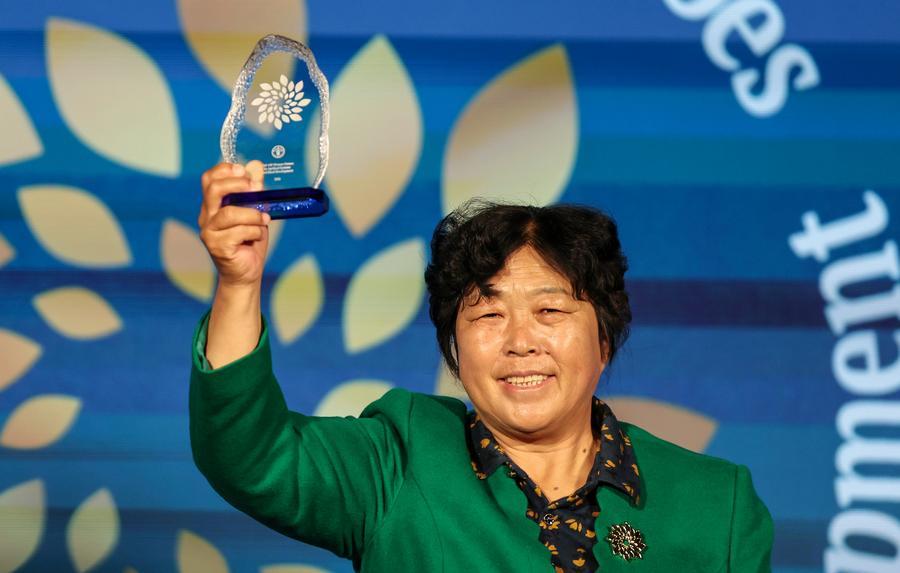
ROME, Oct. 16 (Xinhua) -- When Chinese sand-control pioneer Yin Yuzhen was named one of the 100 Women Heroes in Agrifood Systems and Rural Development by the UN Food and Agriculture Organization (FAO) on Thursday evening, retired U.S. teacher Ronald Sakolsky was there to share the moment.
Sitting in the audience, Sakolsky grew teary-eyed as he applauded Yin's achievement. Later, he was invited to join Yin on stage. The two friends embraced once again and held up an award together. "Yin deserves everything that she gets. She is the heroine," he told Xinhua.
For him, the recognition was about more than Yin's achievements in combating desertification. It was also a celebration of a friendship that had spanned more than two decades, crossing continents, languages and cultures.
Their story began in 1999, when Sakolsky, who came from Pittsburgh, Pennsylvania, was teaching English at a school in central China's Henan Province under a teacher exchange program between the two countries.
One evening, a television program caught his attention. It showed Yin planting trees to hold back the encroaching sands of the Maowusu sandy land in north China's Inner Mongolia Autonomous Region.
Maowusu spans parts of Inner Mongolia, Shaanxi and Ningxia in northern China and has long been a major front in the country's desertification control. It lies within the Three-North Shelterbelt Program, launched in 1978 and scheduled to run through 2050.
Watching Yin's efforts, Sakolsky was deeply moved. "I was so touched that I started to cry," he recalled. "I honestly cannot tell you why. Something just happened to me. I just felt like I needed to help."
Inspired by Yin's determination, he raised 5,000 U.S. dollars to support her and her husband in planting trees. Today, the saplings purchased with the donation have grown into more than 50,000 trees.
More than two decades later, their connection was rekindled. In May this year, Yin turned to social media in search of the American teacher who had helped her years earlier. In late August, Sakolsky returned to Inner Mongolia at her invitation.
The reunion brought back memories of the landscape he had first seen in 2000, when sand dominated the scene. This time, the transformation was striking.
"When I went back this year, it was like a mother and father seeing their children," Sakolsky said. "When I was there in 2000, there was all sand, just sand; now it was all green. Everywhere was green. It was beautiful."
Their reunion in China was not the end of the story. Less than two months later, the two met again, this time in Rome, where they attended the World Food Forum, hosted by FAO.
On Tuesday night, after a busy day, Sakolsky returned to his hotel carrying gifts for Yin and her family. Dressed in a red Tang-style jacket, he proudly showed off the cloth shoes Yin had given him earlier.
"They are perfect. She did not know what size my feet are, but she made the perfect fit," he said, giving two thumbs up.
Yin had also prepared a dark gray suit specially tailored for him, two bilingual magazines documenting their story, and a delicate porcelain tea set from Jingdezhen, a city in east China's Jiangxi Province renowned for its porcelain.
"Sakolsky, whom I regard as an elder brother, and I had not seen each other for 26 years. I never thought that just over two months later, we would meet again here," said Yin.
Sakolsky, in turn, had brought gifts for Yin's family: a miniature set of footballs for her grandson, Halloween-themed mugs for her granddaughter, and a T-shirt bearing the University of Pittsburgh logo for her son.
He also gave Yin a sweatshirt bearing the logo of his hometown football team in Pittsburgh.
The gifts were thoughtful tokens of a bond that had grown far beyond their initial encounter. Though they came from different countries and spoke different languages, they had found a way to understand and care for each other.
"We do not speak the same language; we do not look the same, but we are brother and sister, and we understand each other," Sakolsky said.
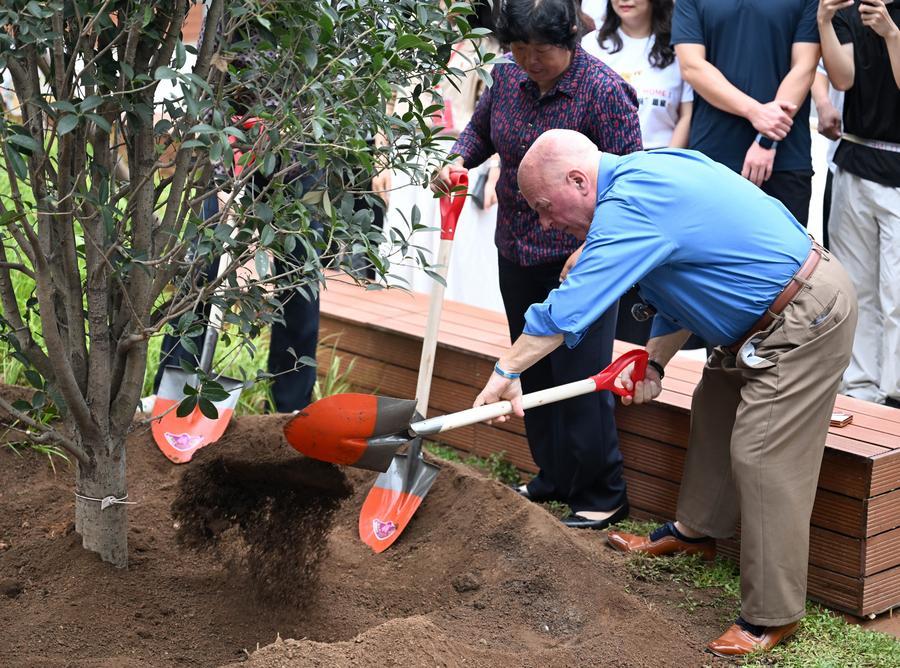
Their friendship has also resonated far beyond the two individuals. Yin sees their friendship as a reflection of the need for international cooperation in environmental protection.
"It is like the vision of a community with a shared future for humanity proposed by China. Although we come from different countries, we live on the same planet," she said. "We must unite to cherish nature and protect our planet."
In remarks at a state dinner hosted by U.S. President Donald Trump at the White House in September, Chinese President Xi Jinping mentioned their story, saying it "touches the hearts of many Chinese people and stands as a shining example of the friendly exchanges between our two peoples."
For Sakolsky, hearing his name mentioned by the Chinese president was almost beyond belief.
"When I heard President Xi mention my name, I thought I went crazy. I'm just a simple social studies teacher who did something nice. And he knows me. I could not believe it," he said.
But the recognition, he said, carried a message far greater than his own story.
"That tells you that the message has been heard: America and China must build a bridge for the world to get better," he added. ■