
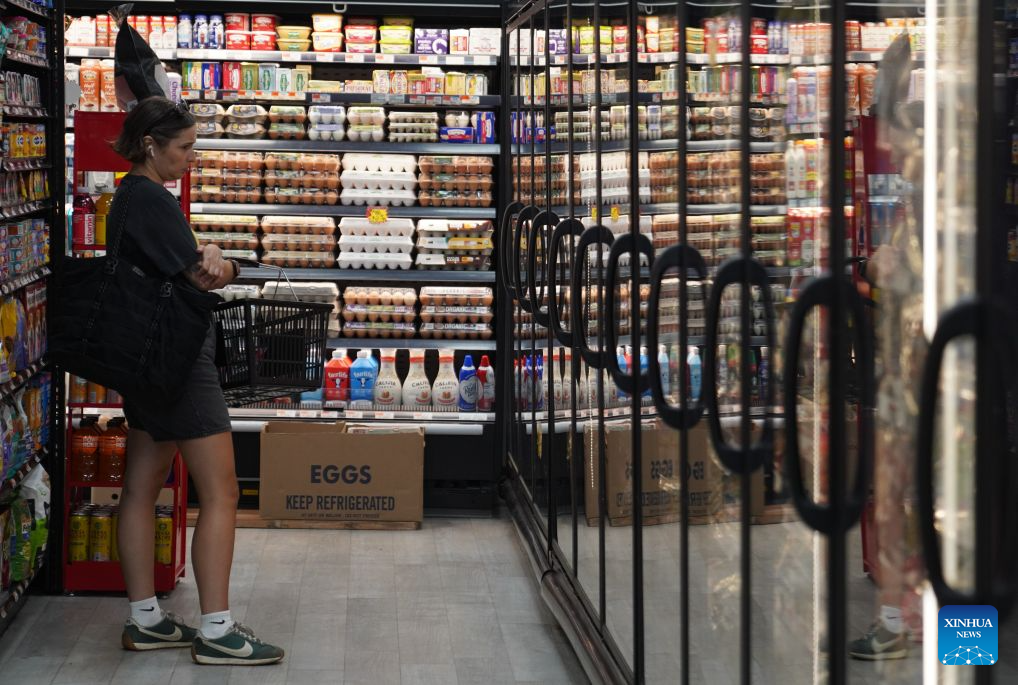
A customer shops at a store in New York, the United States, on Aug. 12, 2026. The U.S. consumer price index (CPI) rose 3.4 percent year on year in July, slightly lower than 3.5 percent in June, according to data released by the U.S. Bureau of Labor Statistics (BLS) on Wednesday. (Xinhua/Zhang Fengguo)
NEW YORK, Aug. 12 (Xinhua) -- The U.S. consumer price index (CPI) rose 3.4 percent year on year in July, slightly lower than 3.5 percent in June, according to data released by the U.S. Bureau of Labor Statistics (BLS) on Wednesday.
The headline inflation indicator increased by 0.1 percent month on month in July, underlining the short-term impacts of lower oil prices in June.
The core CPI, which excludes volatile food and energy prices, expanded 0.2 percent month on month and 2.5 percent year on year in July.
The latest inflation reading was broadly in line with market consensus forecasts. Average hourly earnings slipped 0.2 percent from a year earlier, the BLS also reported.
Energy prices, a primary driver of inflation pressures this year, have recently moved higher amid ongoing geopolitical tensions. In July, gasoline prices declined 2.9 percent, while the price of electricity edged up 0.1 percent, according to the report.
Brent crude oil futures rose to around 90 U.S. dollars per barrel earlier Wednesday, while U.S. crude oil futures approached 84 dollars a barrel. The U.S. national average price for regular gasoline climbed to 4.03 dollars per gallon on Wednesday.
The report showed increases in the prices of medical care, airline fares, communication, education and recreation. Motor vehicle insurance was among the major indexes that declined.
Cleveland Fed President Beth Hammack underscored the need for timely policy action even before the CPI data. "Now is the time to act," she wrote on LinkedIn. "The longer we wait to take action to bring inflation back to our 2 percent objective, the more challenging it will be to bring it back down and the more expensive it will be for the American people."
The CPI data followed a weaker-than-expected July jobs report, which showed U.S. employers unexpectedly lost 23,000 jobs. Employment gains for May and June were also revised sharply lower by a combined 103,000, painting a softer picture of the U.S. labor market.
Analysts remained divided on the implications for financial markets, with some viewing the softer inflation reading as positive and others focused on persistent pressure from energy costs and weaker jobs data.
"In-line inflation will keep the 'no need to hike rates' narrative that took hold after last week's jobs report intact," said Ellen Zentner, chief economic strategist at Morgan Stanley Wealth Management.
The Federal Reserve will likely keep interest rates unchanged in September unless the August inflation data present a different picture, Zentner said.
Prediction markets currently assign a 68.2-percent probability that the Federal Reserve will hold interest rates steady at its September meeting, compared with a 17-percent chance of a 25-basis-point cut and a 9.6-percent chance of a rate hike. ■

A man refills a car at a gas station in New York, the United States, on Aug. 12, 2026. The U.S. consumer price index (CPI) rose 3.4 percent year on year in July, slightly lower than 3.5 percent in June, according to data released by the U.S. Bureau of Labor Statistics (BLS) on Wednesday. (Xinhua/Zhang Fengguo)

A customer checks price at a store in New York, the United States, on Aug. 12, 2026. The U.S. consumer price index (CPI) rose 3.4 percent year on year in July, slightly lower than 3.5 percent in June, according to data released by the U.S. Bureau of Labor Statistics (BLS) on Wednesday. (Xinhua/Zhang Fengguo)

A customer reads product information at a store in New York, the United States, on Aug. 12, 2026. The U.S. consumer price index (CPI) rose 3.4 percent year on year in July, slightly lower than 3.5 percent in June, according to data released by the U.S. Bureau of Labor Statistics (BLS) on Wednesday. (Xinhua/Zhang Fengguo)

Customers shop at a store in New York, the United States, on Aug. 12, 2026. The U.S. consumer price index (CPI) rose 3.4 percent year on year in July, slightly lower than 3.5 percent in June, according to data released by the U.S. Bureau of Labor Statistics (BLS) on Wednesday. (Xinhua/Zhang Fengguo)