
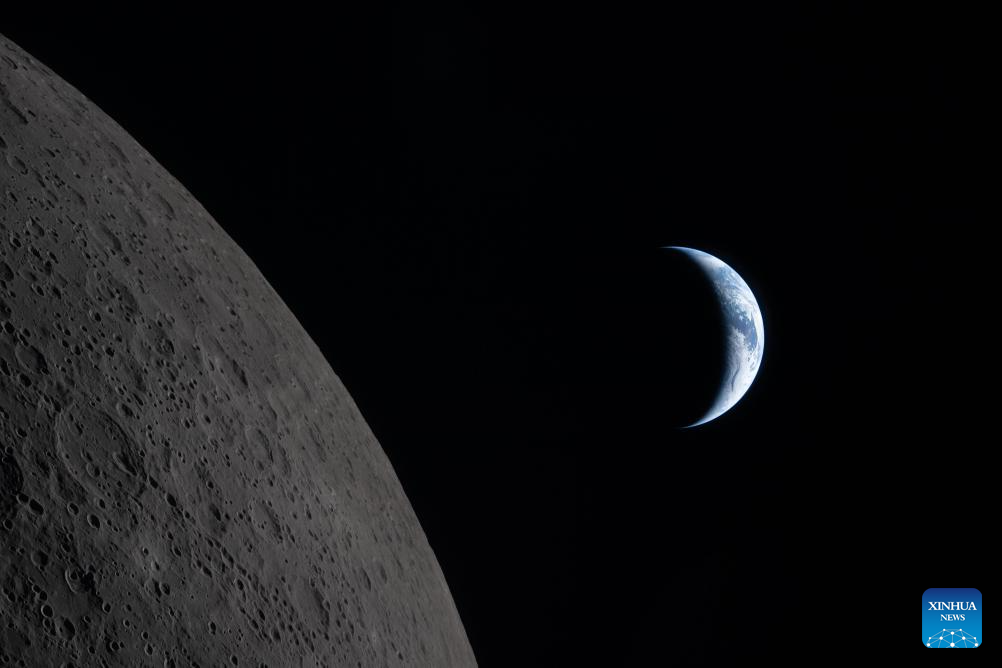
This photo taken on April 6, 2026, shows the Moon (L) and Earth seen from the Orion spacecraft. The crew of the U.S. National Aeronautics and Space Administration (NASA) Artemis II mission began the return phase of their 10-day lunar flight on Tuesday after completing their flyby of the Moon.
Meanwhile, NASA released the first photographs captured during Monday's close approach of the lunar surface and announced the splashdown is scheduled for April 10 in the Pacific Ocean off San Diego, California. (NASA/Handout via Xinhua)
by Wen Tsui
LOS ANGELES, April 7 (Xinhua) -- The crew of the U.S. National Aeronautics and Space Administration (NASA) Artemis II mission began the return phase of their 10-day lunar flight on Tuesday after completing their flyby of the Moon.
Meanwhile, NASA released the first photographs captured during Monday's close approach of the lunar surface and announced the splashdown is scheduled for April 10 in the Pacific Ocean off San Diego, California.
Captured through the Orion spacecraft window, the first image shows a muted blue Earth with bright white clouds setting behind the cratered lunar surface.
NASA noted that the dark portion of Earth visible in the image is experiencing nighttime, while swirling cloud formations are visible over the Australia and Oceania regions on the illuminated side.
In the foreground, NASA identified Ohm Crater, describing its terraced edges and a flat floor interrupted by central peaks. NASA explained that such central peaks form when the lunar surface, liquefied by the energy of impact, splashes upward during the crater's formation.
The second photograph shows the Moon fully eclipsing the Sun as observed from the Orion capsule, with NASA reporting the totality lasted nearly 54 minutes.
NASA said that from the crew's vantage point, the Moon appeared large enough to completely block the Sun, extending totality far beyond what is achievable from Earth's surface.
NASA also released images of the lunar far side taken during the flyby, including a close-up of Vavilov Crater on the rim of the Hertzsprung impact basin, neither of which is visible from Earth.
Further images show the Orientale basin with a dark patch of ancient lava that NASA described as having punched through the Moon's crust billions of years ago, and terrain at the eastern edge of the South Pole-Aitken basin, revealing the shadowed boundary between lunar day and night.
The crew of NASA astronauts Reid Wiseman, Victor Glover, and Christina Koch, along with Canadian Space Agency astronaut Jeremy Hansen, launched on April 1 from the Kennedy Space Center in Florida.
The mission will confirm the systems necessary to support astronauts in deep space exploration and lay the groundwork for a sustained presence on the Moon, NASA said, adding that the primary goal of Artemis II is a crewed test flight in lunar space.
The Artemis II mission broke the record for the farthest distance humans have ever traveled from Earth on Monday.
The crew of Integrity, as the astronauts named their capsule, exceeded the previous record of 400,171 km set by the Apollo 13 crew on April 15, 1970, at 1:57 p.m. EDT (1757 GMT), according to NASA. ■
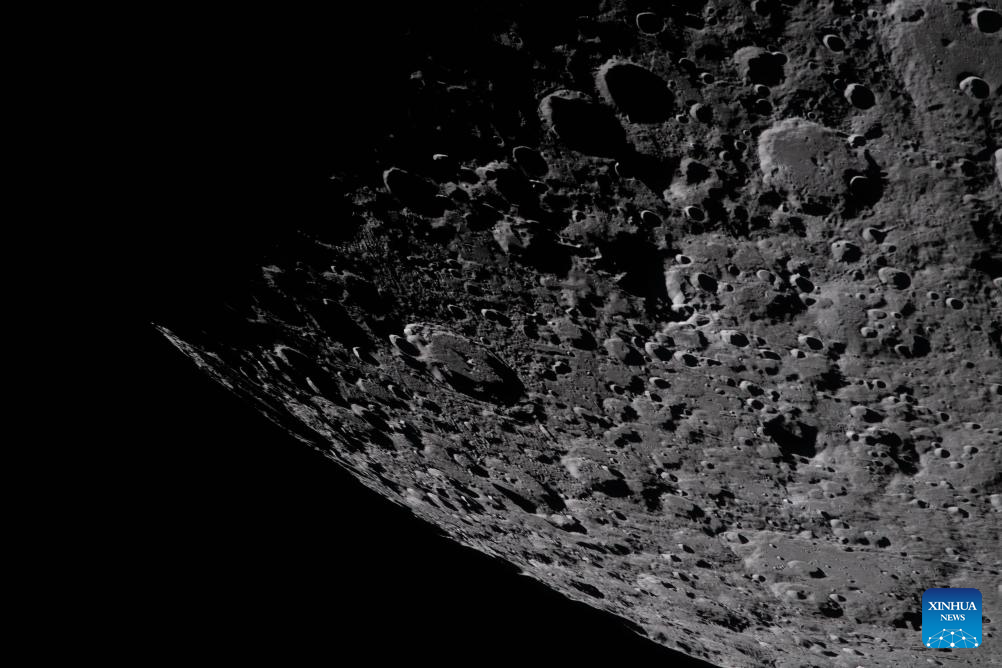
This photo taken on April 6, 2026, shows the Moon seen from the Orion spacecraft. The crew of the U.S. National Aeronautics and Space Administration (NASA) Artemis II mission began the return phase of their 10-day lunar flight on Tuesday after completing their flyby of the Moon.
Meanwhile, NASA released the first photographs captured during Monday's close approach of the lunar surface and announced the splashdown is scheduled for April 10 in the Pacific Ocean off San Diego, California. (NASA/Handout via Xinhua)
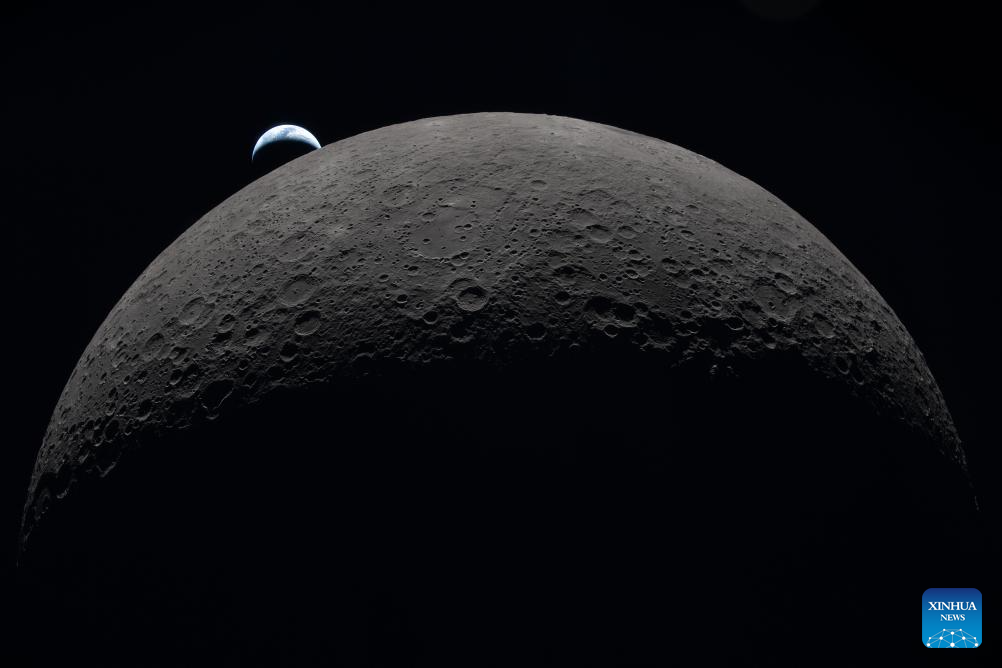
Earth sets over the Moon's curved limb in this photo captured by the Artemis II crew during their journey around the far side of the Moon, on April 6, 2026. The crew of the U.S. National Aeronautics and Space Administration (NASA) Artemis II mission began the return phase of their 10-day lunar flight on Tuesday after completing their flyby of the Moon.
Meanwhile, NASA released the first photographs captured during Monday's close approach of the lunar surface and announced the splashdown is scheduled for April 10 in the Pacific Ocean off San Diego, California. (NASA/Handout via Xinhua)

The U.S. National Aeronautics and Space Administration (NASA) astronaut Victor Glover (L), Reid Wiseman (C), and Canadian Space Agency astronaut Jeremy Hansen prepare for their journey around the far side of the Moon by configuring their camera equipment shortly before beginning their lunar flyby observations, on April 6, 2026. The crew of the U.S. National Aeronautics and Space Administration (NASA) Artemis II mission began the return phase of their 10-day lunar flight on Tuesday after completing their flyby of the Moon.
Meanwhile, NASA released the first photographs captured during Monday's close approach of the lunar surface and announced the splashdown is scheduled for April 10 in the Pacific Ocean off San Diego, California. (NASA/Handout via Xinhua)
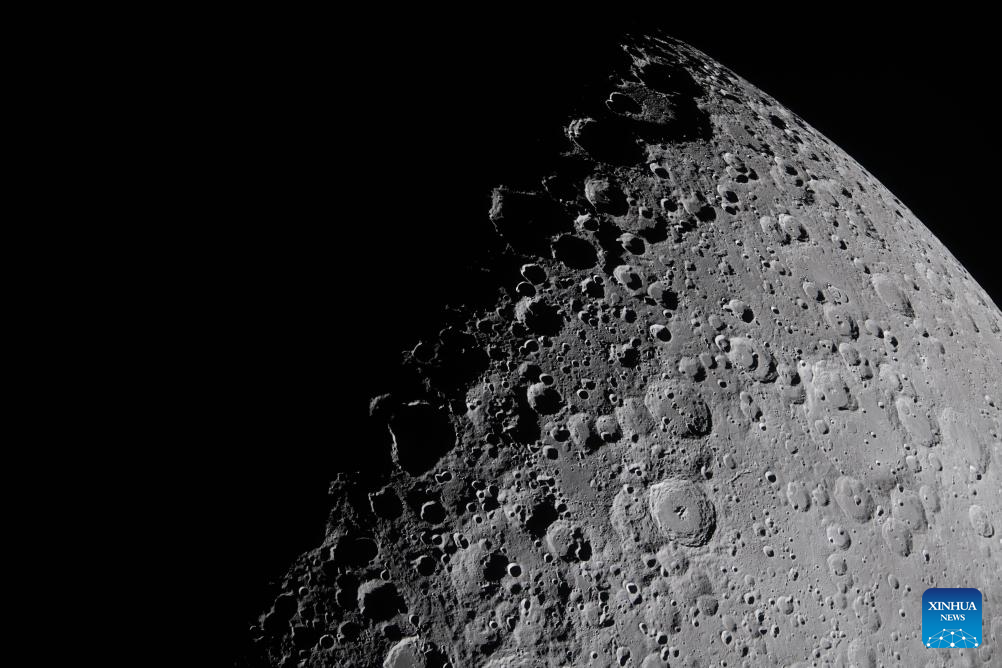
This photo taken on April 6, 2026, shows the Moon seen from the Orion spacecraft. The crew of the U.S. National Aeronautics and Space Administration (NASA) Artemis II mission began the return phase of their 10-day lunar flight on Tuesday after completing their flyby of the Moon.
Meanwhile, NASA released the first photographs captured during Monday's close approach of the lunar surface and announced the splashdown is scheduled for April 10 in the Pacific Ocean off San Diego, California. (NASA/Handout via Xinhua)
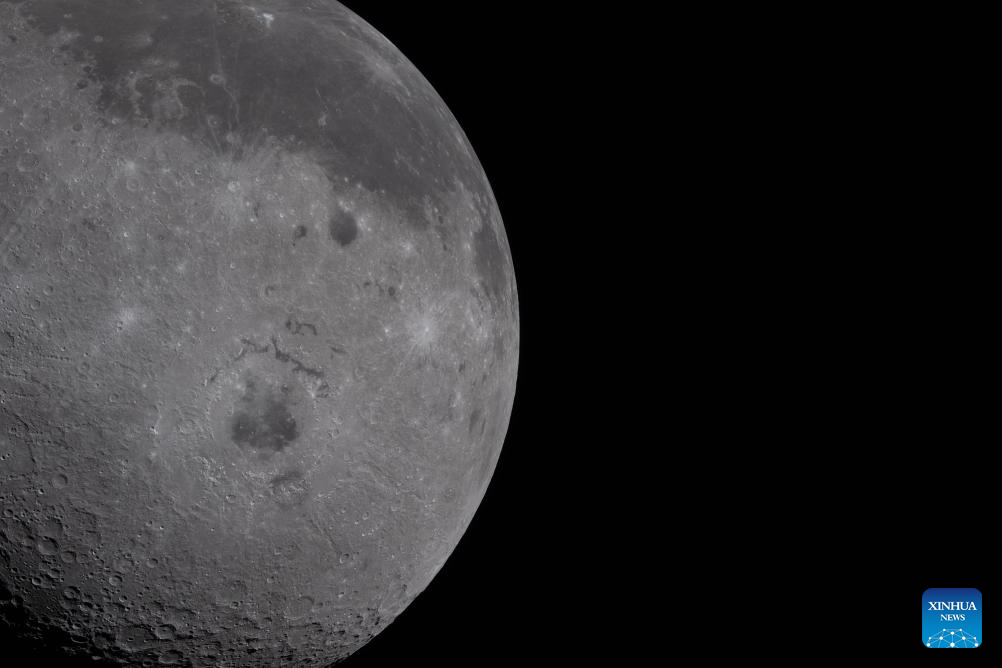
This photo taken on April 6, 2026, shows the Moon seen from the Orion spacecraft. The crew of the U.S. National Aeronautics and Space Administration (NASA) Artemis II mission began the return phase of their 10-day lunar flight on Tuesday after completing their flyby of the Moon.
Meanwhile, NASA released the first photographs captured during Monday's close approach of the lunar surface and announced the splashdown is scheduled for April 10 in the Pacific Ocean off San Diego, California. (NASA/Handout via Xinhua)
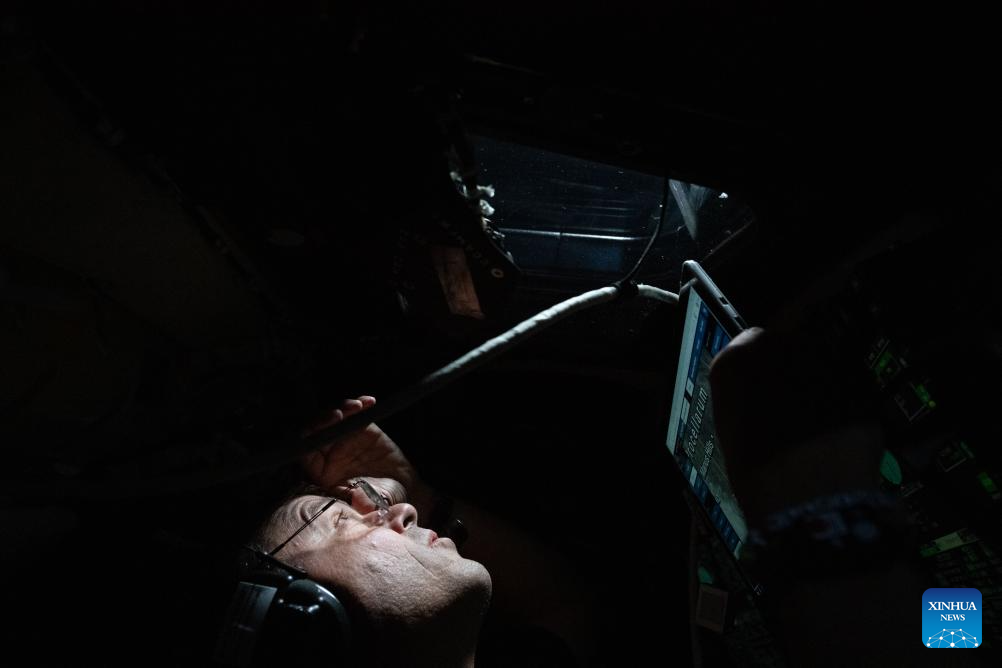
The U.S. National Aeronautics and Space Administration (NASA) astronaut Reid Wiseman peers out the window of the Orion spacecraft, on April 6, 2026. The crew of the U.S. National Aeronautics and Space Administration (NASA) Artemis II mission began the return phase of their 10-day lunar flight on Tuesday after completing their flyby of the Moon.
Meanwhile, NASA released the first photographs captured during Monday's close approach of the lunar surface and announced the splashdown is scheduled for April 10 in the Pacific Ocean off San Diego, California. (NASA/Handout via Xinhua)
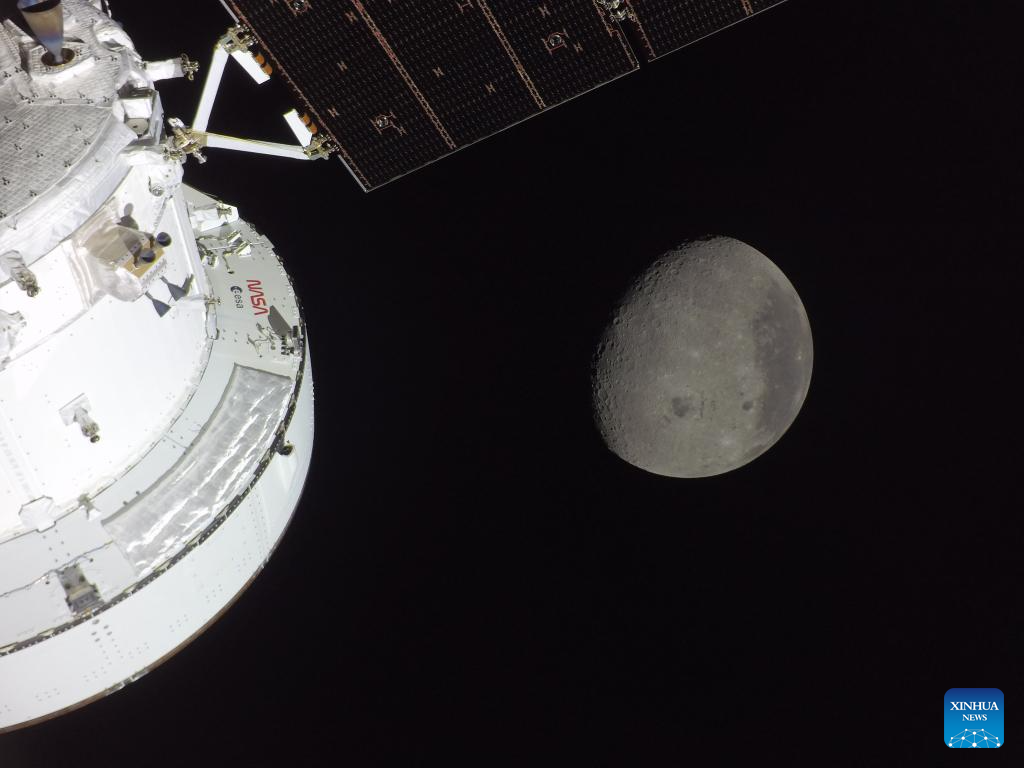
This photo taken on April 6, 2026, shows the Orion spacecraft and the Moon. The crew of the U.S. National Aeronautics and Space Administration (NASA) Artemis II mission began the return phase of their 10-day lunar flight on Tuesday after completing their flyby of the Moon.
Meanwhile, NASA released the first photographs captured during Monday's close approach of the lunar surface and announced the splashdown is scheduled for April 10 in the Pacific Ocean off San Diego, California. (NASA/Handout via Xinhua)