
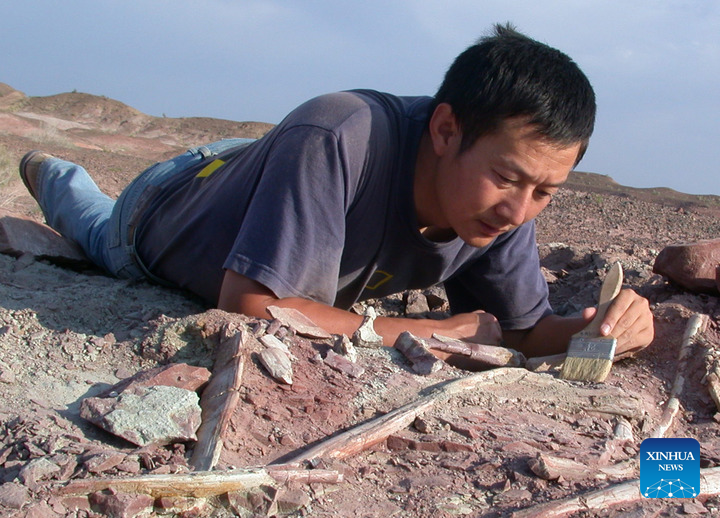
This undated photo shows Xu Xing working on exposed fossils in northwest China's Xinjiang Uygur Autonomous Region. (Xinhua)
by Xinhua writers Yuan Quan, Yan Yong
BEIJING, Sept. 18 (Xinhua) -- In his school days, Xu Xing dreamed of becoming a martial-arts monk, an economist and even a coder. Dinosaurs were nowhere in his plans.
But now, the 57-year-old is known as China's Dinosaur Whisperer, a scientist whose decades of digging have rewritten how humans understand these prehistoric giants.
Xu has been on the move this September, China's National Science Popularization Month.
As a leading paleontologist at the Chinese Academy of Sciences, he is busy giving lectures. Last week, his talks to high school and university students in Ili, Xinjiang Uygur Autonomous Region in northwest China, made local headlines.
Onstage, in glasses, a blue T-shirt and jeans, the gray-haired Xu traced his unlikely journey into the world of dinosaurs.
Xu was born in Ili in 1969. His father was an intellectual who had moved from east China's Jiangsu Province to support Xinjiang's development.
In those years, despite struggling to feed the family, his parents still managed to buy books. "Some were literature, some were popular science," Xu recalled.
He loved physics. But in 1988, he received an admission letter from Peking University informing him that he had been enrolled in Paleontology, a major he had never heard of; neither had his teacher.
"Maybe it is a new field," Xu thought to himself before heading to Beijing.
However, paleontology textbooks hardly sparked his interest. Instead, he attended courses in finance and computer science, both hot fields in the 1990s. The turning point came in his third year of master's studies, when he spotted a dinosaur fossil in his advisor's office.
"It was an amazing feeling," Xu recalled, describing the moment he touched the fossil dating back approximately 190 million years to the Early Jurassic Period. It later became the subject of his 1998 study in the journal Nature.
Xu likes to joke that his relationship with dinosaurs was "an arranged marriage." "We got married first, then fell in love," he explained.
Since then, he and his colleagues have made a string of discoveries, including feathered dinosaur fossils and a gigantic bird-like dinosaur, which have made headlines worldwide. Some attribute his achievements to luck. Xu does not deny it.
"But science is not always about luck." He said at least a third of his expeditions have been fruitless, but that this has never stopped him from setting out again.
Fossils are often found in China's remote, rocky Gobi Desert, and Xu sometimes raises a few chickens at camp to improve the team's meals.
The fossil hunt can be grueling. Researchers comb fossil-bearing areas, stripping away rock layers, sweeping and tagging day after day. The smallest dinosaur fossils Xu's team has collected are teeth that were scattered on the ground, too tiny to see with the naked eye.
Some researchers suffer "desert syndrome," becoming bad-tempered or apathetic during expeditions. As team leader, Xu takes along sports equipment, usually a soccer ball, to help relieve stress.
In 2002, Xu undertook an expedition lasting over three months. When returning home, he was so sunburned and dirty that his 2-year-old son was frightened and ran to his wife.
In 2025, Xu and two other scientists received the Future Science Prize in life sciences for "discoveries of fossil evidence for the origin of birds from dinosaurs."
When the prize committee reached him via live link-up at the announcement ceremony, Xu was digging in a remote valley, straw hat on his head.
The discovery of how dinosaurs took to the sky is one of Xu's crowning achievements. Back in 1996, Sinosauropteryx, a small feathered dinosaur, showed that feathers were not unique to birds, and scientists have continued to find more related evidence since then.
In 2015, Xu's team discovered a dinosaur species with bat-like membranous wings, a finding that challenged mainstream assumptions. Using CT scans and other advanced equipment, Xu's team analyzed the fossils and ultimately convinced skeptics.
Xu's ability to start from a detail, peel back layers and get to the key question has left a deep impression on Xing Lida, a dinosaur researcher at China University of Geosciences (Beijing) who has collaborated with Xu for years.
"Whenever he talks about dinosaurs, there seems to be a light shining in his eyes," Xing told Xinhua.
Xu is also known for naming dinosaurs. He named many species using Chinese pinyin, the romanization system for Mandarin, breaking long-established Latin conventions.
A typical example is Mei long, meaning "sleeping dragon" in Chinese, for its bird-like sleeping posture. Another one is Yi qi, meaning "strange wing," and also the shortest dinosaur name in the world so far.
Xu said he initially felt pressure from the academic community for making such changes, but he considered them "acceptable and worthwhile." Names should reflect not only the science itself but also regional and cultural flavors.
In May 2026, Xu was elected a foreign fellow of the Royal Society of London, joining the ranks of scientific giants such as Newton, Darwin and Einstein.
But he believes science should not stay confined to academia. His article "Dinosaurs Flying into the Sky" has been included in China's primary school textbooks.
Xu became a national political advisor in 2018, and science outreach has been central to his work ever since. He has submitted proposals to expand science courses in schools and integrate science education with the cultural tourism industry.
Like his research work, his science education career began humbly. In 2000, Xu gave his first public lecture at a Beijing bookstore, when only seven people showed up, including himself.
Two decades later, his lectures draw full houses, with audiences lining up for his autograph.
"I will take him as my role model," said Shan Zeyun, a student in Ili, after hearing Xu's speech.
Xu does not see paleontology as a marginalized field; instead, he is optimistic about the future.
In recent years, museums' integration with tourism has drawn young people and enterprises. Besides, AI technology is unlocking vast research potential.
"As more discoveries are made, public curiosity about prehistoric environments is likely to grow," he added.
Decades ago, a boy who never planned to study dinosaurs spent his life chasing them. Decades later, another child in his audience may set out on the same journey. ■
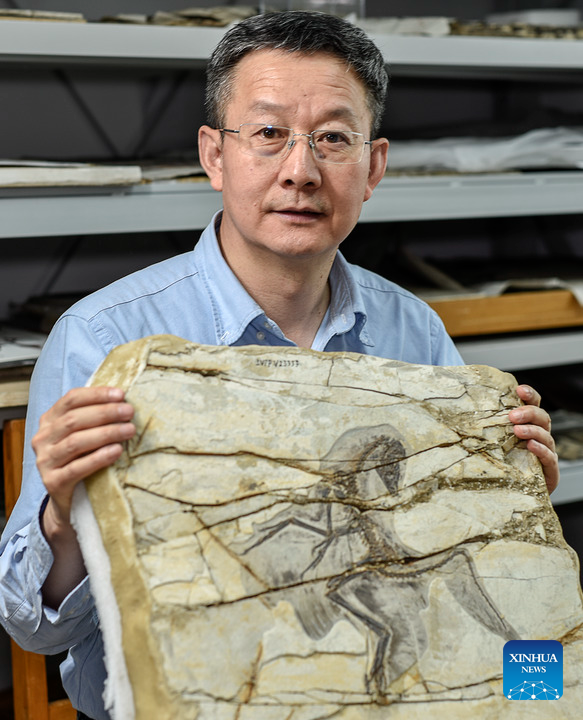
This undated photo shows Xu Xing presenting a dinosaur fossil that he and his colleagues discovered in 2024. (Xinhua)


