
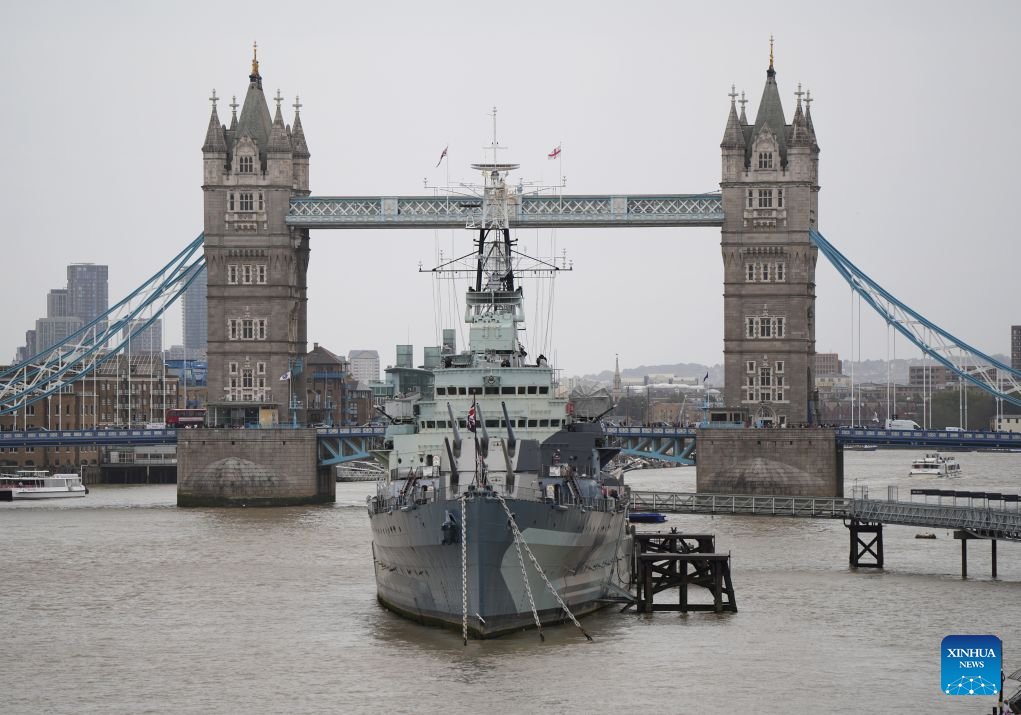
Photo taken on Sept. 18, 2026 shows HMS Belfast, a former Royal Navy light cruiser, in front of Tower Bridge in London, Britain. (Xinhua/Zhang Feng)
by Xinhua writer Zhang Feng
LONDON, Sept. 18 (Xinhua) -- Near the banks of the River Thames in London, not far from Tower Bridge, a 187-meter-long vessel sits quietly at anchor, its massive hull a reminder of its wartime past.
HMS Belfast, a former Royal Navy light cruiser, took part in major operations during World War II. It entered the Thames in 1971 and later opened to the public as a museum.
Walking through the cruiser, visitors could encounter marks of age everywhere. At the gun turret on the quarter deck, three 6-inch guns remained in place, with rusted shell casings lying nearby.
Inside the turret, a date stood out on the wall: June 6, 1944 -- D-Day, when Allied forces led by Britain and the United States crossed the English Channel and landed in Normandy, opening a major new front in Western Europe against Nazi Germany.
The date stood as one of the defining moments for HMS Belfast, and a symbol of the alliance between Britain and the United States in the 20th century.
But that relationship faces a more complicated political landscape today.
During U.S. President Donald Trump's two-day visit to Ireland recently, he said he would "love" to see the unification of Ireland and Britain's Northern Ireland.
It came as no surprise that the remarks sparked stiff opposition from British politicians, including Conservative Party leader Kemi Badenoch and Reform UK leader Nigel Farage, saying that Northern Ireland is an integral part of the United Kingdom.
Bruce, a staff member aboard HMS Belfast, offered an analogy when asked about the unification comments.
"You have America and you have Canada, they're the same place (continent), but they're different," he said. "Well, Northern Ireland is different from Ireland. Ireland is Irish, Northern Ireland is the UK."
Below deck, another exhibition aimed to showcase the Anglo-American alliance. A compartment of the ship has been turned into a display for Pressure, a film about the tough decision of the U.S. general Dwight Eisenhower over whether to postpone the Normandy landings amid bad weather and military pressure.
More than 80 years on, the relationship between the allies looks markedly different: Trump has repeatedly called on European allies, including Britain, to shoulder more of the European security costs.
On the Malvinas Islands, known in Britain as the Falkland Islands, Trump has suggested that Washington could reconsider its position in the sovereignty dispute between Britain and Argentina.
When it came to Greenland, former British Prime Minister Keir Starmer said flatly Greenland and Denmark must determine the future of Greenland and "nobody else."
For visitors walking through HMS Belfast, the gap between the past and the present was particularly stark.
The guns at the bow stood silent, but evoked the deafening battlefields where they once thundered. The transmitting station has long since fallen silent, but one could almost hear the hiss of electrical signals. In the sick bay, wards and surgical instruments reminded onlookers of the very human cost.
The cruiser also carried another connection to British politics: its name.
Belfast, capital of Northern Ireland and a city with a shipbuilding tradition, gave its name to the 1998 Belfast Agreement, also known as the Good Friday Agreement which helped bring an end to decades of violence referred to as "the Troubles."
The 1998 agreement established a political framework under which Northern Ireland's constitutional status can change if a majority of people in Northern Ireland vote for a united Ireland in a referendum.
The debates on the future of Northern Ireland, however, have not disappeared. The first ministers of Wales, Scotland and Northern Ireland met in Cardiff on Monday to declare "Westminster's time is coming to an end," pushing for independence from Britain and rejoining the European Union.
As the debate continued, British Prime Minister Andy Burnham and Irish Prime Minister Micheal Martin on Friday reaffirmed "their shared commitment to upholding the Good Friday Agreement."
For many people in Britain, the status of Northern Ireland remains deeply sensitive, touching both Britain's territorial integrity and the fragile peace established by the Belfast Agreement.
"Belfast is part of the UK," Bruce said. "It's not part of Ireland." ■
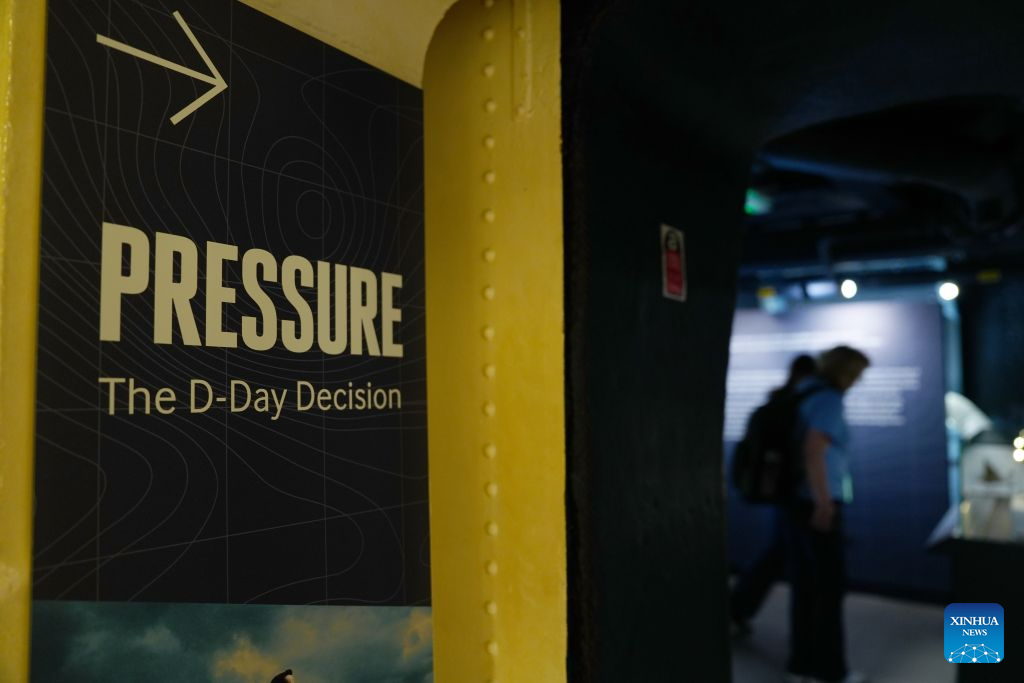
Photo taken on Sept. 16, 2026 shows a display compartment for the film Pressure on HMS Belfast, a former Royal Navy light cruiser, in London, Britain. (Xinhua/Zhang Feng)