
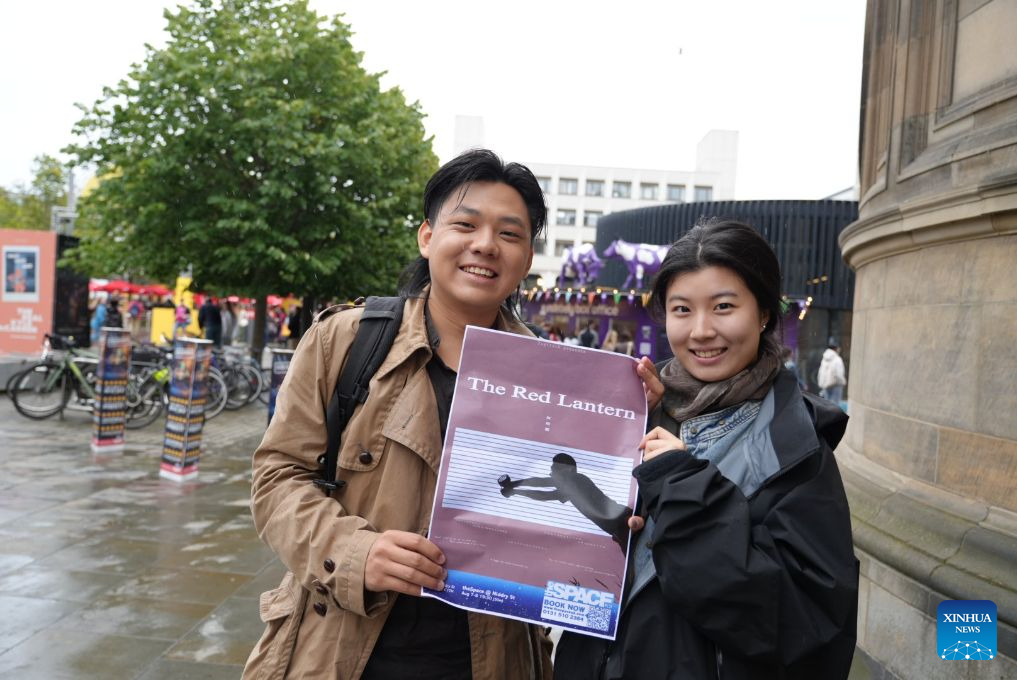
Fan Shaolun (L) and Liang Yumin, creators of Chinese-language solo play "The Red Lantern," pose for photos with a poster of their play in Edinburgh, Britain, Aug. 9, 2026. (Xinhua/Zhao Jiasong)
by Xinhua writer Zhao Jiasong
EDINBURGH, Britain, Aug. 15 (Xinhua) -- For people living in Chongqing, southwest China, in the late 1930s and early 1940s, fog was more than weather. It could offer precious hours of cover from bombers overhead.
Thick fog made it harder for pilots of Japanese aircraft to see the ground, giving residents some respite from repeated air raids by the invaders. For a city now known for its misty landscape and viral presence on TikTok, fog was once closely tied to safety and survival.
A Chinese-language solo play staged Aug. 7-8 at the Edinburgh Festival Fringe, which runs through Aug. 31 this year, offers audiences a glimpse into what life under such circumstances might have been like.
In "The Red Lantern," Shaolun Fan performs alone, shifting between narration and multiple characters. Through voice, movement and sound, he recreates wartime Chongqing through the eyes of a boy named Guang, whose unusually sensitive hearing allows him to detect danger before others.
Starting in 1938, Japanese warplanes bombed Chongqing, then China's provisional capital, killing and injuring more than 32,000 people. On June 5, 1941, about 2,500 people suffocated to death while seeking shelter in a tunnel during an air raid.
The play was created by Fan and Yumin Liang, who studied theater in Beijing before pursuing postgraduate studies in Britain. The idea grew from conversations about Chongqing's wartime experience and the Chinese People's War of Resistance Against Japanese Aggression.
"When I first heard that a city had been bombed for more than five years, I began to wonder what that meant for everyday life," Fan said. "How did people's lives change? How did they respond to such difficulties, and how did they keep going?"
For Liang, the history was personal.
A native of Chongqing, she recalled hearing air-raid sirens every June 5 from primary school onward, when the city commemorated those killed in the wartime bombings.
She had learned about the history in school, but revisiting it for the play raised new questions.
"When you really look at the history from the perspective of the people who lived through it, you begin to see how they lived and how they managed to get through those years," Liang said.
In May 2026, Fan and Liang traveled to Chongqing for field research, visiting museums and the June 5 tunnel massacre site and watching the stage production "Chongqing 1949."
They studied records of the bombings and the June 5 attack, as well as air-raid sirens, red-lantern signals, shelters and the daily lives of residents and children. They also examined the city's streets, architecture, dialect, customs and wartime theater.
One detail stood out: the fog.
They found that during periods of particularly heavy fog, air raids could become less frequent. What Liang had regarded since childhood as an ordinary feature of her hometown suddenly took on a different meaning.
"For people at that time, fog was connected with survival," she said.
They also found records of people playing mahjong, chatting and carrying on with their daily routines amid the bombing.
Such details shaped the pair's understanding of the city: people lived with fear and loss, but still found ways to carry on.
"That optimistic attitude toward life really moved us," Liang said.
Fan and Liang chose to tell the story through a child.
"We didn't want to put the transformation of an entire city directly onto the stage," Fan said. "We wanted to follow the changes in one child and, through him, show something of the state of mind of the whole city."
But one image from their research stayed with them above all.
After an air raid, four Chinese characters were written on a surviving wall amid the ruins: "Yu zha yu qiang" -- "The more you bomb, the stronger we are." A replica of the slogan is now displayed at a museum commemorating the June 5 bombing.
"Behind that wall was already rubble," Fan said. "Someone still wrote, 'The more you bomb, the stronger we are.' That really moved us."
The play's Edinburgh run also coincides with an important date in the history it depicts. This year's Aug. 15 marks the 81st anniversary of Japan's announcement of its unconditional surrender in World War II.
Dong Ning, chairwoman of Beijing Performance & Arts Group, said the production offers an accessible way into a difficult chapter of history.
"On a limited stage, the work creates a city through sound, making wartime Chongqing something audiences can hear and feel," Dong said.
She added that the production's blend of local character and contemporary theatrical expression gives overseas audiences an emotional entry point into the history, offering "a noteworthy example of Chinese theater reaching the world."
For Fan and Liang, bringing the play to Edinburgh is another way of allowing audiences to encounter that history through the experiences of ordinary people.
"We are not historians," Fan said. "What theater allows us to do is use imagination to get closer to the people who lived at that time, and to ask where their hope came from." ■
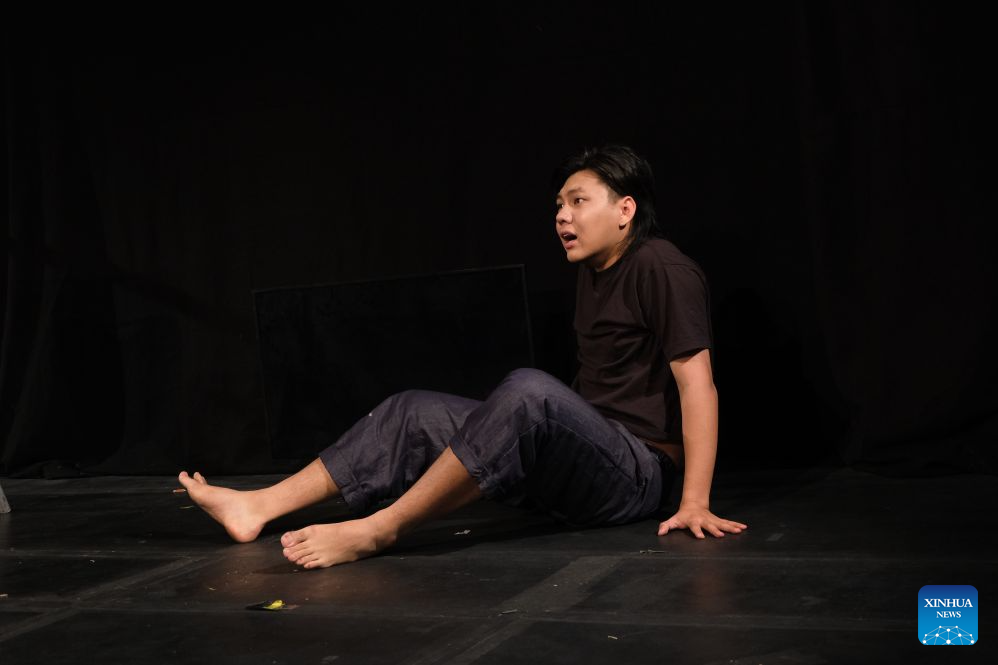
Fan Shaolun performs during the Chinese-language solo play "The Red Lantern" at the Edinburgh Festival Fringe in Edinburgh, Britain, Aug. 8, 2026. TO GO WITH "Feature: Chinese theater artists bring WWII Chongqing story to Edinburgh stage" (Xinhua)